CII Calculator
-
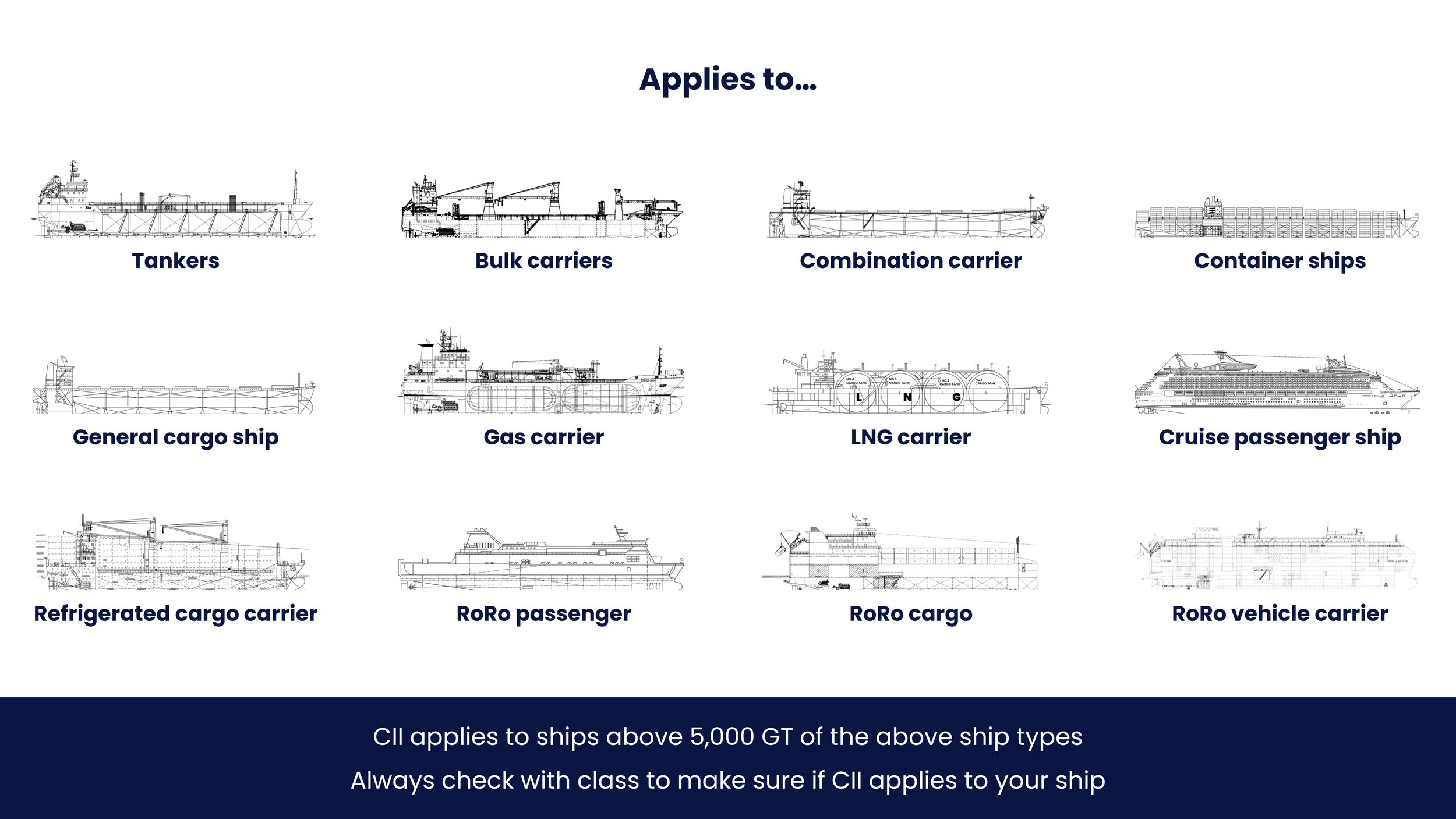
The Carbon Intensity Indicator CII is an IMO measure of how efficiently a ship transports goods or passengers. CII applies to all cargo, RoRo and cruise ships above 5,000 GT.
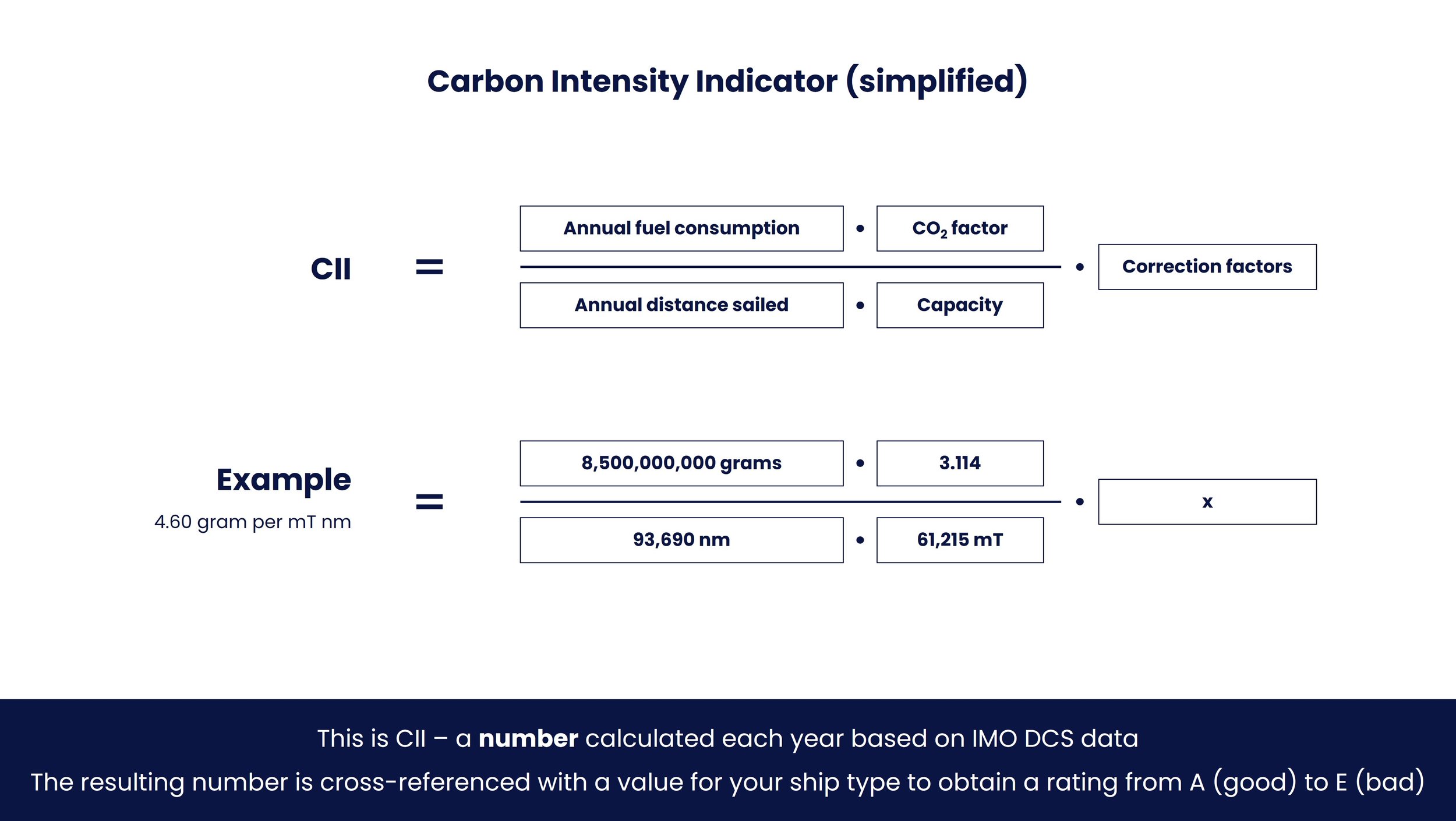
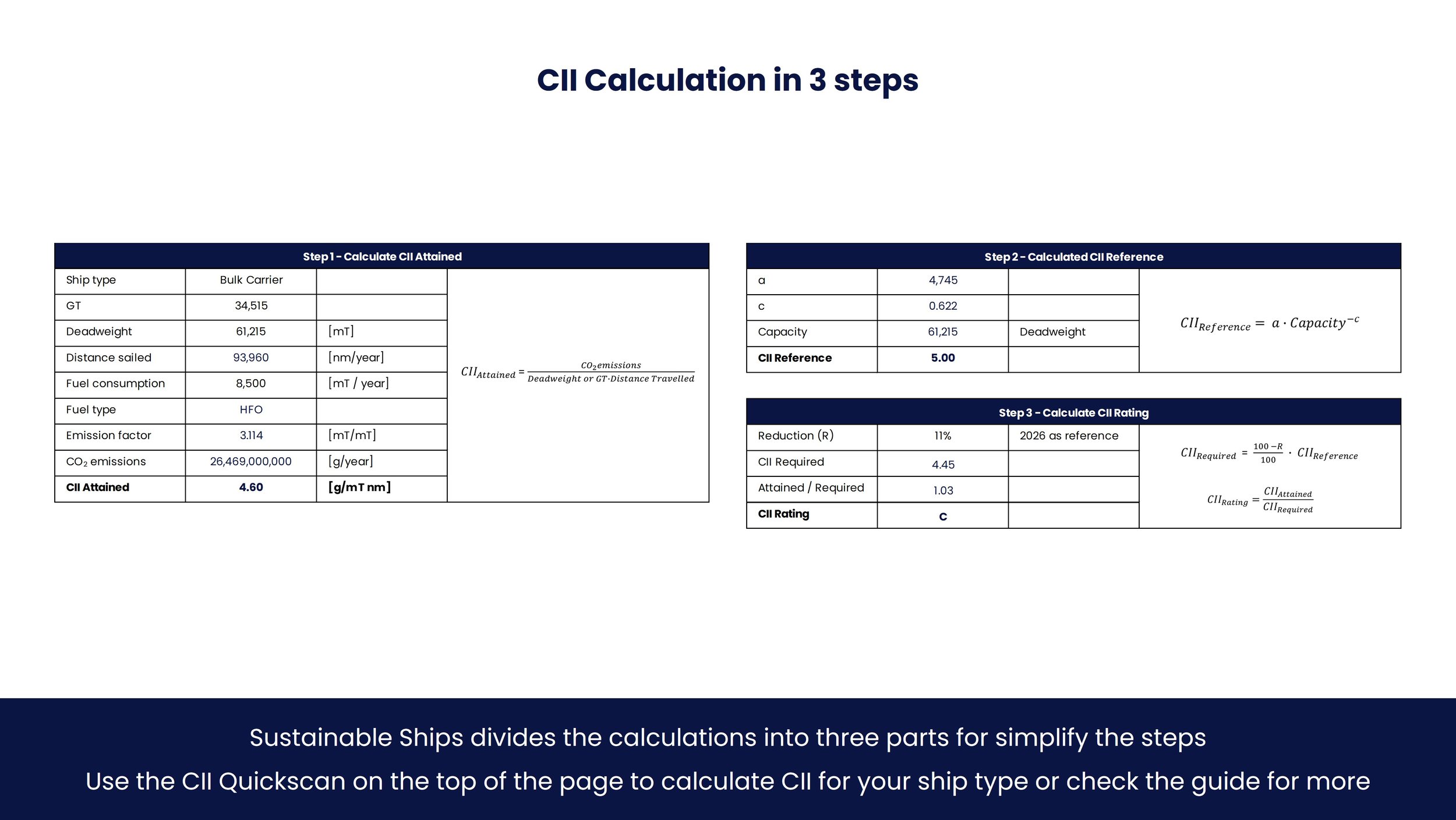
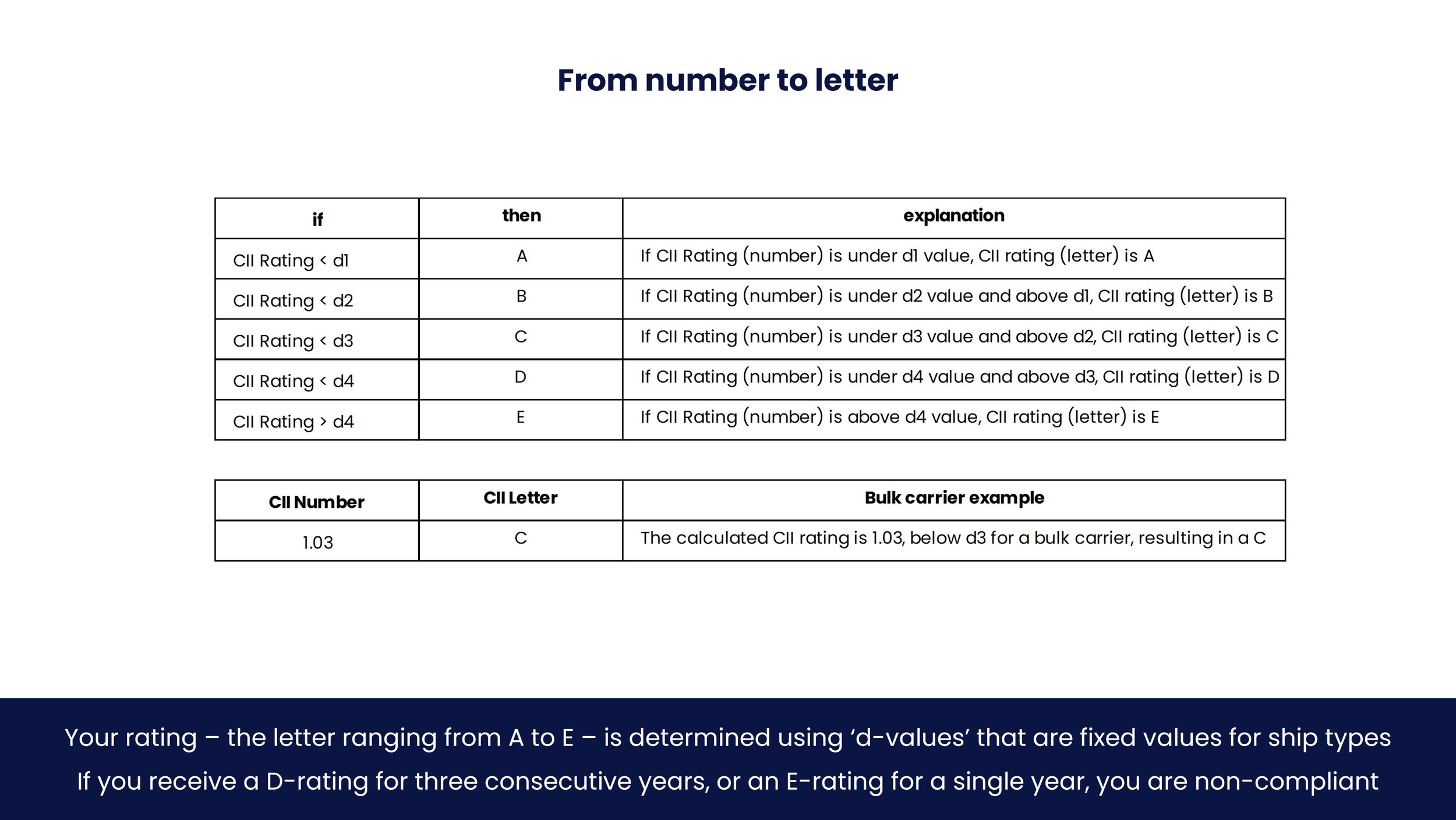
CII is a number, calculated by dividing annual CO2 emissions with the capacity multiplied by the annual distance sailed. The number is transformed into a rating using reference values per ship type. Ships receive a yearly rating from A (good) to E (bad). C+ rating is required.
Target CO2 reduction of 11% in 2026. Unknown trajectory after 2026.
How the tool works
Watch the tutorial for a step-by-step explanation of the tool, or check the case studies below. Download the Excel model to further tweak your analyses. Contact the helpdesk for support and customization options.
CII Guide
The premium tool is accompanied with a study guide template to further accelerate your developments.
Access premium tool and benefits

This tool allows you to calculate your CII in a matter of seconds. It includes an easy to use tutorial, link to the CII guide for free download, in addition to all 7 other sources used including IMO, ClassNK, DNV and Bureau Veritas. This purchase will allow you to estimate and store your CII, or to compare different ship types and scenarios.
Use Apple Pay to purchase the Excel (only on iPhone) - contact helpdesk for payment by invoice
Check pay-per-use options if you don’t want to sign up
CII in a nutshell
The Carbon Intensity Indicator (CII) is a measure of how efficiently a ship transports goods or passengers. It is given in grams of CO2 emitted per cargo-carrying capacity and nautical mile.
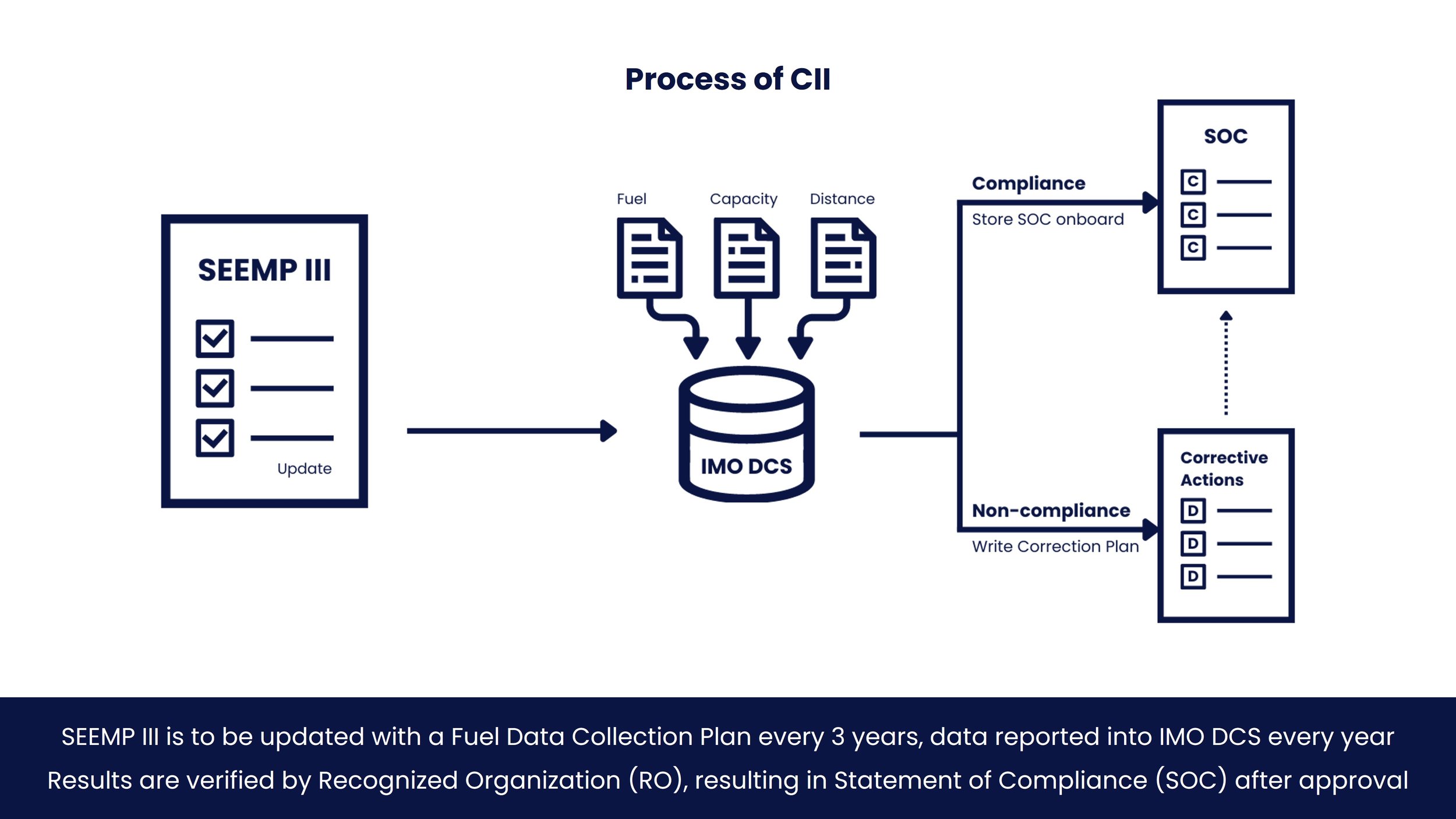
Every year from 2023 onwards, each ship has to calculate and report their CII according to the latest guidelines provided by IMO. The yearly CII is calculated based on reported IMO DCS data and the ship is given a rating from A to E, where A is the best category and E the worst. The CII rating will intensify each year and becomes increasingly more stringent.
The CII applies to ships above 5,000 GT of the following ships types: bulk carriers, gas carriers, tankers, container ships, general cargo ships, refrigerated cargo carriers, combination carriers, LNG carriers, vehicle carriers, Ro-Ro cargo vessels, Ro-Ro passenger vessels and cruise ships.
Ships must achieve rating C as the minimum standard. Ships that achieve a D rating for three consecutive years or an E rating in a single year, a corrective action plan needs to be developed as part of the SEEMP (Ship Energy Efficiency Management Plan) and to be approved by the Administration or Recognized Authority (RO).
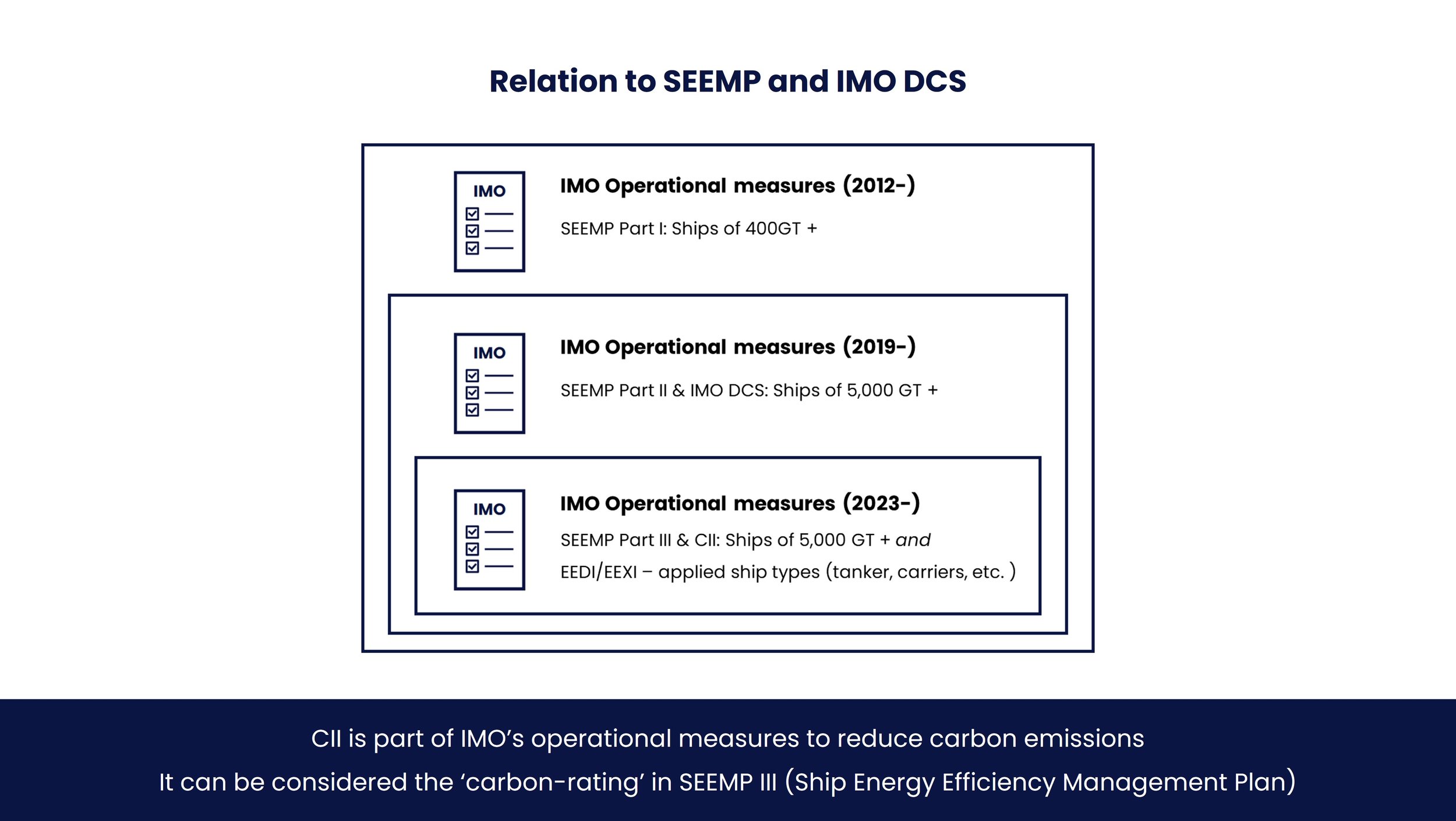
Ships must document the CII as part of SEEMP 3, retain the Statement of Compliance (SOC) to CII onboard and at verification audits prove that they are compliant with a reduction trajectory of 11% by 2026.
Assessing Your Vessel’s Carbon Intensity and Compliance Trajectory
Helps you to assess current performance, identify compliance gaps, and plan improvements toward the 2026 11% CO₂ reduction target.
CII in depth
-
The below list shows a basic minimum of requirements under the regulations stipulated by IMO.
Revisions of SEEMP to add the Ship Fuel Oil Consumption Data Collection Plan (DCP) which includes a description of the methodology for data collecting and the reporting processes.
Data collection on board from 2019 onwards.
Reporting the collected data to the Administration or Recognized Organization (RO) in accordance with IMO DCS (Data Collection System) fuel reporting data.
Verification of the reporting data by the Administration or RO, which are “ratings” from A (good) to E (bad) which will be added on Statement of Compliance form.
Retaining the Statement of Compliance issued by Administration or RO onboard, and keeping the relevant data.
An “E” rating for a single year, or a “D” rating for three consecutive years constitutes a low rating. Low-rated vessels are non-compliant and are to develop a plan of corrective actions. This plan is to be approved by the Administration or Recognized Authority.
Download the guide to learn more.
-
CII applies to ships above 5,000 GT of the following ships types:
• Bulk carriers
• Gas carriers
• Tankers
• Container ships
• General cargo ships
• Refrigerated cargo carriers
• Combination carriers
• LNG carriers
• Vehicle carriers
• Ro-Ro cargo vessels
• Ro-Ro passenger vessels
• Cruise passenger ships
Download the guide to learn more.
-
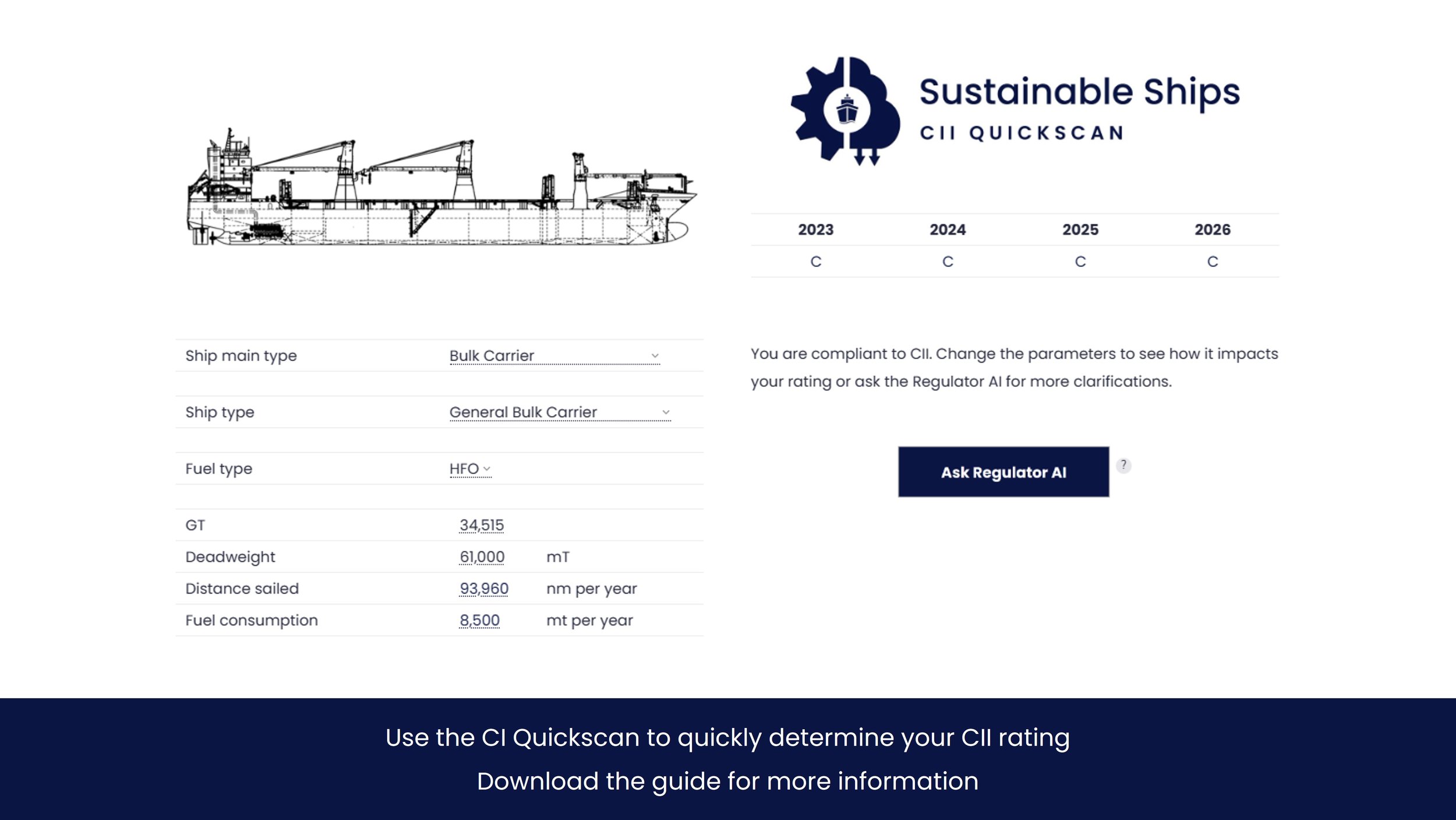
(!) Use the quickscan at the top of this page to quickly determine your CII rating including calculations.
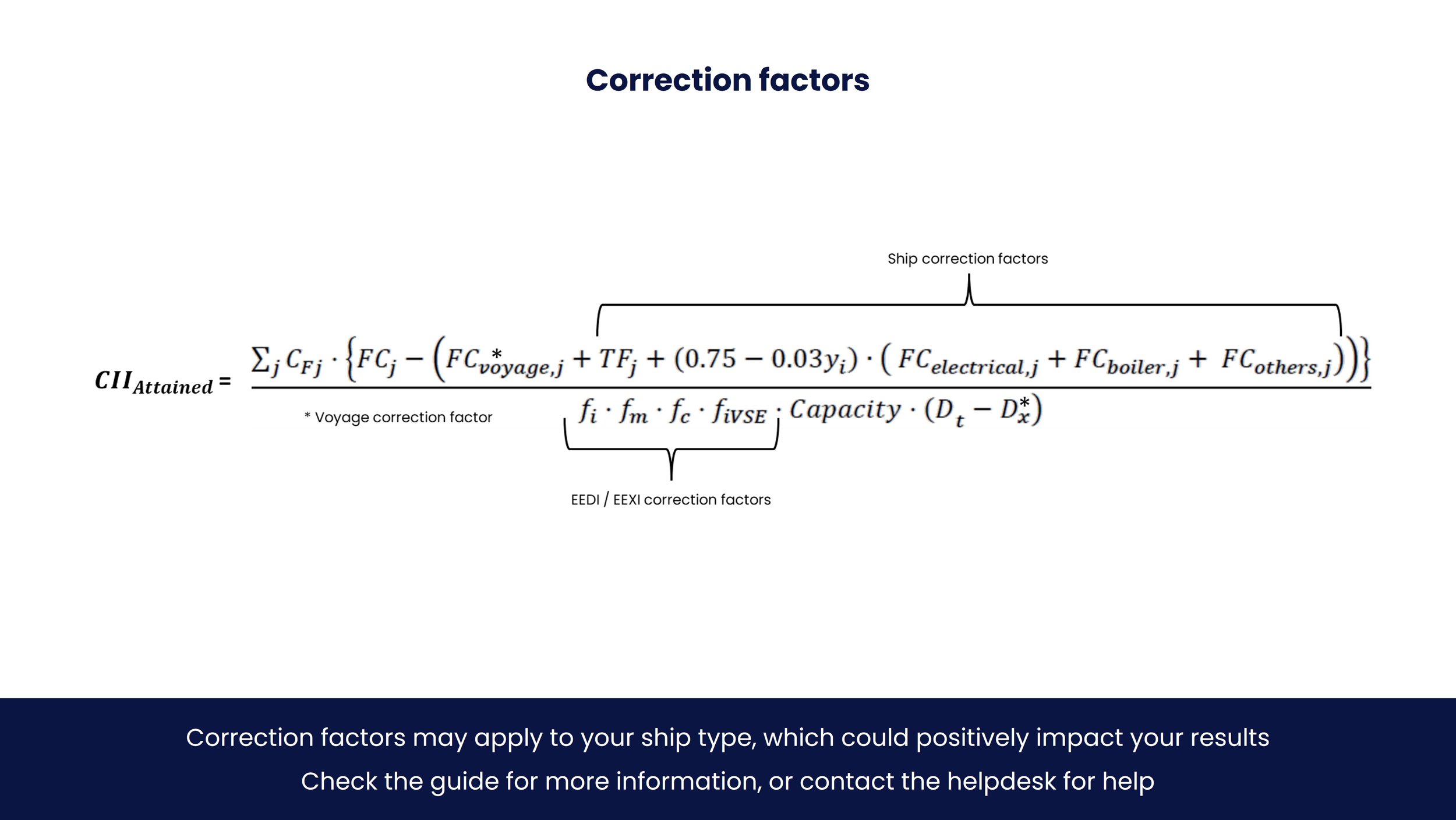
CII is calculated by dividing annual CO2 emissions with annual distance travelled multiplied by ship capacity. If applicable, correction factors are applied. The CII unit is “grams of CO2 emitted per cargo-carrying capacity times nautical mile”, whereby cargo capacity is either deadweight or gross tonnage depending on ship type. Correction factors are similar to those used for EEXI/EEDI, in addition to factors for specific ship types and voyage circumstances.
The full calculation including correction factors are described in more detail in chapter 2 in the guide.
-
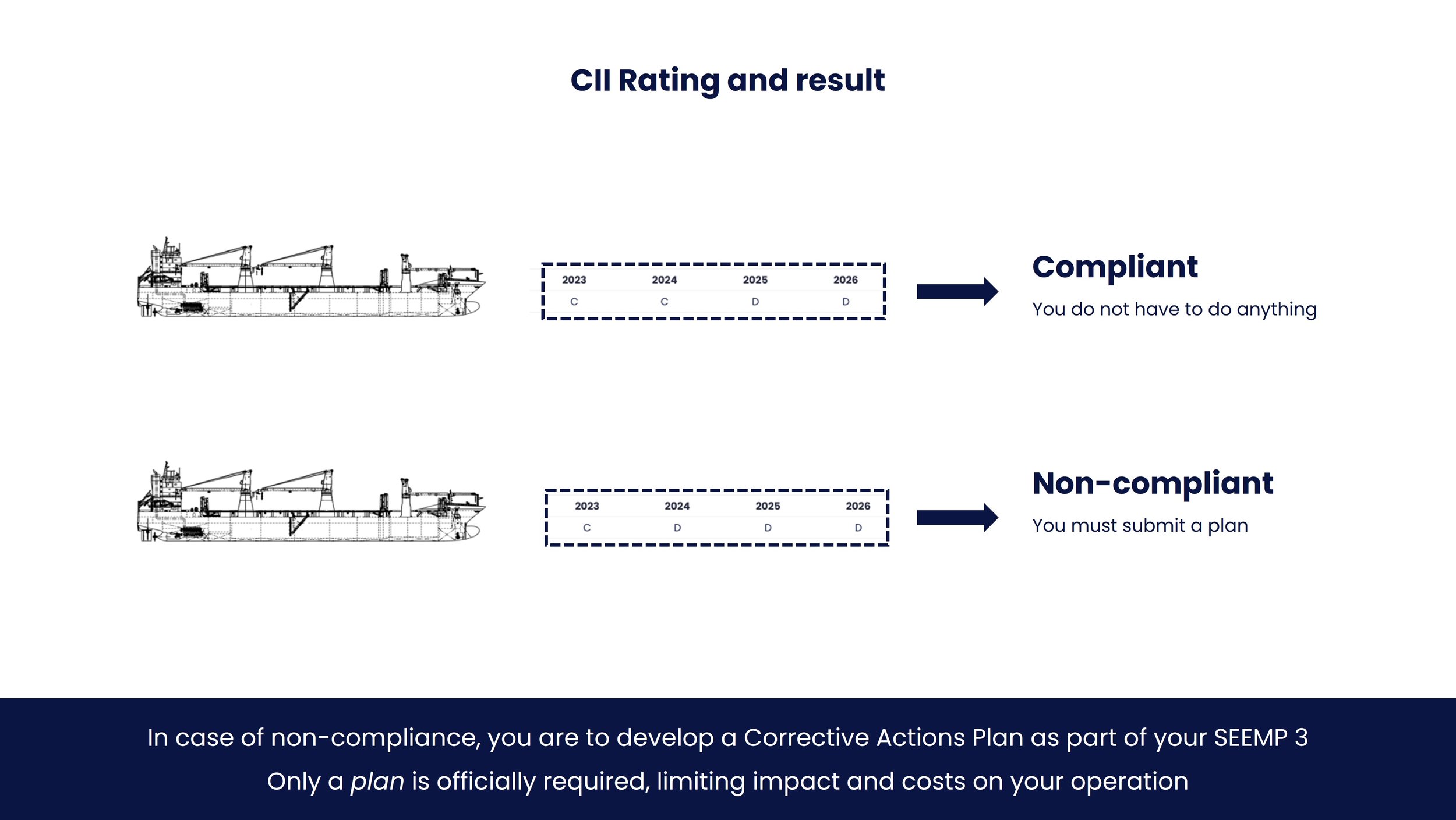
Compliance means to receive a maximum amount of two (2) D-ratings. For example, you receive a C-rating in 2023 and 2024, and a D-rating in 2025 and 2026, your vessel is compliant. In this scenario, no specific actions or consequences are defined by IMO. It is nevertheless advised to closely monitor CII performance in order to avoid having to take drastic measures unexpectedly. Compliance requirements might change of the CII revision of 2025.
Non-compliance means an n E-rating in a single reporting year, or a D-rating for three consecutive years, which constitutes a “low-rating”. Low-rated vessels are to develop a SEEMP Part III Corrective Actions Plan. This plan shall be submitted to and approved by the Administration or Recognized Authority before DCS Statement of Compliance for that year can be issued.
Download the guide to learn more.
-
An E-rating in a single reporting year, or a D-rating for three consecutive years constitutes a “low-rating”. Low-rated vessels are non-compliant and are to develop a SEEMP Part III Corrective Actions Plan. This plan shall be submitted to and approved by the Administration or Recognized Authority before DCS Statement of Compliance for that year can be issued.
To achieve compliance in the case of means to submit a Corrective Actions Plan that includes measures to either reduce CO2 emissions with same distance travelled; or increase distance travelled with same CO2 emissions. Sustainable Ships generally works with a CO2 reduction approach.
Either approach would work however and lead to the same result, as it would both decrease the CII rating. Below are stated several options that can be included in a SEEMP Corrective Actions Plan. You can use the Decarbonizer to quickly (and freely) determine possible actions for your ship and to download the corresponding plan. Below is an overview of potential measures for our bulk carrier example, though these is certainly not an exhaustive list. Contact the helpdesk for customization options for your ship.
Download the guide to learn more.
-
CII can be viewed as part of a strengthening of the SEEMP (Ship Energy Efficiency Management Plan), referred to by some as the ‘enhanced SEEMP’. The intention is to ensure continuous improvement of energy efficiency and to lower carbon intensity. The enhanced SEEMP shall include an implementation plan on how to achieve the CII targets (called the Ship Operation Carbon Intensity Plan) which will be subject to approval and company audits.
Starting in 2024, the CII must be calculated and reported to the Data Collection System (DCS) verifier together with the aggregated DCS data for the previous year, including any correction factors and voyage adjustments (see 2.5). Deadline for DCS and CII submission is no later than 31 March each year.
Attained CII and additional CII data will be visible in IMO DCS upon submission after the year end. After successful verification, both attained CII and acquired Environmental Rating (A to E) will be presented on the DCS Statement of Compliance.
The attained annual operational CII and the environmental rating will be noted on the DCS Statement of Compliance (SoC), which will be required to be kept on board for five years.
Ships that achieve a D rating for three consecutive years or an E rating in a single year, a corrective action plan needs to be developed. That means the SEEMP III must be updated and verified before the SoC can be issued. The corrective action plan should consist of an analysis of why the required CII was not achieved and include a revised implementation plan.
A corrective action plan can be made using the Decarbonizer. Use this to make your own plan, or download the guide to learn more.
Frequently Asked Questions
Use the Regulator to quickly find what your are looking for
-
The Carbon Intensity Indicator (CII) is an IMO enforced regulation that measures the efficiency with which goods or passengers are transported. It is expressed in grams of CO2 emitted per cargo-carrying capacity - nautical mile. CII is calculated per year based on IMO DCS data, and receives a rating from A to E.
The CII applies to all cargo, passenger, and cruise ships exceeding 5,000 GT. A corrective action plan must be developed as part of the SEEMP and approved for ships that receive a D rating for three consecutive years or an E rating in a single year.
The rating becomes increasingly stringent over time, aiming for an absolute reduction of emissions to zero by 2050 as per IMO targets.
-
CII is calculated as the amount of CO2 emitted per ton of cargo and nautical mile. Correction factors will be added to the CII calculation in a separate guideline that will be developed next year.
For the time being, using actual cargo carried rather than capacity (i.e. the EEOI) can only be reported voluntarily and not for CII rating purposes.
-
CII applies to ships above 5,000 GT of the following ships types:
Bulk carriers
Gas carriers
Tankers
Container ships
General cargo ships
Refrigerated cargo carriers
Combination carriers
LNG carriers
Vehicle carriers
Ro-Ro cargo vessels
Ro-Ro passenger vessels
Cruise passenger ships
-
Verification of the CII may be carried out by another Recognized Organization (RO) than the one that Classes the ship, since this is a verification that can be carried out remotely. It should however be the same verifier as for IMO Data Collecting System for fuel oil consumption of ships (IMO DCS) since the CII is to be calculated based on the collected and reported ship fuel oil consumption data which has been submitted to the DCS.
-
Since the RO's are already authorised to conduct the surveys and to issue the certificates as regulated in MARPOL Annex VI, and the new requirements regarding EEXI and CII are amendments to MARPOL Annex VI, no separate authorisation is required. The Appendix to Annex 1 to the Agreement between the NL and RO dated 03 April 2014 already provides for this (link).
-
For ships which are falling into more than one categories of ships, as per MARPOL Annex VI, regulation 28(.1), the most stringent attained annual operational CII, as calculated for the categories the ship may fall into, shall be used.
-
When an ice-classed ship sails in ice conditions to and from a port within the same sea area within the same ice edge:
the period of time the ship is in that port (port period) may be included in either the voyage period to that port or the voyage period from that port; and
all fuel consumption for that port period may be included in the voyage adjustment to the calculation of the attained annual operational CII.
For further clarification and instructions see Resolution MEPC.355(78).
-
As per Q1 2024, this is still unknown. CII requirements will be evaluation in a planned 2025 revision by IMO. Currently, IMO is aiming for approximately 20-30% reduction in 2030 and 100% reduction in 2050. These values are adhered to by Sustainable Ships as a guideline for the longer term, but a more likely scenario towards 2030 is simply a continuation of the 2% yearly increase of the Reduction Factor (R).
Case studies
Sign up to get one customized case study for yourself each month













References
Hyperlinks and downloads for premium users only
IMO - MEPC.346(78) 2022 Guidelines for development of SEEMP
IMO - MEPC.355(78) 2022 Interim guidelines on CII calculations
ClassNK - CII (Carbon Intensity Indicator)
DNV - Frequently Asked Questions
DNV - CII - Carbon Intensity Indicator
Bureau Veritas - EEXI and CII: dual regulations reducing ship’s carbon impact
Sustainable Ships - Emissions Calculation Guide

This case study determines what it takes to remove the fuel from a cruise ship, comparing a 50,000 GT ocean cruise ship with an inland river cruise vessel. The ocean cruise ship obtains a payback of around five years, but only with very cheap electricity, battery prices of $150 per kWh, long-term financing and the sale of FuelEU surplus (many caveats!). The river cruise ship is technically easier, but is extremely challenging to make a business case for because EU ETS and FuelEU do not apply to it.