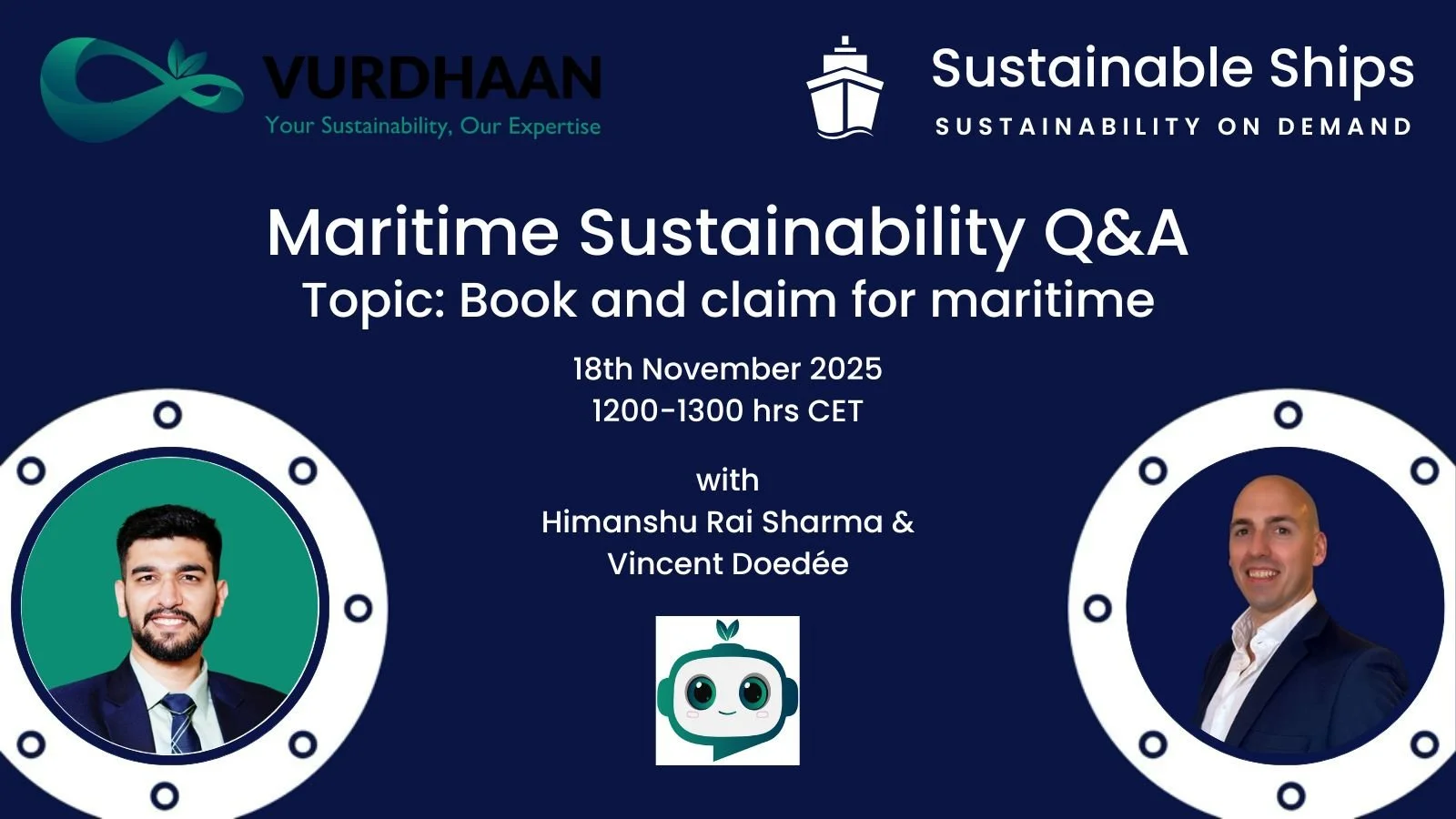
Book and Claim explained - Q&A with Vurdhaan
About Q&A
This Q&A dives into the principles, mechanics, and future of book and claim systems in maritime decarbonization. Hosted by Vincent Doedee, the conversation features Himanshu Sharma, a sustainability consultant with experience in aviation and transport emissions, and touches on the practicalities of Scope 3 emissions reduction, registry systems, and independent verification.
Book and claim enables cargo owners to fund real decarbonization measures, such as biofuel use or retrofits, without requiring the low-carbon action to happen on their specific voyage. Instead, credits are issued for verified fuel usage or emission reduction elsewhere in the network.
Himanshu explains how book and claim differs from compliance frameworks like FuelEU Maritime pooling, and why transparency, additionality, and independent auditing are essential for its credibility. He also walks through recent transactions and outlines the cost structures and challenges around standardization.
Vurdhaan develops and operates independent book and claim registries, providing verification, issuance, and retirement services that ensure credibility, traceability, and alignment with voluntary and emerging regulatory frameworks.
Key insights
1) Book and claim can fund decarbonization projects
Book and claim separates environmental attributes from the physical product, allowing emission reductions to be transferred virtually through registries and verified documentation. It enables cargo owners to voluntarily fund biofuels, retrofits, or fleet renewals, supporting in-sector decarbonization and claiming Scope 3 credits, provided the transaction is additional and independently verified.
2) All transactions need to be ‘voluntary’ and transparent
Book and claim is not a compliance mechanism. Credits cannot be used to fulfill regulatory obligations, and only Tier 2 credits (voluntary, additional transactions) can be traded or claimed. Tier 1 credits, those used for FuelEU pooling for example, cannot be double-claimed or monetized outside that system. Transparency is essential: both fuel suppliers and shipowners must issue declarations ensuring Scope 3 credits are not claimed elsewhere, particularly not under mandatory schemes like FuelEU Maritime.
3) Revenues vary (€70 - €270
Market prices for Scope 3 credits vary by feedstock and verification rigor. Credits from Used Cooking Oil (UCO) biofuels can reach €270 per ton CO₂e, while those from HVO are typically around €70–90 per ton CO₂e. Revenues generated from retrofits have - as far as is known by Vurdhaan - not yet taken place.
Questions asked
What is the difference between book and claim and FuelEU Maritime pooling?
FuelEU pooling is a compliance mechanism within the EU, subject to regulatory penalties and limits. Book and claim is voluntary, does not fulfill compliance, and enables emission reductions to be monetized through separate Scope 3 accounting.Can you trade Tier 1 and Tier 2 credits in the book and claim system?
No. Only Tier 2 credits (additional, voluntary actions) can be transferred or claimed. Tier 1 credits, such as those used for FuelEU pooling, cannot be double-counted or monetized outside that system.How do you ensure a book and claim credit is not double-counted?
All actors—fuel supplier, shipowner, and cargo owner—must sign declarations confirming the emission reduction is not claimed elsewhere. Vurdhaan uses independent verification and registry controls to prevent overlap with compliance schemes.Is book and claim compatible with FuelEU Maritime?
It is complementary, not overlapping. FuelEU addresses operational carbon intensity at the vessel level; book and claim allows cargo owners to support decarbonization without direct control over vessel operations.Can book and claim be used for retrofits or only for biofuels?
Yes, retrofits and fleet renewals can be eligible, provided they lead to measurable, verifiable CO₂ reductions. However, retrofit-based credits are still emerging, and few (if any) transactions have taken place so far.What’s the price range for Scope 3 credits under book and claim?
UCO-based biofuel credits can reach around €270 per ton CO₂e. HVO credits typically range from €70 to €90 per ton, depending on verification and demand.What’s the main barrier to scale book and claim in shipping?
Lack of standardization, limited awareness among cargo owners, and unclear treatment under sustainability reporting frameworks. A key challenge is aligning registry systems with Scope 3 accounting standards like GLEC or SBTi.Is third-party verification mandatory?
Yes, for credibility and audit readiness. Vurdhaan includes independent verification in all transactions to ensure claims meet corporate reporting and ESG assurance requirements.What registries or systems are used in book and claim today?
Vurdhaan operates its own registry aligned with book and claim principles, enabling issuance, tracking, and retirement of Scope 3 credits linked to maritime activity.Can a cargo owner claim a credit if the emission reduction was from a different trade lane?
Yes. That’s the core principle of book and claim: the environmental benefit can occur in a different location or voyage, as long as it is verified, not double-claimed, and transparently documented.









This Q&A looks at how equipment finance and leasing shape decarbonization decisions, with Kevin Swannack and Andy Bailey of Wavefront Asset Management, who explain why and how leasing of equipment can actually be the most cost-effective option.