
Biofuels & EU ETS - when do biofuel blends payoff?
Finding the break-even point between fuel price and ETS costs - could already be at €85
As EUA prices rise (reaching around €100 earlier this year), shipowners are looking for smarter ways to manage fuel-related compliance costs. One increasingly viable option is to use biodiesel or HVO blends, which are typically approved by engine manufacturers up to 30% and carry a CO₂ emission factor of zero under EU ETS. But when do these fuels actually become cost-competitive?
Sustainable Ships built a simple tool that allows users to explore this exact question. By factoring in both fuel price and ETS cost based on VLSFO-equivalent energy content, the tool helps decision-makers compare the total cost per tonne of fuel across different fuel types and EUA price levels.
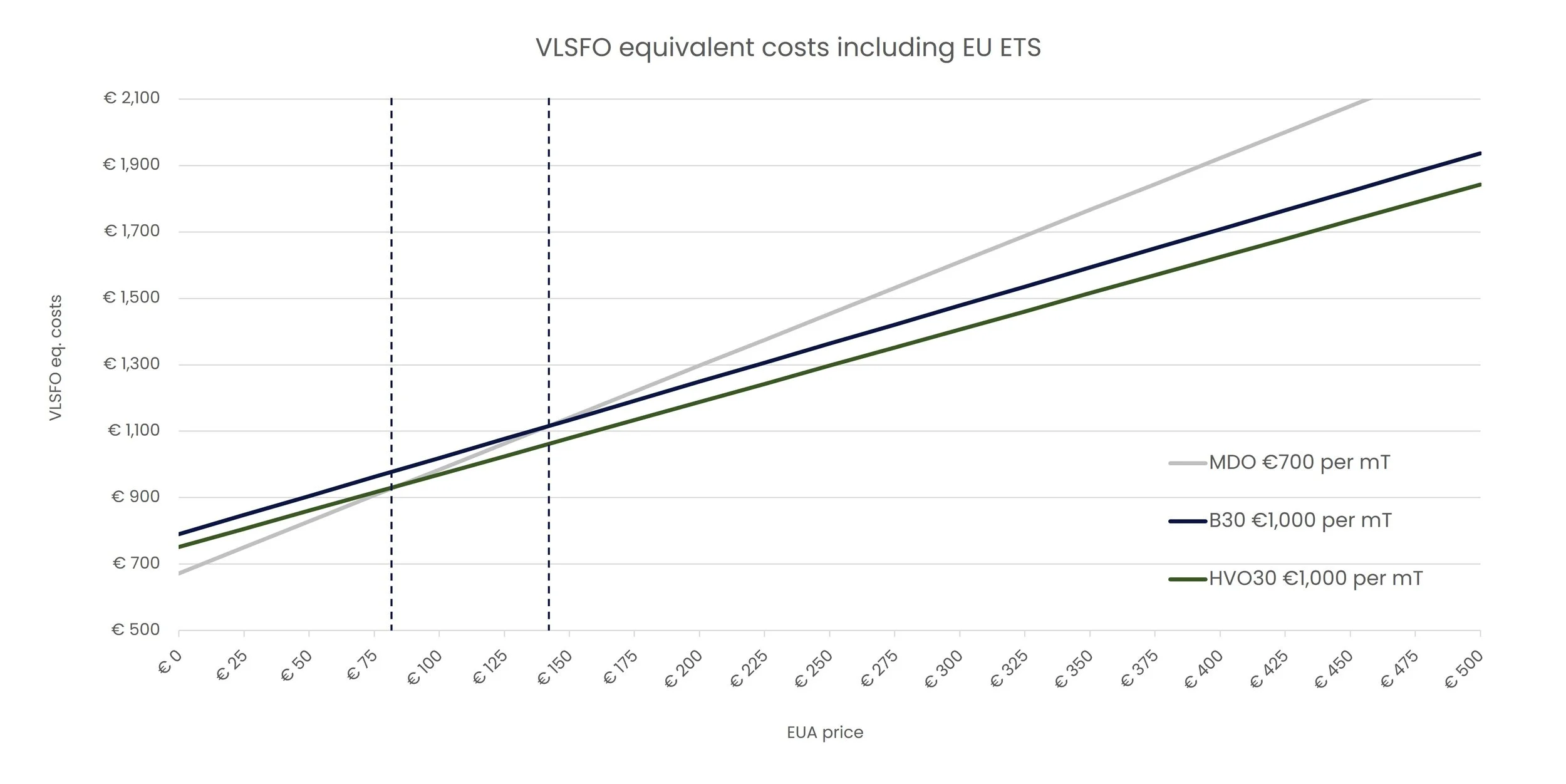
Based on the current assumptions (noting that fuel and EUA prices vary across markets), results show that MDO remains the most cost-effective option up to an EUA price of approximately €85 per tonne. Above this threshold, it could be more cost-effective to use biofuel blends. As this EUA price aligns with current market levels and are only expected to increase, shipowners may find it increasingly useful to carry out similar break-even analyses with their fuel suppliers.
Members can download and adjust different scenarios or have this done for them by Sustainable Ships. Become a member today to get support.
Members only
Sensitivity analysis of B30 and HVO30 blends
At what EUA price does switching to biofuels make economic sense?
Answering this question requires input on the bare fuel cost (in €/tonne) of MDO, B30, and HVO30, as well as the prevailing EUA price. Given the variability of marine fuel prices across time and space, it easily becomes a very complicated analysis. To clarify the picture, a simplified sensitivity analysis was carried out in which fuel prices were held constant and only the EUA price was varied. For this scenario MDO price was fixed at €700 per mT and B30 and HVO30 were both set at €1,000 per mT. This approach allows a direct comparison of the VLSFO-equivalent total cost, combining both fuel cost and ETS compliance cost.
Based on these assumptions, MDO remains the most cost-effective option up to an EUA price of approximately €85 per ton. HVO30 becomes cost-effective beyond that point, primarily due to its higher lower calorific value (LCV), which results in more energy per tonne. B30 becomes cost-competitive at around €140 per EUA.
Since both fuel and EUA prices used in this example reflect plausible market levels, shipowners and operators may find it increasingly valuable to conduct similar break-even analyses together with their fuel suppliers, particularly in light of tightening ETS regulations and expected rise in EUA in the coming years.
Methodology and assumptions
Key principle of this tool is to compare volumetric energy density. That means the costs are always normalized per unit of energy, which is 41,000 MJ per mT for this analysis (VLSFO equivalence). Total costs per metric tonne of fuel are then calculated by:
Total Cost = Fuel Price per 41,000 MJ + Emission Factor × EUA Price per mT
The default assumptions are based on recent market prices and RED-compliant emission factors, but all inputs can be adjusted for scenario testing.
-
For all analyses, MDO as per EU ETS regulations is taken as reference fuel, with which B100 (Biodiesel or FAME) and HVO is blended. The base case assumes a blend of 30% bio-component (B100 or HVO) and 70% MDO.MDO - LCV 42,700 MJ / mT - Density 0.890 mT per m3 - Cf 3.255
Biodiesel (B100) - LCV 37,000 MJ / mT - Density 0.880 mT per m3 - Cf 0.049
HVO - LCV 44,000 MJ / mT - Density 0.780 mT per m3 - Cf 0.049
More information and fuel properties can be found in the Fuel Properties and Cost Guide.
-
Fuel prices can be readily varied but are fixed at a price point that makes for easy comparison, i.e.:MDO - €700 per mT
Biodiesel (B100) - €1,000 per mT
HVO - €1,000 per mT
For an overview of historic fuel and EUA prices, use the Fuel Cost Calculator.
-
To compare the cost of different fuels on a fair and consistent basis, all fuel costs are expressed in terms of Very Low Sulphur Fuel Oil (VLSFO) equivalence. This provides a common benchmark to assess price competitiveness, emissions performance, and regulatory compliance. In other words, the effective price per unit of energy delivered is calculated for each fuel, the corresponding mass for that unit of energy, and subsequent fuel and ETS costs derived.
In line with EU regulations (FuelEU Maritime and EU ETS), a Lower Calorific Value (LCV) or Lower Heating Value (LHV) of 41,000 MJ per metric ton for VLSFO is taken as unit of energy delivered. MDO, B30 and HVO30 are normalized to this energy content for apples-to-apples comparisons.
Sign up for premium tools and benefits
This purchase allows you to compare the cost of Very Low Sulphur Fuel Oil (VLSFO) with other fuels on an energy-equivalent and total cost basis. It includes scenario-based fuel price projections, regulatory cost assessments for EU ETS and FuelEU Maritime, and the ability to define custom price trends. Easily generate operational cost forecasts and investment case reports to support strategic decision-making.
Use Credit card, Stripe, PayPal or Apple Pay (only on iPhone). Contact the helpdesk for payment by invoice.
Don’t want to sign up? Check pay-per-use options
You might also like











This case study compares three compliance strategies for FuelEU (paying the penalty (business as usual), buying pool credits from a third party, and blending biofuels) for a representative 4-ship fleet over 2026–2040. Results show that pooling and biofuels both beat business as usual by 6–7%, but it is a coin toss on which is better for you. The outcome is highly sensitive to B100 price and tightens structurally in favour of biofuels after 2030, making this a tipping-point question rather than a one-off choice.