Compliance exposure costs of Greek dry bulk carriers until 2050
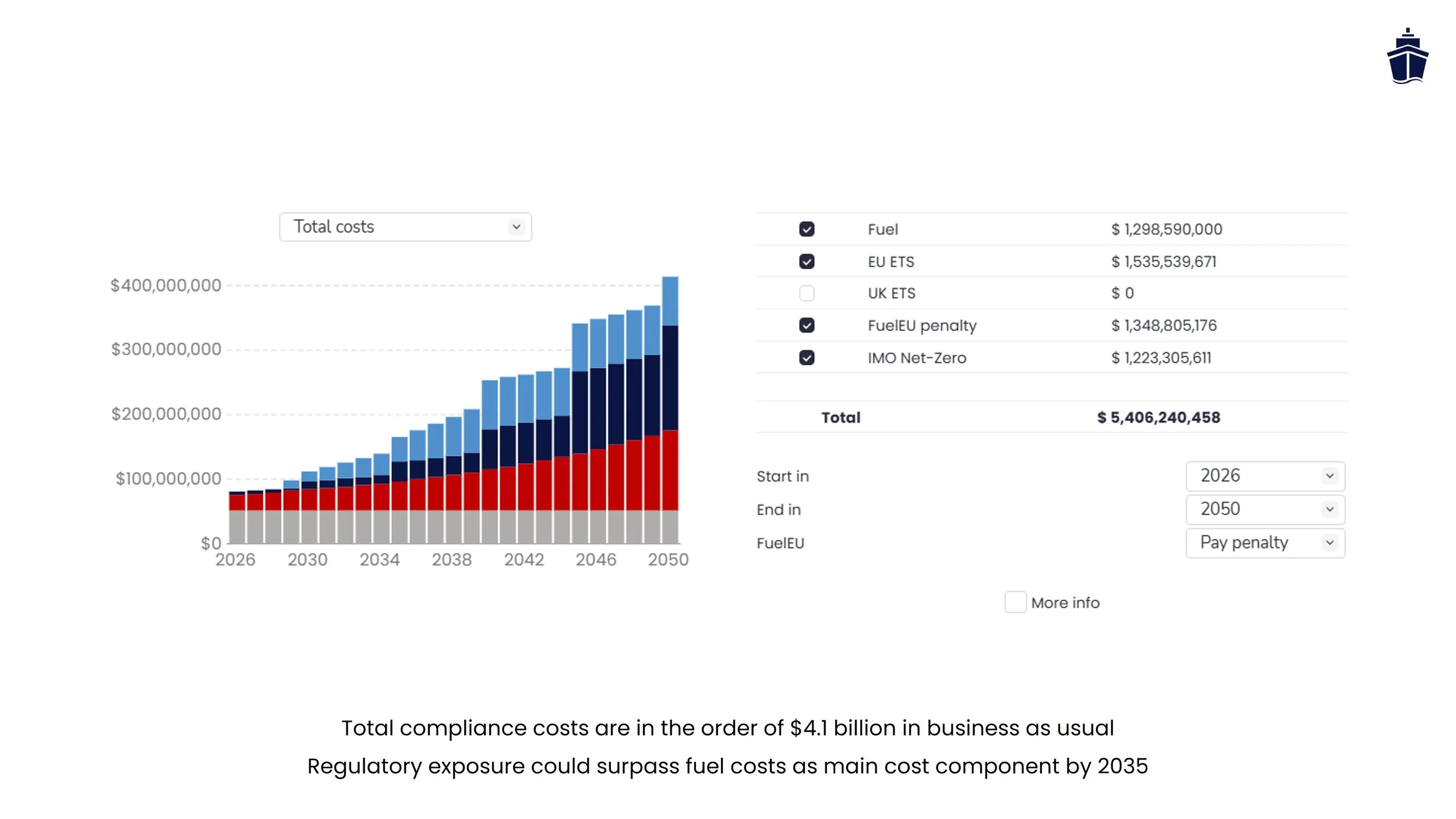
What EU ETS, FuelEU Maritime and IMO Net-Zero will cost you in business as usual scenario - an estimated $4.1 billion
Shipping companies face a growing set of regulatory obligations (EU ETS, UK ETS, FuelEU Maritime, and IMO Net-Zero) that directly affect operating costs. The financial exposure varies significantly depending on a ship's fuel type, trading routes, and port behaviour. For most fleet managers this is a nightmare. Understanding exactly what this costs, requires hours of work with uncertain inputs and regulatory assumptions.
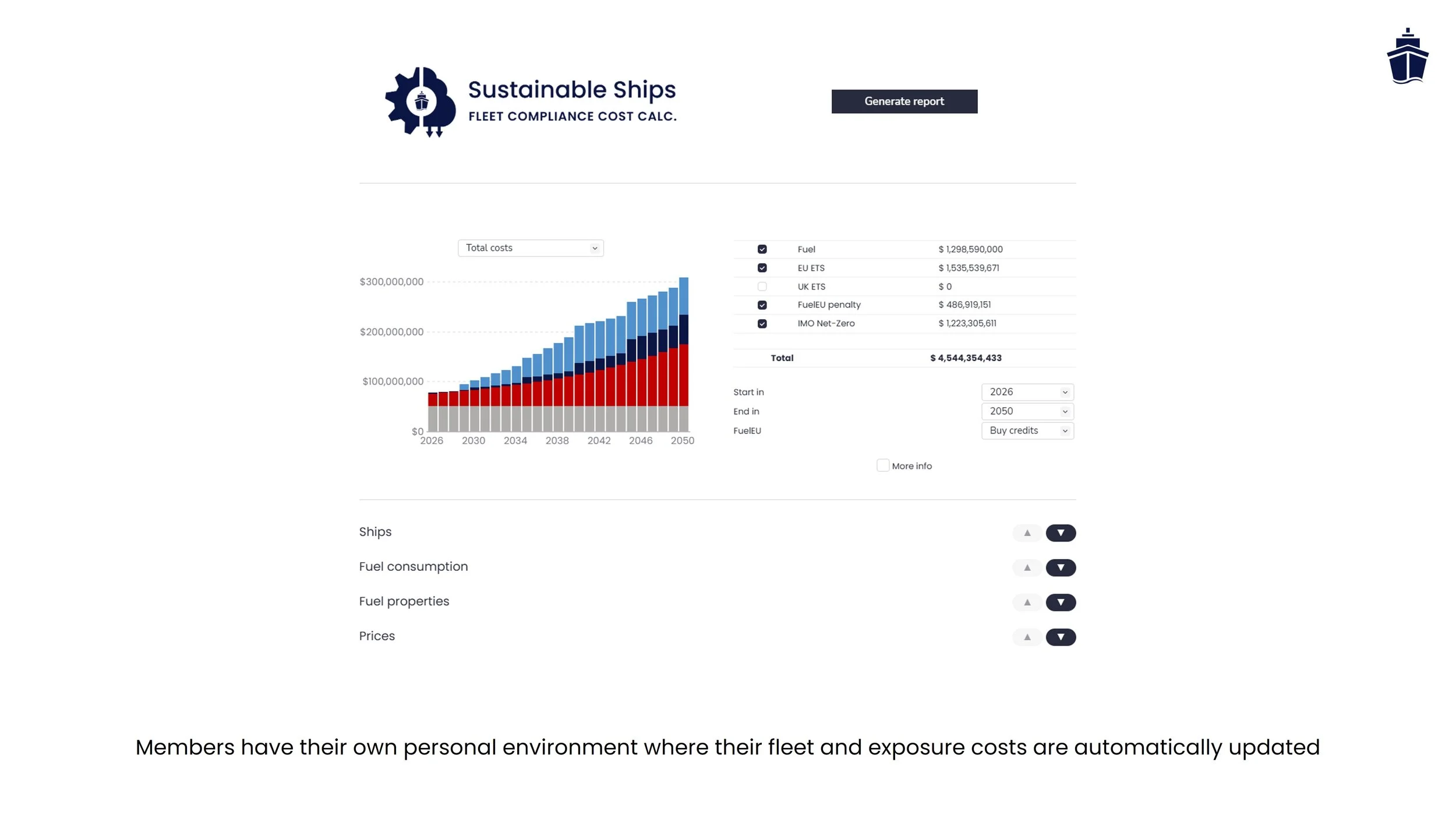
This case study determines regulatory exposure costs of a representative fleet of eight Greek Dry Bulk Carriers, calculating exposure under EU ETS, FuelEU Maritime and IMO Net-Zero from 2026 to 2050. The analysis assumes all ships continue operating on their current fuel (HFO for seven ships, MDO for one) with no operational changes, fuel switches or compliance strategies applied. Under these conditions, the fleet faces a total compliance cost of $4.1 billion over the analysis period, escalating from $30 million in 2026 to $ 362 million in 2050.
For this analysis, the Fleet Compliance Cost Calculator is used to determine total costs of exposure on demand. This tool is intended solely for shipowners who want to understand their compliance cost exposure in the coming years at the right order of magnitude. It does not recommend strategies, compare fuel alternatives, or evaluate credit purchasing. For those decisions, separate tools are available.
Use or download the Fleet Compliance Cost Calculator to perform a sensitivity analysis on your own exposure - scroll down below and have fun!
Case study details for Greek Bulk Fleet
Meet the fleet - 8 Ships
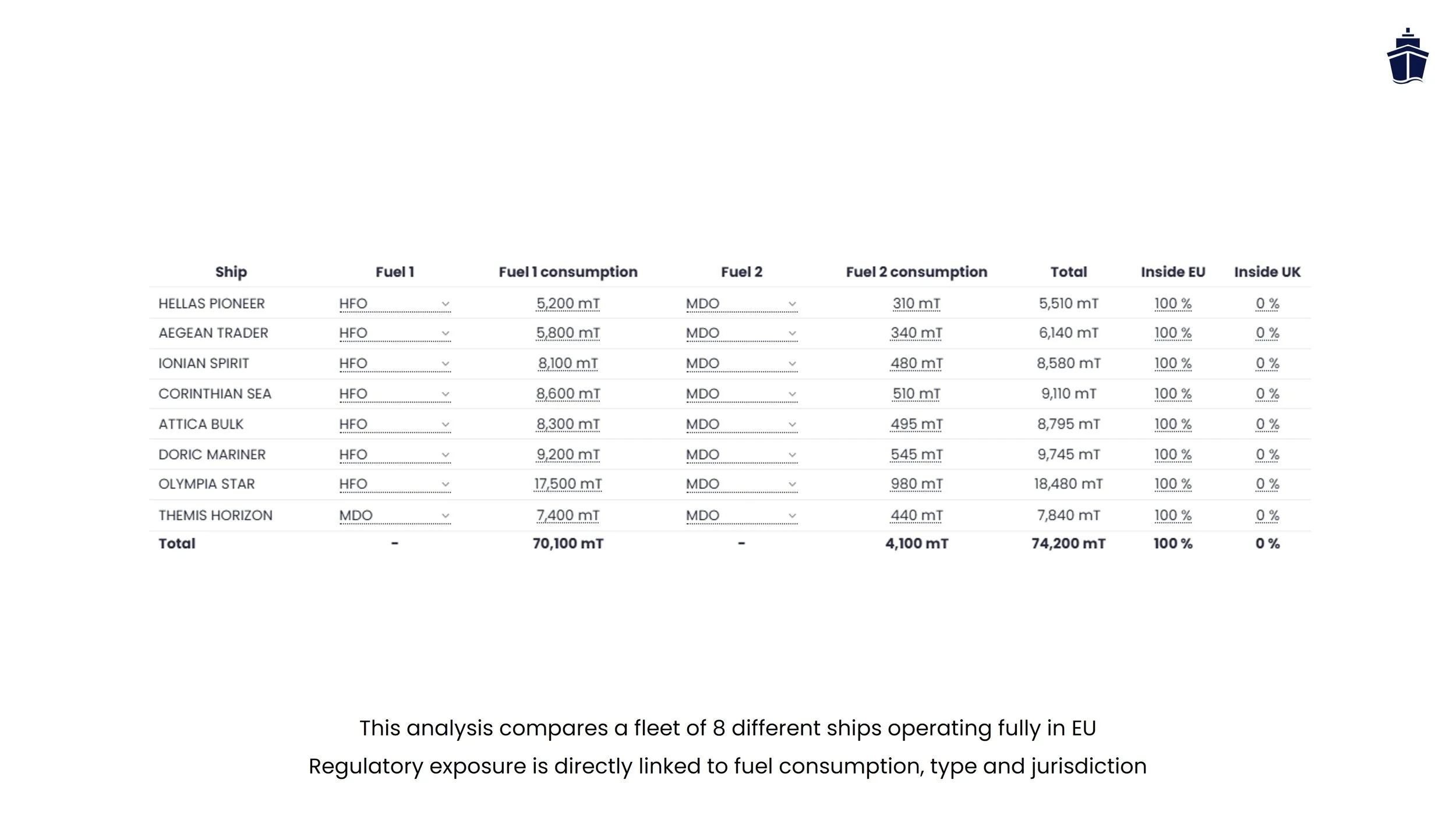
The case study fleet is modelled on a mid-size Greek dry bulk operator with vessels trading exclusively within EU waters — a realistic profile for an owner active in the Mediterranean, North Sea and Baltic. The fleet spans four size classes: Handysize, Supramax, Ultramax and Capesize, with build years ranging from 2007 to 2018. Seven of the eight vessels burn HFO as their primary fuel. The eighth, Themis Horizon, runs on MDO and is included deliberately as a comparison case: a newer, cleaner vessel in the same fleet, used to test whether switching to MDO provides meaningful compliance relief.
Voyage, fuel consumption and operational profile
All eight vessels are assumed to trade 100% within EU waters, making them fully subject to EU ETS and FuelEU Maritime obligations on every voyage. UK ETS exposure is set to zero in this scenario, reflecting a fleet that does not call at UK ports — a common pattern for operators focused on Mediterranean and Northern European continental trades. No shore power, wind propulsion or other abatement technologies are included. Fuel consumption figures are based on engine power and typical load factors for each vessel class and are held constant across the analysis period, meaning no efficiency improvements are assumed over the 25-year horizon. This is conservative by design — the purpose is to establish a clear baseline exposure, not an optimistic projection.
Exposure today and escalation towards 2050
The model calculates compliance costs from 2026, the first full year of the analysis. In 2026 alone, the fleet's combined compliance bill — EU ETS plus FuelEU Maritime, with IMO Net-Zero not yet applicable — amounts to approximately $30 million. This is not a future liability: it is a current operating cost that belongs in every charter negotiation and budget cycle today.
From 2029, IMO Net-Zero costs begin to layer on top of ETS and FuelEU, and the escalation accelerates. By the mid-2030s, annual fleet-wide compliance costs exceed $200 million per year. By 2045–2050, as FuelEU targets tighten to 80% GHG reduction below the 2020 baseline, annual penalties for a fleet still running on HFO become severe. The model assumes full stacking of FuelEU Maritime and IMO Net-Zero — that is, both are applied simultaneously, with no harmonisation. While discussions on harmonisation are ongoing at EU and IMO level, the timeline and outcome remain uncertain. Users can toggle IMO Net-Zero on or off in the tool to model a harmonised scenario.
A striking result is that compliance costs exceed fuel costs by more than 3:1. For an industry that has historically treated fuel as its primary variable operating cost, this reordering represents a fundamental shift in the cost structure of owning and operating fossil-fuelled tonnage.
MDO does not save you
Themis Horizon, the MDO-burning Ultramax, is the fleet's "clean" vessel - newer, usinga lighter distillate fuel, and broadly representative of what many owners have done as a first-step compliance response. The numbers tell a sobering story.
Compared to Ionian Spirit, the closest HFO-burning Supramax in the fleet, Themis Horizon's total compliance cost over 25 years is $443.9 million versus $473.7 million, a saving of $29.8 million, or just 6.3%. MDO has a slightly lower WtW GHG intensity than HFO, but the gap is not large enough to meaningfully move the FuelEU compliance dial as targets tighten toward 2035 and beyond. Meanwhile, MDO carries a significant fuel price premium. For this analysis, $793/mT versus $683/mT for HFO, meaning Themis Horizon's total fuel bill over the period is quite a lot higher than a comparable HFO vessel. The owner pays more for fuel and receives only marginal regulatory relief in return.
This is not an argument against MDO. It is an argument against treating MDO as a compliance strategy. It is a cleaner fuel than HFO, but it does not solve any compliance problems.
Purchase of credits
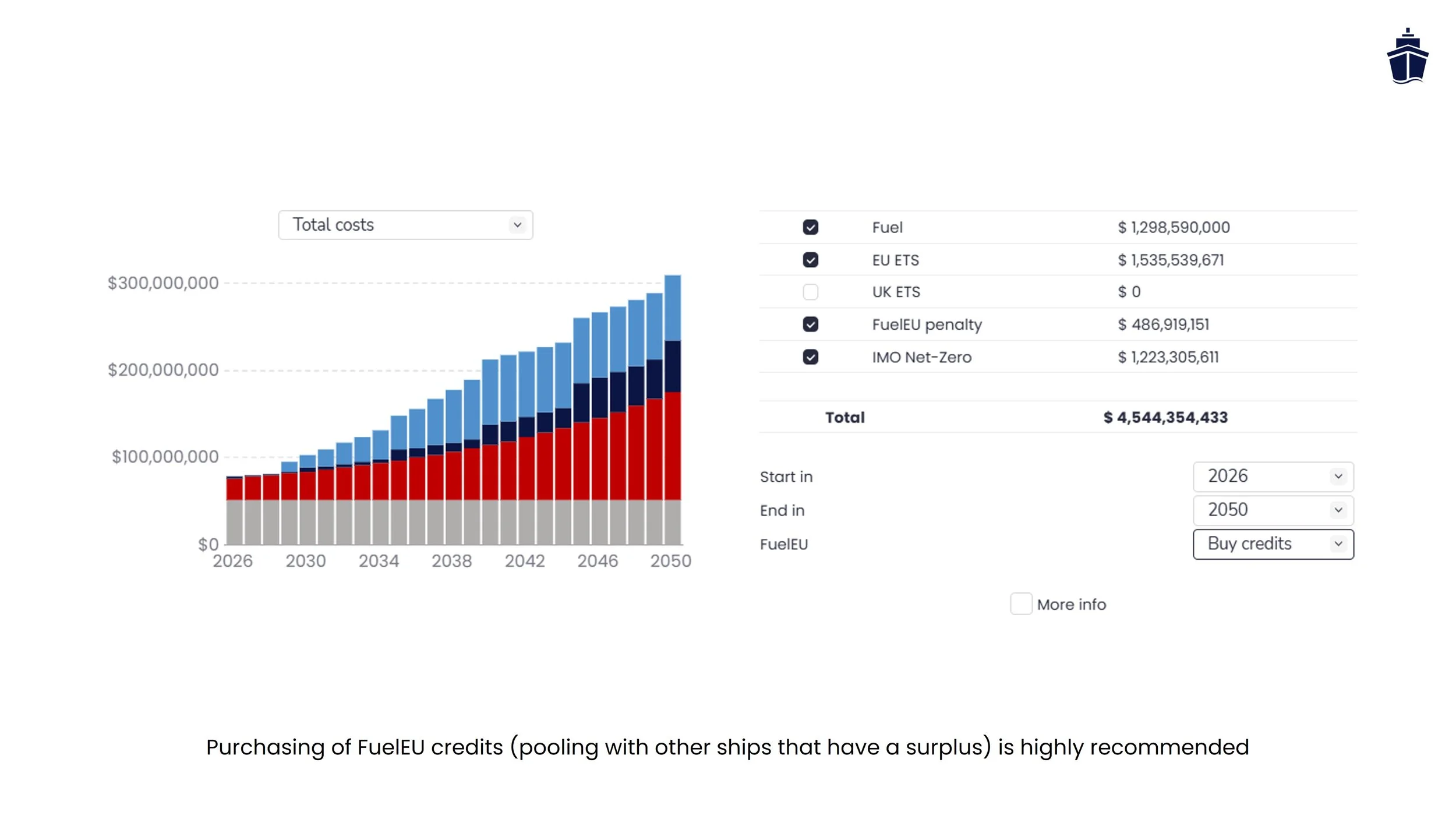
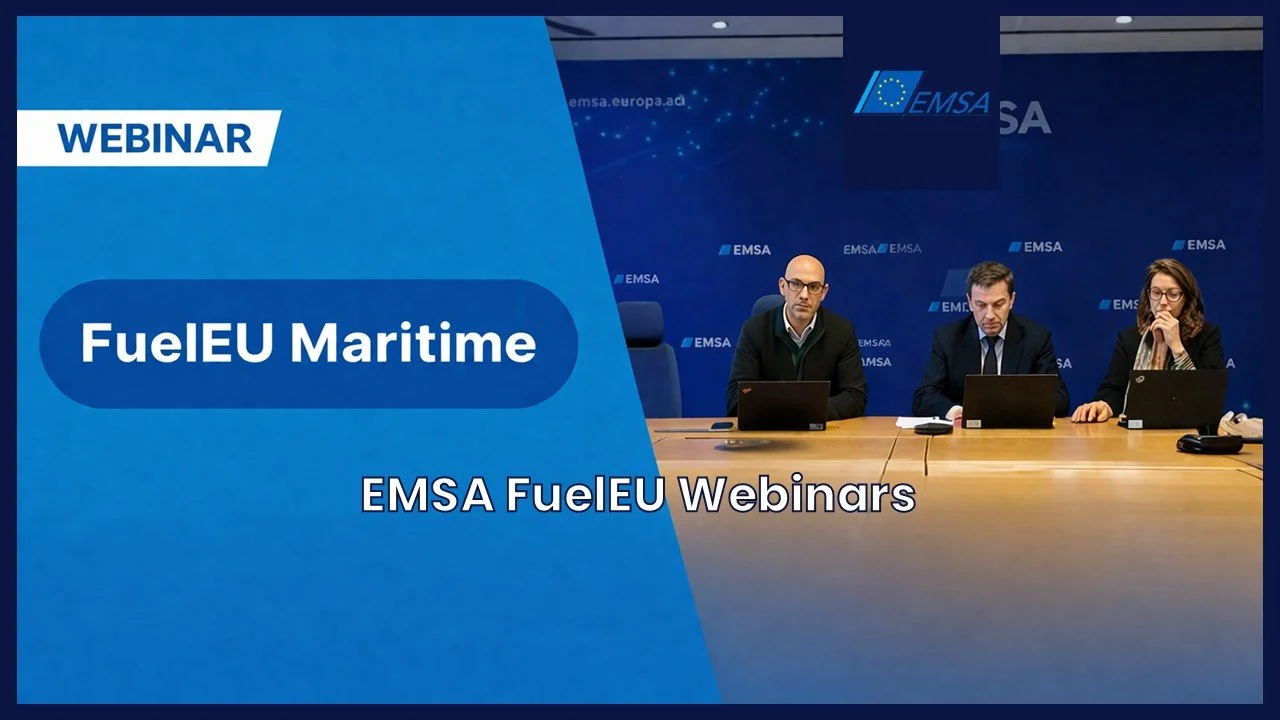
For shipowners facing FuelEU Maritime deficits, paying the full penalty is rarely the only option. FuelEU Maritime includes a pooling mechanism that allows vessels with GHG intensity below the target — typically LNG-fuelled ships or vessels using high-blend biofuels — to sell their surplus to non-compliant vessels. Purchasing pooling credits is typically more cost-effective than paying the statutory penalty, though it introduces counterparty risk and market dependency. As a general principle, exploring pooling options is always advisable before accepting the full penalty. For a detailed analysis of the penalty-versus-credits trade-off, and to directly compare pooling with biofuel blending strategies, the updated FuelEU Pool Tool is the appropriate instrument. Further guidance is also available in the Sustainable Ships EMSA FuelEU webinar series.
Key takeaways
An important practical question for shipowners is which of these costs can be passed on to charterers, and which must be absorbed by the owner. The following below generic advice can be given based on the analysis. Contact the helpdesk for tailor-made advice.
Fuel costs
Typically borne by the charterer under time charter arrangements already, so no structural change is required there. Long-term fuel contracts (for biofuels) are recommended.
EU ETS costs
Similar to fuel and most transferable of all regulatory frameworks. Because ETS allowances can be purchased monthly based on actual voyages, owners can invoice charterers for ETS costs as an additional line item, much like bunker adjustment factors. With clear contractual language, ETS exposure can be passed through with relatively little friction, and BIMCO has published standard clauses to facilitate this.
FuelEU Maritime and IMO Net-Zero penalties
These are considerably harder to pass on. Both are calculated annually based on the vessel's full-year GHG intensity profile, which depends on the fuel mix actually consumed. When a single fossil fuel is used consistently, the annual compliance cost is relatively predictable and could in principle be expressed as a flat per-day rate in the charter. However, when pooling is involved, biofuels are blended, or fuel mix changes mid-charter, the cost calculation becomes voyage- and time-dependent in ways that are difficult to express in standard charter terms. Until 2030, FuelEU penalties remain manageable enough that some owners are absorbing them directly, but this approach is not sustainable as targets tighten.
From 2030 onwards, a clear contractual and compliance strategy is essential
Whether that strategy involves pooling with LNG or biofuel-burning counterparts, blending biofuels onboard, or other decarbonisation measures, it needs to be in place before the cost becomes the primary driver of vessel economics (!). Meaningful strategies can be explored using the FuelEU Pool Tool or by contacting the helpdesk for support.
-
Shipping companies face a growing set of regulatory obligations (EU ETS, UK ETS, FuelEU Maritime, and IMO Net-Zero) that directly affect operating costs, and the financial exposure varies significantly depending on a vessel's fuel type, trading routes, and port behaviour. For most fleet managers, understanding exactly what this costs, requires hours of work with uncertain inputs and regulatory assumptions. This tool does that work for you.
By entering your vessel's fuel consumption, voyage details, and fuel pricing or properties (or have it done for you as a member), the Fleet Compliance Cost Calculator produces a full cost comparison of all fuel costs and regulatory costs on demand. Costs are calculated per year and summed in a Lifecycle Analysis (LCA) or shown per year over the analysis period. The user is able to change fuel prices, regulatory assumptions, fuel properties including emissions factors and more. The premium model, available to download for premium users and members, allows for even more than 10 ships to be compared and three fuels per ship.
This tool is designed for fleet managers, technical superintendents, and sustainability teams who need a defensible, transparent number to bring to management - not a rough estimate, but a full lifecycle cost breakdown tied directly to your fleet's operating profile, customizable to the individual ship.
This tool helps you answer:
What is my total regulatory exposure under EU ETS, FuelEU, and IMO Net-Zero for each vessel in my fleet, each year?
What is the impact of different voyages and routes on my fleet’s exposure?
What is the total cost of my exposure in the coming years and how can I manage this in my contracts?
How does my cost exposure change if fuel prices, carbon prices, or port call patterns shift?
Sign up for premium tools and benefits
This Excel model enables shipowners, operators, and fleet managers to assess the total compliance costs of their fleet under FuelEU Maritime, EU ETS, and IMO Net Zero regulations. It aggregates multiple ship specific data such as fuel consumption, emission factors, and operational profiles to calculate costs under business-as-usual conditions and compare them with different mitigation strategies. The tool provides fleet and ship projections, penalty assessments, and long-term compliance cost forecasts across multiple vessels, allowing users to evaluate and optimize their decarbonization pathways. Easily generate detailed fleet compliance reports to support strategic decision-making, investment prioritization, and regulatory reporting.
Use Credit card, Stripe, PayPal or Apple Pay (only on iPhone). Contact the helpdesk for payment by invoice.
Don’t want to sign up? Check pay-per-use options
You might also like





This case study determines what it takes to remove the fuel from a cruise ship, comparing a 50,000 GT ocean cruise ship with an inland river cruise vessel. The ocean cruise ship obtains a payback of around five years, but only with very cheap electricity, battery prices of $150 per kWh, long-term financing and the sale of FuelEU surplus (many caveats!). The river cruise ship is technically easier, but is extremely challenging to make a business case for because EU ETS and FuelEU do not apply to it.