
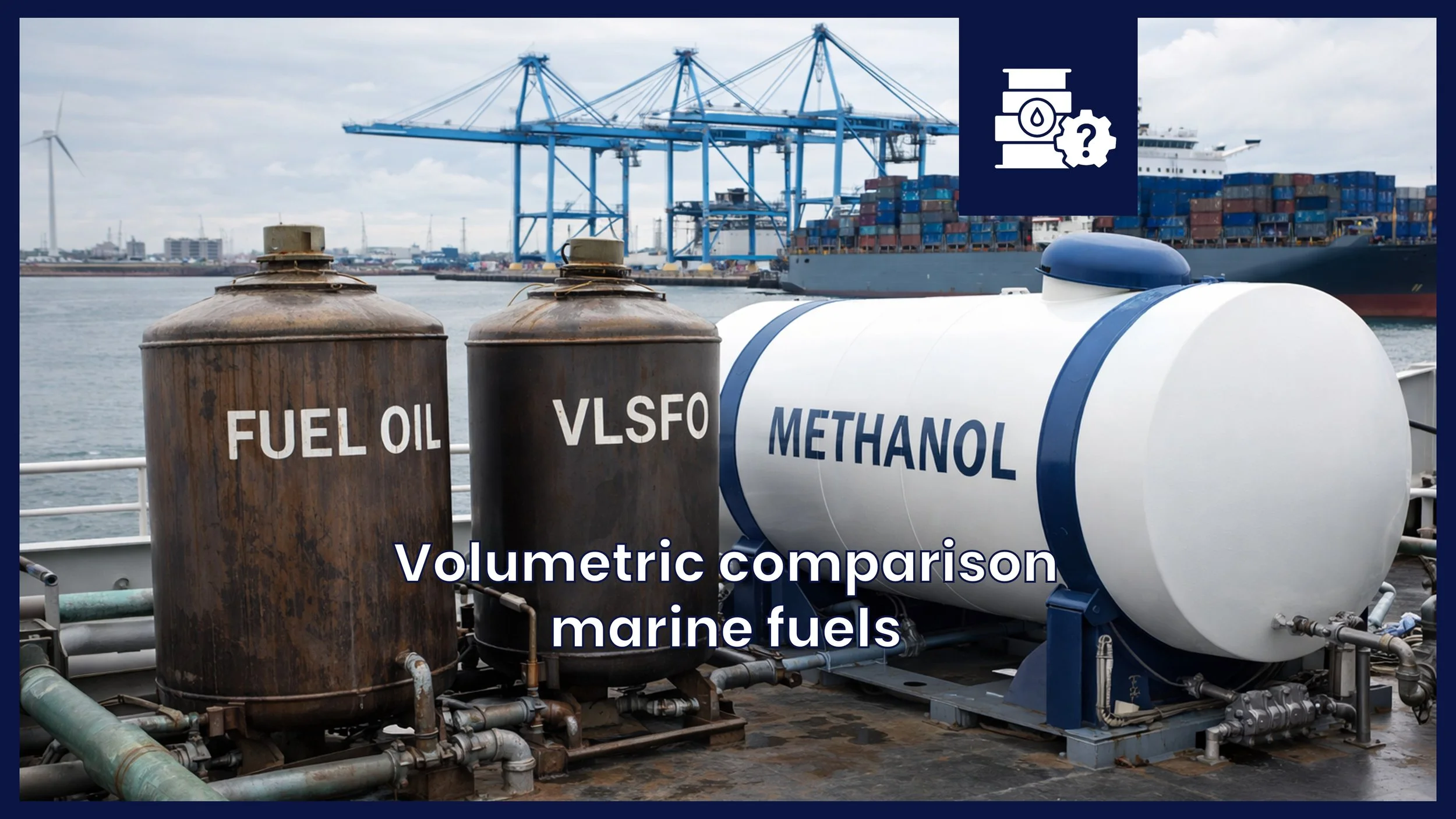
Volumetric comparison marine fuels
Why methanol makes sense from a shipowner perspective
When evaluating alternative marine fuels, discussions often focus on emissions, regulations, or fuel price. But for shipowners and naval architects, a much simpler constraint often dominates the decision: Tank space.
This blog highlights the key reasons why methanol is an attractive alternative for some, and not for others. This is not intended to be a sales-pitch for methanol - on the contrary. It is merely a comparison of different alternative marine fuels from a technical, shipowner’s perspective. When this comparison is made, the logic as to why many shipowners (Maersk, Van Oord) choose methanol becomes clear: the same amount of energy only requires a small amount of volume when it is in HFO, whilst liquid ammonia and hydrogen require pressurized tanks with a high degree of insulation.
The key takeaway is simple: energy density of fuels varies enormously once translated into tank volume. From this perspective, methanol currently occupies a unique position: it is far from perfect, but it strikes a practical balance between energy density, storage complexity, and regulatory compliance.
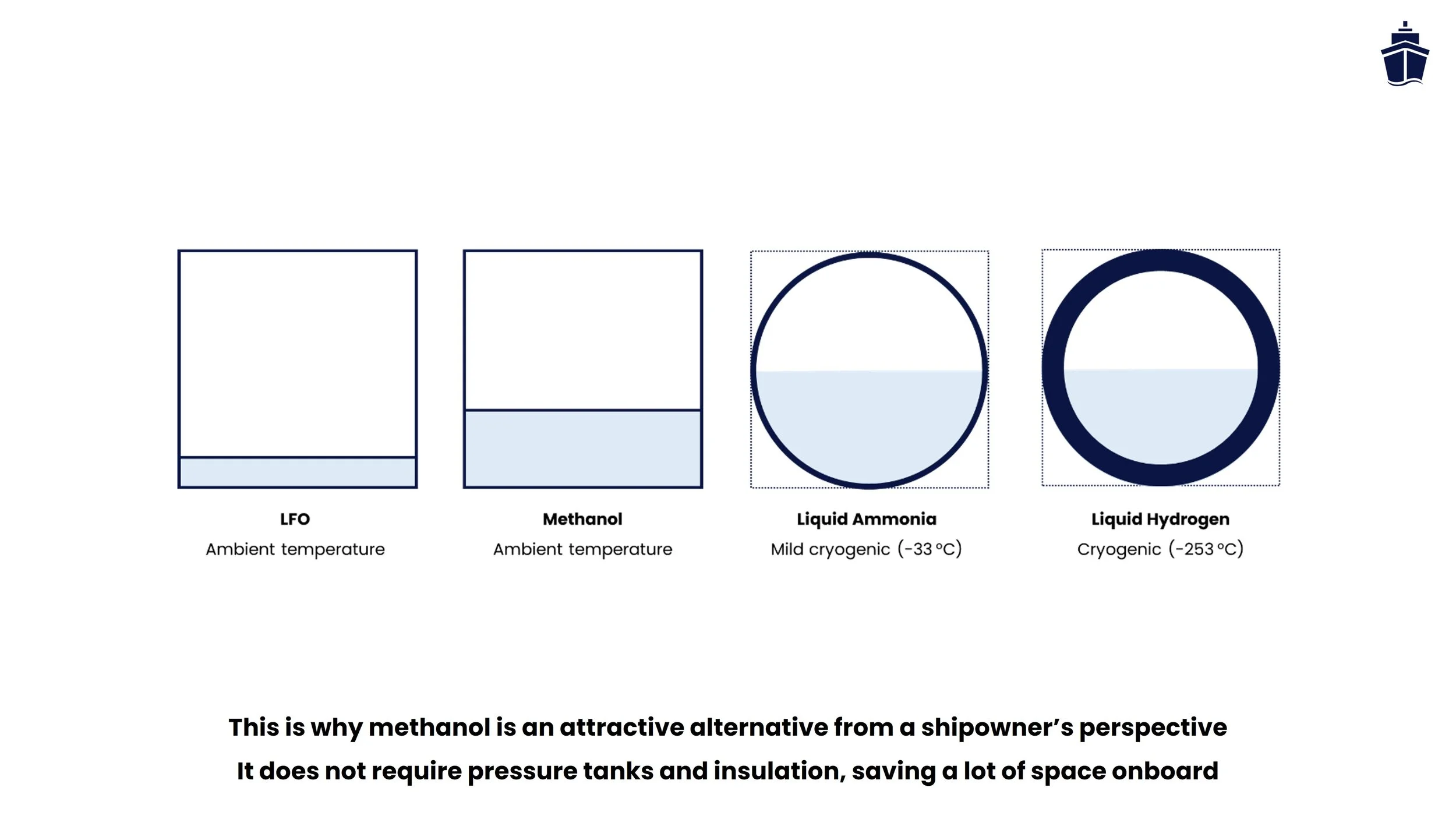
Methanol Is the volumetric winner among the alternatives
Among the main low-carbon fuel options currently considered for shipping, i.e. methanol, ammonia and hydrogen, methanol performs best when comparing required tank volume. Methanol requires roughly 2–2.5 times the tank volume of VLSFO to deliver the same amount of energy. While this is a substantial penalty, it is still far better than other alternatives:
LNG requires roughly 1.8× the volume of diesel, depending on tank design and insulation.
Liquid ammonia requires roughly 3× the tank volume.
Liquid hydrogen requires 4–5× the volume, even before accounting for insulation and operational margins.
This volumetric advantage is one of the main reasons why methanol has gained significant traction for newbuilds, particularly for container vessels and other deep-sea ships where cargo space remains critical and ships need to operate for weeks. Importantly, methanol also benefits from ambient liquid storage, avoiding the complex cryogenic storage systems required for LNG or hydrogen.
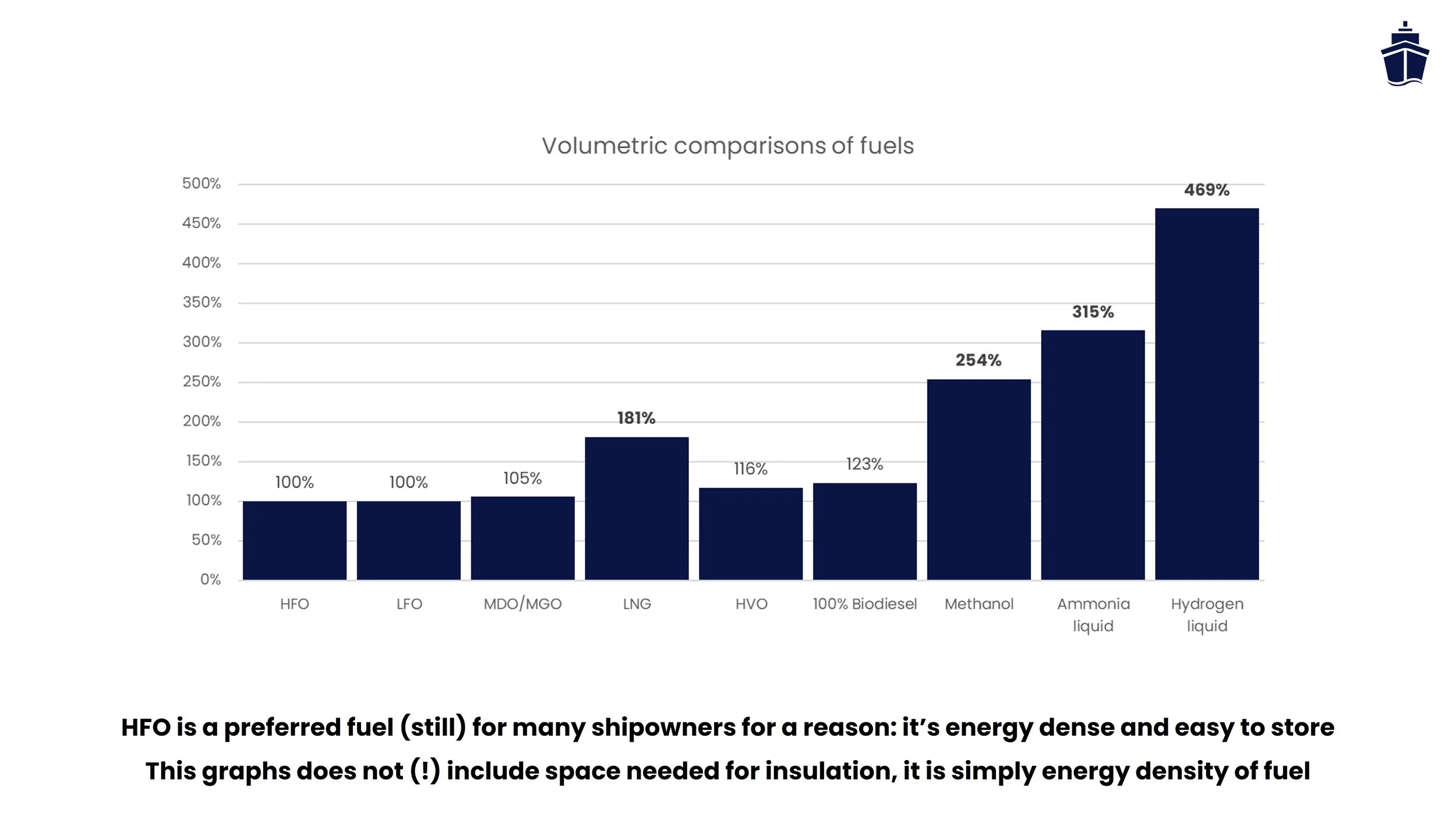
HFO is technically an excellent marine fuel…
Heavy Fuel Oil (HFO) sits at the top of the shipowner’s chart for a reason. It is:
Very energy dense
Easy to store
Extremely cheap
The famous phrase “bottom of the barrel” originates from exactly this phenomenon. HFO is the residual fraction left after refining higher-value petroleum products. Historically, it was both abundant and difficult to use in other industries, leaving shipping as the primary consumer. From a purely technical and operational standpoint, HFO was almost the perfect marine fuel. Ships could carry large amounts of energy in relatively small tanks, with minimal complexity in storage systems. Unfortunately, its high sulfur and carbon content also make it one of the most environmentally problematic fuels, which is why the industry is now searching for alternatives.
Tank volume becomes a hard constraint for many ships
For vessels that are volumetrically constrained, fuel choice becomes limited very quickly. Examples include:
Smaller ships with limited tank space
Long-distance vessels with high endurance requirements
Ships where cargo space is directly linked to revenue
Once tank size and insulation penalties are taken into account, several alternative fuels become difficult to implement:
Liquid hydrogen and ammonia require very large tanks and complex storage systems.
LNG may work, but tank geometry and insulation requirements can significantly reduce usable space onboard.
Methanol often becomes a practical alternative fuel outside of biofuels.
There are exceptions to these heuristics, of course. Companies such as CMB Tech have successfully deployed hydrogen vessels for niche applications. However, these projects typically rely on dedicated infrastructure, strong financial backing, and specialized expertise. For most shipowners, these conditions are not easily replicated. As a result, the physical constraints of ship design continue to play a major role in determining which fuels are realistically deployable.
-
This analysis is part of the Sustainable Ships Fuel Properties & Cost Guide, where we compare marine fuels based on:
Energy density
Storage requirements
Retrofit complexity
CAPEX and OPEX impacts
Regulatory compliance considerations
If you're working on fuel selection, newbuild design, or retrofit strategy, the guide may be useful.
Premium tools and expert support at your fingertips

The Fuel Properties and Cost Guide is a technical reference and strategic planning tool for evaluating marine fuels under today’s evolving regulatory landscape. Aligned with FuelEU Maritime, EU ETS, and the IMO Net-Zero Strategy, it benchmarks 22 fuels from HFO and MGO to e-methanol and bio-LNG on properties such as LCV, GHG intensity, flash point, CH₄/N₂O emissions, and VLSFO-equivalent cost.
Use Credit card, Stripe, PayPal or Apple Pay (only on iPhone). Contact the helpdesk for payment by invoice.
Don’t want to sign up? Check pay-per-use options
You might also like












Choosing a marine fuel is no longer about price per metric ton, it is about total regulatory exposure. This masterclass covers 22 marine fuels across three groups and six families, how EU ETS, FuelEU Maritime and IMO Net-Zero each calculate costs differently, and why 2035 is the tipping point that should drive your decision.