
Shore Power (OPS) price per kWh in EU
Analysis on the pricing structure of shore power across the EU, main drivers and different models
AFIR and FuelEU Maritime make the use of onshore power supply (OPS) effectively mandatory from 2030 onwards at key ports, but they say virtually nothing about what OPS should cost or how it should be priced. Pricing is therefore left to ports, utilities, and national grid and tax frameworks. The result is a patchwork of tariff designs and cost recovery approaches, with limited standardisation and varying levels of transparency, making like-for-like comparisons difficult for shipowners and operators. This blog aims to provide at least some guidance on the matter.
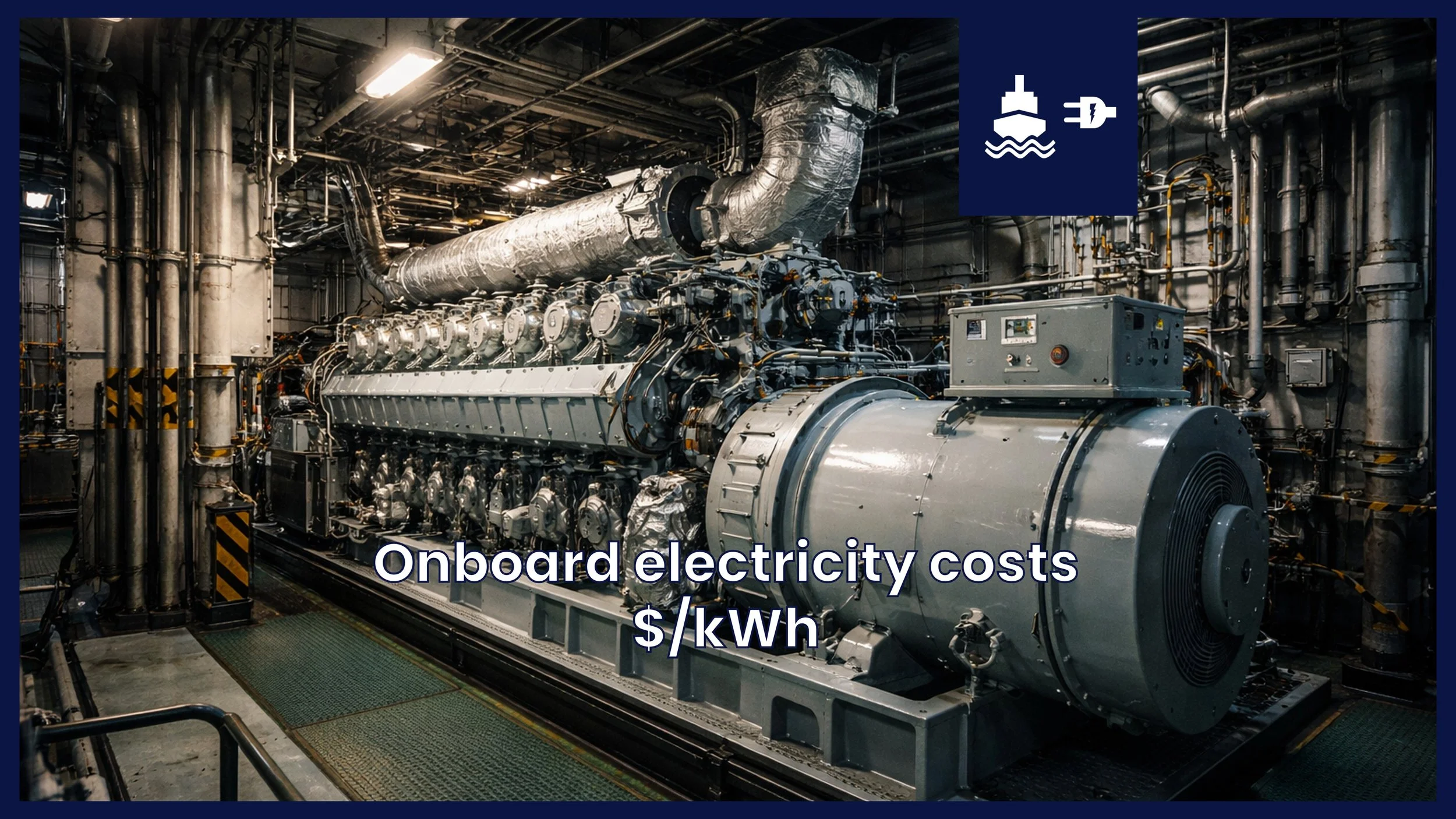
To start with a shipowner perspective, a practical “reasonableness” benchmark is the alternative: generating electricity onboard with auxiliary engines while at berth. On a fuel-only basis that implies a break-even around €0.15/kWh, but this benchmark rises sharply once regulatory and maintenance costs are included, trending toward ~ €0.80/kWh by 2030 in our scenario. Even with a clear break-even price, comparisons on price per kWh are difficult because of different pricing models used. Across the EU, publicly available HVSC tariffs broadly fall into three models: (1) €/kWh only, (2) fixed fees + €/kWh, and (3) time/access fees + €/kWh. Observed prices for key ports cluster around ~ €0.25/kWh, which is very roughly comparable to “country electricity cost + ~ €0.10/kWh” once grid charges, service layers, and infrastructure recovery are embedded.
Sign up to become a member and download the latest versions of the tool and databases used for this analysis.
AFIR and FuelEU Maritime mandate the use of shore power …
Shore power (also called OPS, also called ‘cold ironing’) is moving from “nice-to-have” to “default requirement” in Europe. Two EU regulations drive this shift: AFIR (infrastructure deployment shore-side) and FuelEU Maritime (operational use ship-side). Together they create a system where ports must build the plug, and ship operators are increasingly expected to use it. In practice, this is most relevant for seagoing container ships and passenger ships above 5,000 GT calling at TEN-T ports, because these segments drive the largest share of emissions at berth.
AFIR sets the infrastructure baseline: Member States must ensure OPS is deployed in TEN-T core and comprehensive ports where traffic thresholds justify it. FuelEU Maritime then adds the operational pressure: for the same ship categories, it requires the use of zero-emission technology while at berth in TEN-T ports. In plain language: once OPS exists, connecting becomes the expected compliance path.
These regulations will ensure that the use of shore power might become mandatory, but the pricing of electricity is left to market forces and Member State discretion.
-
Under AFIR, Member States are required to ensure the deployment of OPS infrastructure in TEN-T core and comprehensive maritime ports, as well as in TEN-T inland waterway ports, subject to traffic-based thresholds. Mandatory deployment focuses primarily on seagoing container ships and seagoing passenger ships above 5,000 GT, which are identified as the vessel categories producing the highest emissions while at berth. The regulation obliges ports to make ‘sufficient shore-side electricity supply available’ in order to enable compliance with emission reduction requirements applicable to ships at berth. AFIR therefore establishes a clear infrastructure mandate, ensuring that OPS is physically available where justified by traffic volumes and operational relevance.
-
FuelEU Maritime complements this infrastructure obligation by imposing use-related requirements on ship operators. For certain ship categories, notably container ships and passenger ships, FuelEU Maritime requires the use of a zero-emission technology while moored at berth in TEN-T ports. In practice, compliance with these requirements is expected to be achieved primarily through the use of OPS, where available. As a result, while FuelEU Maritime does not explicitly mandate OPS use in all circumstances, it creates a de facto obligation for ship operators to connect to shore-side electricity once such infrastructure has been deployed under AFIR.
… but AFIR and FuelEU do not determine the price of shore power
In essence, AFIR and FuelEU Maritime do not regulate the price of shore power: they just tell ports and shipowners what must happen operationally. “What you must pay”, or how for that matter, is left to Member States, port authorities, electricity suppliers, and national frameworks. That creates a mismatch: ships may have to connect, but the EU does not provide a harmonised rulebook to keep OPS prices predictable or comparable across ports.
This is especially notable because AFIR does contain detailed price-transparency and consumer-protection rules for EV charging onshore (clear prices before charging, ad-hoc payment options, non-discriminatory access). Comparable provisions are absent for OPS: there are no EU-wide principles on acceptable tariff structures, caps, or cost-based pricing for electricity supplied to ships at berth.
The result is a kind of regulatory asymmetry. OPS is being rolled out as climate-critical infrastructure, and ship operators are pushed toward using it, yet pricing can vary widely depending on national grid charges, taxes, port cost recovery logic, and whether the service is offered as a published tariff or a negotiated contract. That leads directly to the core question this blog tries to answer: what would be a “reasonable” OPS price for shipowners and what are shipowners actually paying today?
Reasonable price for shipowner → break-even point per kWh
If OPS use is becoming mandatory, the next question is obvious: what is a “reasonable” price? In other words, when is it as attractive for a shipowner to use electricity as to burn fuel? Rather than trying to define a universal OPS price (this is non-sensical because it differs for every ship and voyage) a more practical benchmark is to look at the shipowner’s only alternative: generating electricity onboard with auxiliary engines while at berth. This gives a concrete “break-even” reference in €/MWh, against which OPS price per MWh can be evaluated.
To build that benchmark, we modelled a representative reference vessel operating in the ARA region (Amsterdam - Rotterdam - Antwerp) running auxiliary engines on marine diesel oil (MDO) while at berth. Fuel is converted into electricity cost using standard parameters such as engine load, specific fuel consumption (SFC ~240 gram / kWh) and lower calorific value (LCV as per FuelEU), resulting in a comparable cost per MWh of electrical output.
The key insight is that fuel-only onboard power is a misleading benchmark. Once you add the regulatory and operational layers that shipowners will face over time (IMO Net-Zero, FuelEU Maritime, EU ETS) as well as auxiliary engine maintenance, the effective cost of onboard generation rises sharply. In other words, what looks like “cheap electricity generated onboard” becomes substantially more expensive once the full compliance and operating cost stack is internalised. This trajectory can then be used as the decision line: OPS below that level improves the shipowner’s cost position; OPS above it risks deterring uptake, even in a world where regulatory pressure is pushing vessels to connect.
-
Ship operating in ARA region using marine diesel oil (MDO) for auxiliary engines.
Electricity generation converted from fuel consumption using reasonable engine load, SFC, and fossil LCV values as per FuelEU.
Fuel price escalation: 0% indexation.
A constant USD/EUR exchange rate of 1.15 is assumed for the modelling period.
EU ETS applied to emissions at berth only, with 7% annual indexation of EUA.
FuelEU Maritime costs calculated on full-year Well-to-Wake GHG intensity.
IMO Net-Zero costs assumed stacked on top of FuelEU (no harmonisation).
Auxiliary engine maintenance costs included in €/MWh calculation.
Retrofit CAPEX excluded from analysis.
OPS prices models in EU → how price is structured
Even with a clear break-even benchmark, OPS pricing in Europe is difficult to compare because most ports do not “sell electricity” in the simple retail sense. What the shipowner pays is usually composed of several elements, including electricity procurement (spot/contract), regulated grid charges (often including capacity or demand elements), taxes/levies, and then a port/operator layer to recover infrastructure costs and cover operations (booking, supervision, switching, billing). Some ports publish this transparently as a tariff product, others embed it in broader port charges, and in some cases the effective price is driven by contract terms rather than a public schedule. In practice, this produces a handful of recurring pricing models:
The first is a pass-through model, where electricity is charged at (or close to) market cost and the port primarily recovers costs via fixed fees or general port charges.
The second is a combination of fixed fees (per call, per connection, subscription/capacity reservation) plus a €/kWh component, sometimes with seasonal or time-of-use differentiation.
The third is a service/contract model, where OPS is delivered as a managed service and the commercial terms are partially negotiated, making public benchmarking harder even when the underlying cost stack is similar.
That is why a “single OPS price per kWh” is often misleading. A port can look expensive on €/kWh but cheap once fixed charges and utilisation are considered, or vice-versa. As long as the regulations do not mandate standardization or harmonization, price models and prices themselves will remain opaque. That does not mean we cannot venture a guess nor a comparison.
OPS prices per kWh in selection of EU Ports
This chart highlights that the key difference across EU OPS offerings is often the pricing model, not just the headline €/kWh. Even within HVSC-only examples (High Voltage Shore Connection systems), there is wide dispersion in observable €/kWh values, driven not only by national electricity fundamentals but also by differences in grid tariff structures, fiscal treatment (including cases where Member States apply reduced electricity taxation for shore-side supply), and how ports choose to recover infrastructure costs under uncertain utilisation.
The figure therefore distinguishes between ports that present OPS as a pure volumetric price (€/kWh only) and those that combine a €/kWh charge with fixed fees per call or over time. For benchmarking and “reasonableness” checks, the defensible approach is to compare ports on (1) price model and transparency (what is fixed, what is variable, what is pass-through), (2) evidence quality (published tariffs vs secondary reporting vs negotiated), and (3) expected utilisation and load profiles, rather than relying on a single €/kWh figure. Nonetheless these numbers - subject to change! - provide some indication of what a shipowner can currently expect for major ports in the EU.
Sign up for premium tools and benefits

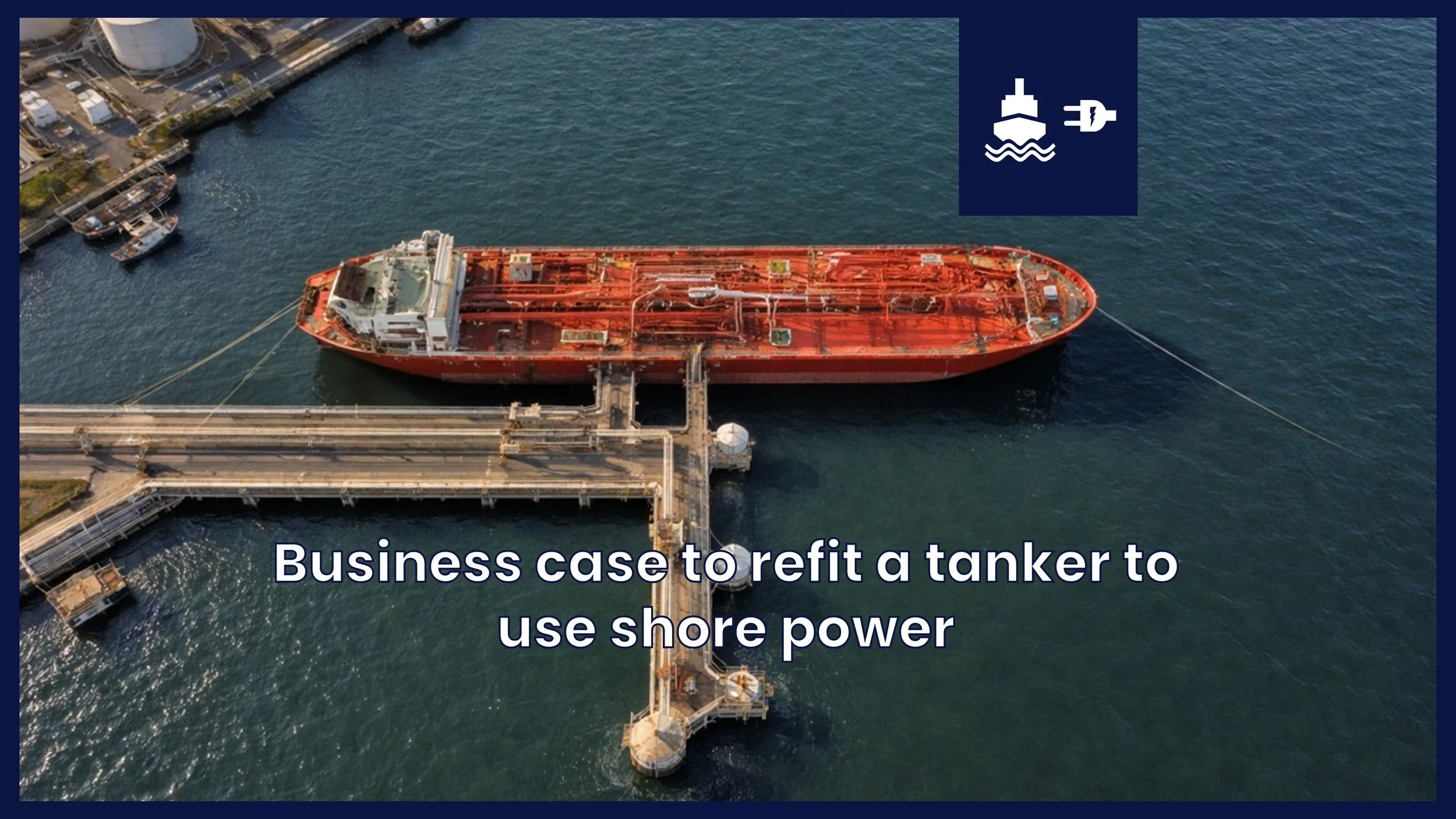
The Shore Power Quickscan is a comprehensive tool designed to provide a business case for a shore power refit onboard vessels, based on IEC/IEEE 80005. It includes CAPEX estimates, operational expenses including fuel costs and engine maintenance, emissions savings as well as key regulations such as FuelEU and EU ETS. This purchase allows you to store your calculations, work offline anywhere, plus print a comprehensive techno-economic feasibility that you can show off to friends or your management.
Use Apple Pay to purchase the Excel (only on iPhone) - contact helpdesk for payment by invoice
Don’t want to sign up? Check pay-per-use options
References
Sustainable Ships - Shore Power Quickscan
Sustainable Ships - OPS Connections and Pricing Database
Sustainable Ships - Average Shore Power Demand Database
Sustainable Ships - Shore Power Demand 2030+
Sustainable Ships - FuelEU Maritime
You might also like













How much power does a ship actually draw at berth? The same vessel can vary by 300%, sister ships doing exactly the same can differ by 30%, and Tankers of the same size can differ tenfold in installed capacity. This masterclass explains the methodology we use to estimate average shore power demand per ship category, using GT-based scaling functions and calibrated load factors built on 7,102 ships and 153 measured datasets.