
Shore Power (OPS) Connections and Prices Masterclass
How shore power connections are defined, how EU ports price them, and when plugging in beats burning fuel
AFIR and FuelEU Maritime make the use of onshore power supply (OPS) effectively mandatory at key EU ports from 2030, but neither regulation says anything about what shore power should cost or how it should be priced. There is a technical framework, there is a regulatory framework, but there is no pricing framework. For anyone developing a shore power project, that missing piece is the whole business case.
This masterclass covers three things. First, what shore power actually is, the terminology used across the industry, and the methodology we at Sustainable Ships use to define a single OPS connection and the layers of infrastructure at terminal, port and national level. Second, the pricing: which pricing models are observed across EU ports, what ships currently pay per kWh, and how that compares to the cost of generating electricity onboard once maintenance, EU ETS and FuelEU are included. Third, how to use the interactive database and break-even tool to get a number for your own project.
This masterclass is intended primarily for developers of shore power projects, port authorities and terminal operators, but also for shipowners who want to understand the pricing models they are being quoted and when connecting is cheaper than burning fuel.
Sign up to become a member and download the latest version of the guide, database and tools used in this masterclass.
(1) Shore power, OPS, cold ironing: same thing, different names
Shore power is simply bringing grid electricity from the shore to the ship, so the vessel can shut down its auxiliary generators while moored. The industry uses several names for it: onshore power supply (OPS), shore power, and cold ironing. Regulatory frameworks tend to use OPS, so that is the term used in AFIR and FuelEU Maritime.
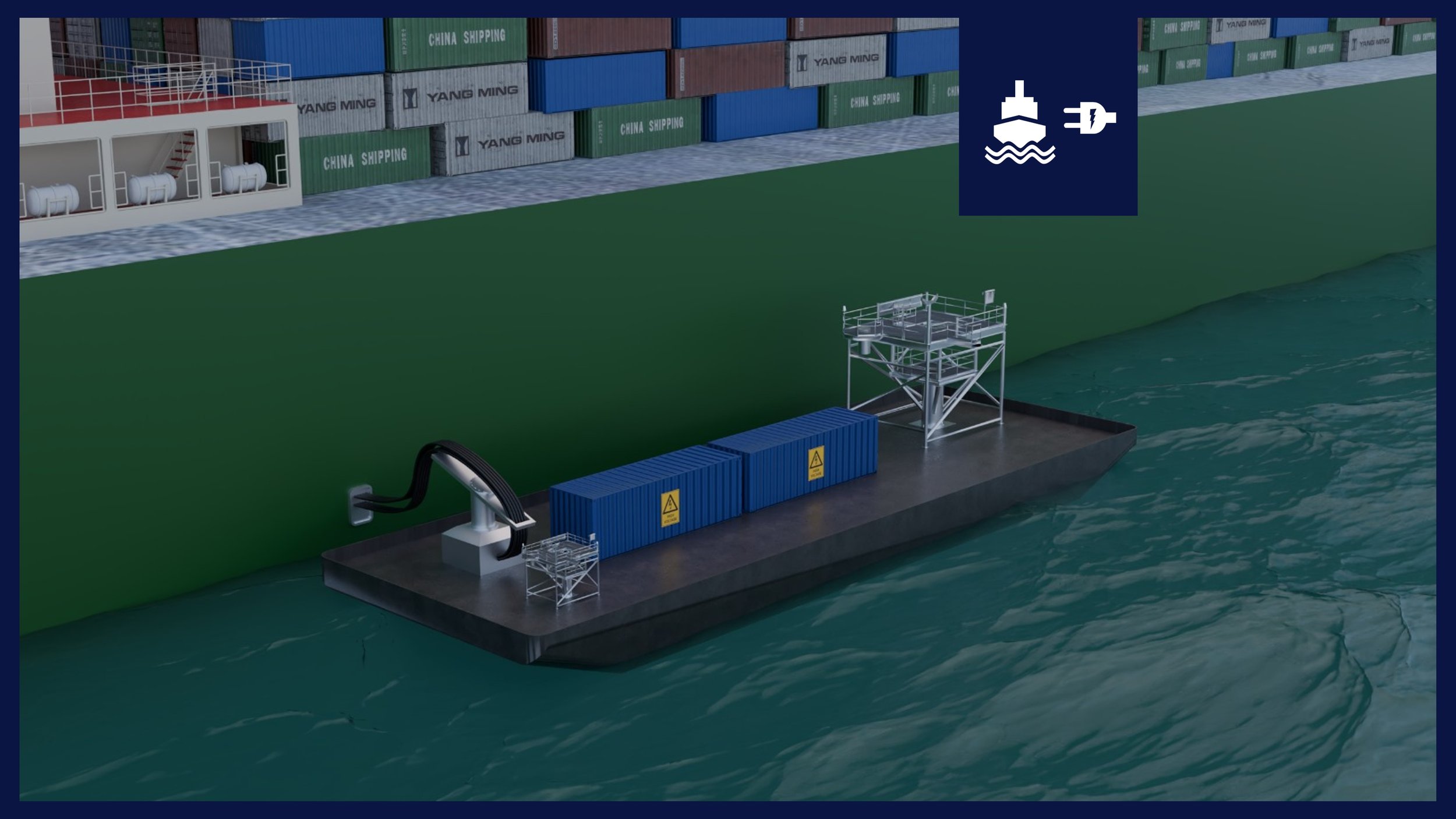
The scale varies enormously. At one end, a small inland waterway vessel powered from a quayside pit, sometimes supported by a battery rather than a grid connection. At the other, the Heerema installation at the Calandkanaal in Rotterdam, where each module is a transformer capable of delivering up to 5 MW, and where two offshore construction vessels can be connected simultaneously. Cruise ships need more still. In every case the principle is the same: plug the ship into the grid so the engines can be switched off, cutting CO2, particulate matter, sulphur and nitrogen oxides, and noise.
That local pollution point is worth dwelling on. Greenhouse gases from shipping are roughly 3% of the global total, but at berth in a port city the more immediate problem is what people are breathing. In Rotterdam terms, ambient particulate exposure translates into the rough equivalent of several cigarettes a day for residents, and ships at the quayside are part of that.
(2) Shore side, ship side: how power actually reaches the vessel
Every technical and regulatory framework splits the system into a shore side and a ship side, with the cable management system in between. A practical rule: whatever stays on the quay is the shore side, whatever floats away with the vessel is the ship side. Container ships are the exception, because their cable management system sits onboard. Working from the grid to the ship, the chain is:
Grid. In the EU at 50 Hz. Most ships run at 60 Hz, which is where the first complication starts.
Substation (DSO). The local distribution system operator's connection, typically medium voltage onshore. This is where responsibility transfers from the grid operator to the terminal.
E-house. Also called a substation or, loosely, a busbar. Terminal-side equipment, almost always including a transformer, usually a frequency converter for the 50 to 60 Hz step, and the power management system that handles switching, protection and interlocks. Sometimes two transformers are needed for a step-up and step-down arrangement.
Cable management system (CMS). The crane, reel or davit that gets the cable to the vessel. For most ship types this sits on the quay, often feeding from a pit in the quayside. For container ships it is onboard.
Connection panel. Onboard, where the plug lands. Needs to be a secure enclosure because of the high voltage risk.
Ship transformer. Where the incoming voltage differs from the onboard voltage, which is frequently the case.
Main switchboard. Also called the busbar. This is where electricity is distributed around the vessel, and therefore the point that has to be fed for the ship to operate normally.
Auxiliary engines. The generators that shore power replaces.
The changeover itself happens one of two ways. Either the auxiliary engines are synchronised with the shore supply and load is transferred gradually, or the engines are simply shut down, the ship goes through a short blackout, the plug goes in and the switches come back on.
(3) HVSC or LVSC: the 1 MVA split
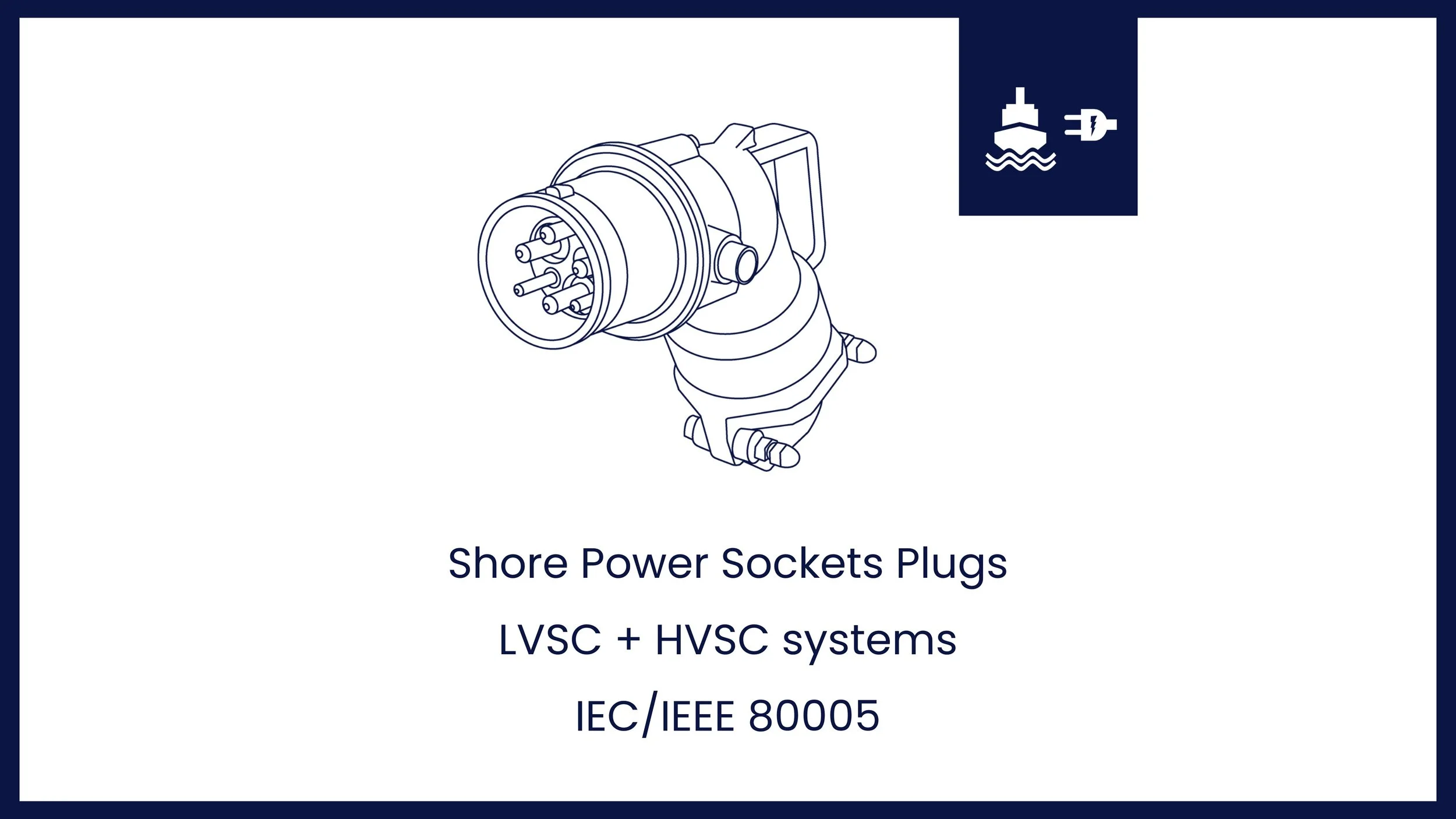
The governing standard is IEC/IEEE 80005. It separates shore power into two systems:
HVSC, high voltage shore connection (80005-1). Typically 6.6 kV and 11 kV, at both 50 and 60 Hz, for larger ships. The standard notes that high voltage systems are expected to be the practical application for ships requiring 1 MVA or more, or ships with a high voltage main supply.
LVSC, low voltage shore connection (80005-3). Typically 400 V, 440 V and 690 V, again at 50 and 60 Hz, for smaller vessels.
Note that 1 MVA is not the same as 1 MW: available real power is always lower than apparent power. The practical consequence is that higher voltage means lower current and therefore thinner, more manageable cables, which is why most larger ports now default to 11 kV connections even for relatively modest ships from a few hundred kilowatts upwards.
Our analysis focuses primarily on HVSC. Low voltage systems are technically easier and cheaper, less exposed to the regulations, and priced differently, which makes them hard to compare on a like-for-like basis.
On plugs and sockets. Some ship types have defined plug and socket geometries in the standards, and some do not. Container ships and tankers are the best covered on the high voltage side; for low voltage only a handful of ship types have defined arrangements. If your ship type is not in the standard, the route forward is a discussion with your class society or verifier. In practice this is rarely a technical showstopper, it is a cost and interoperability problem: sockets and plugs can be changed, but doing so costs money, and arriving at a terminal with a different arrangement is exactly what you want to avoid.
(4) Why OPS becomes important now: AFIR and FuelEU
Shore power is not new. Naval vessels and others looking to cut engine hours have used it in the Netherlands for something like 60 or 70 years. What has changed is regulation.
From 2030 onwards across the EU, container ships and passenger ships have to be electrified at berth under FuelEU Maritime, and AFIR requires that a high share of relevant port calls at TEN-T ports can be served with shore power. FuelEU points at the shipowner; AFIR points at the port authority. Outside the EU, California's at-berth rules for ocean-going vessels are the other main driver, and China has been moving on electrification as well.
What none of these frameworks do is set a price. The technical framework exists, the regulatory framework exists, but pricing is left entirely to ports, terminal operators, utilities and national tax and grid regimes. That is the gap this database and masterclass exist to fill.
(5) What counts as one OPS connection?
Answering this question is harder than it looks. A cruise ship might take four plugs at once. Is that four connections or one? An installation might be able to serve two vessels at the same time. Does that count as a single connection, or two?
Our definition starts at what we call the atomic unit: one OPS connection is defined as one ship connected. It can be one plug, four plugs or four hundred plugs. If it serves a single vessel, it is one connection point. Everything in the database is built up from that definition. Above it sit five layers:
Connection point. A single physical OPS connection serving one ship.
Substation or e-house. The electrical installation feeding one or more connection points. This sets the maximum power and maximum number of ships that can be served, and there can be limits: an installation rated at 5 MW might deliver 3 MW to one vessel and 3 MW to another individually, but cap at 2.5 MW each when both are connected.
Site. The terminal, zone or quay cluster where the infrastructure stands, and where there is a single owner. This is the layer where pricing lives, because this is the entity the ship pays.
Port. All connections under one port authority.
Country. National roll-up.
The one thing worth remembering from all of that: prices sit at layer 3, the site, because that is where the transaction between the ship and the supplier happens.
(6) Three pricing models
Every port and terminal does it slightly differently, and no two are truly identical. But reduced to their structure, publicly available tariffs fall into three models:
Structure 1: purely volumetric, €/kWh only. You pay per kilowatt hour, as you do at home. All infrastructure, financing and operating costs are embedded in the rate. Most common at low voltage installations, where costs are lower. Simple and transparent at first glance, but infrastructure recovery is hidden inside the rate.
Structure 2: fixed fee per call plus €/kWh. A per-call, connection or startup fee on top of the volumetric charge. Widely used in Scandinavia. The fixed component can vary in interesting ways: some ports charge more for a first-time call because more work is involved in establishing the connection, and Marseille varies both the fixed fee and the kWh price between winter and summer because of local grid conditions.
Structure 3: long-term contract, fixed fee per year plus €/kWh. Effectively a lease, with electricity charged on top. Least common in publicly available information, because long-term commitments are difficult for owners doing tramp trades. It works well for vessels that always return to the same berth: offshore support vessels, emergency towing vessels, tugs and port craft. It is also the structure that allows risk to be shared most deliberately between ship and shore.
In the publicly available data, the split between purely volumetric and fixed-fee-plus-volumetric is now roughly even, with long-term contracts a thin slice. That balance has been shifting toward fixed-fee-plus-volumetric as more information comes in.
(7) What ships currently pay
Across the sites where prices are disclosed, the average sits at roughly €0.24 per kWh. Two caveats, both important. First, that figure is a moving target: it has already risen with the latest data and it changes continuously as tariffs are updated and new sites are added. Second, an average across different pricing models is inherently rough, because a port that looks expensive on €/kWh can be cheaper overall once fixed fees and utilisation are accounted for, and vice versa.
A more robust way to read the market is against national electricity prices. Compare disclosed OPS tariffs with EU electricity costs for non-household consumers and a pattern appears: most ports take the prevailing national electricity price and add roughly €0.10 per kWh. The uplift observed ranges from about €0.06 to €0.19, with the Netherlands at the upper end. Since national electricity prices themselves range from under €0.10 per kWh in Finland to above €0.25 in Ireland, that rule of thumb explains most of the cross-border variation. Fiscal treatment and grid tariff structure drive the differences more than infrastructure cost does.
For a developer, that is the more useful benchmark: it tells you what you can reasonably ask, given what you pay for electricity.
(8) The other side of the trade: what electricity costs onboard
A shore power price only means something next to the alternative, which is running an auxiliary engine. Fuel goes in, the engine turns a generator, and the generator produces kilowatt hours.
On a fuel-only basis, generating electricity onboard has historically cost somewhere in the region of €0.15 to €0.20 per kWh, at the upper end currently because fuel prices are high. That is the number a shipowner has in mind when a developer offers them electricity at €0.40 per kWh, and it is the reason shore power business cases were so hard to make for so long.
Then the compliance layers stack on top:
Engine maintenance, spares and consumables. A modest addition for most ships, more significant for vessels with many or large auxiliary engines.
EU ETS. A carbon cost on the fuel burned at berth, expected to rise.
FuelEU Maritime. The largest single layer. Using shore power improves a vessel's GHG intensity for the whole year, not just for the hours at berth, so the benefit is larger than the at-berth fuel saving alone suggests. Modelling it properly means comparing the full-year compliance position with and without shore power rather than treating the berth in isolation.
IMO Net-Zero. Not in force, and if it arrives it would stack similarly.
Add those together and the effective cost of onboard generation approaches €0.50 to €0.60 per kWh, with further upside if ETS prices climb or the IMO framework lands. Against a shore power price around €0.24, the trade looks very different from the fuel-only comparison.
And then there is the penalty. Article 23(5) of FuelEU Maritime sets a specific charge for non-compliant port calls: €1.50 multiplied by the established total electrical power demand of the ship at berth, multiplied by the number of hours spent at berth in non-compliance, rounded up to the whole hour. For a vessel with 1,000 kW established demand, that is €1,500 per hour. Note that it is calculated on established peak demand rather than metered consumption, which makes it deliberately punitive. For a container ship or passenger ship obliged to connect, this turns the decision into a formality rather than a business case.
(9) Main conclusions
One OPS connection is one ship connected, regardless of how many physical plugs are involved. Everything else is built up from that definition.
Pricing lives at site level, layer 3 of the framework, because that is the entity the ship transacts with.
Three pricing models cover the EU market: volumetric only, fixed fee per call plus volumetric, and long-term contract plus volumetric. The split between the first two is now roughly even.
Average disclosed price is around €0.24 per kWh, but it moves constantly and an average across models is a blunt instrument.
A better benchmark is national electricity price plus roughly €0.10 per kWh, which explains most of the variation between countries.
Onboard generation costs €0.15 to €0.20 per kWh on fuel alone, but approaches €0.50 to €0.60 once EU ETS and FuelEU are included, which is what makes shore power competitive.
The FuelEU non-compliance penalty is €1.50 per kW of established demand per hour, which removes the choice entirely for obliged vessels.
HVSC and LVSC are different markets. The 1 MVA split in IEC/IEEE 80005 separates them technically, and they price differently enough that mixing them distorts any benchmark.
Sign up for premium tools and benefits
The Shore Power Quickscan is a comprehensive tool designed to provide a business case for a shore power refit onboard vessels, based on IEC/IEEE 80005. It includes CAPEX estimates, operational expenses including fuel costs and engine maintenance, emissions savings as well as key regulations such as FuelEU and EU ETS. This purchase allows you to store your calculations, work offline anywhere, plus print a comprehensive techno-economic feasibility that you can show off to friends or your management.
Use Apple Pay to purchase the Excel (only on iPhone) - contact helpdesk for payment by invoice
Don’t want to sign up? Check pay-per-use options
References
Sustainable Ships - OPS Connections and Prices Database
Sustainable Ships - Shore Power (OPS) price per kWh in EU
Sustainable Ships - What does it cost to generate electricity onboard a ship?
Sustainable Ships - Shore Power Quickscan
Sustainable Ships - Overview of Shore Power Sockets and Plugs, IEC/IEEE 80005
Sustainable Ships - FuelEU Maritime
Sustainable Ships - AFIR
EU - Regulation (EU) 2023/1805 FuelEU Maritime
IEC/IEEE 80005-1 and 80005-3 - shore connection systems
EMSA - overview of regulatory framework for shore power
You might also like
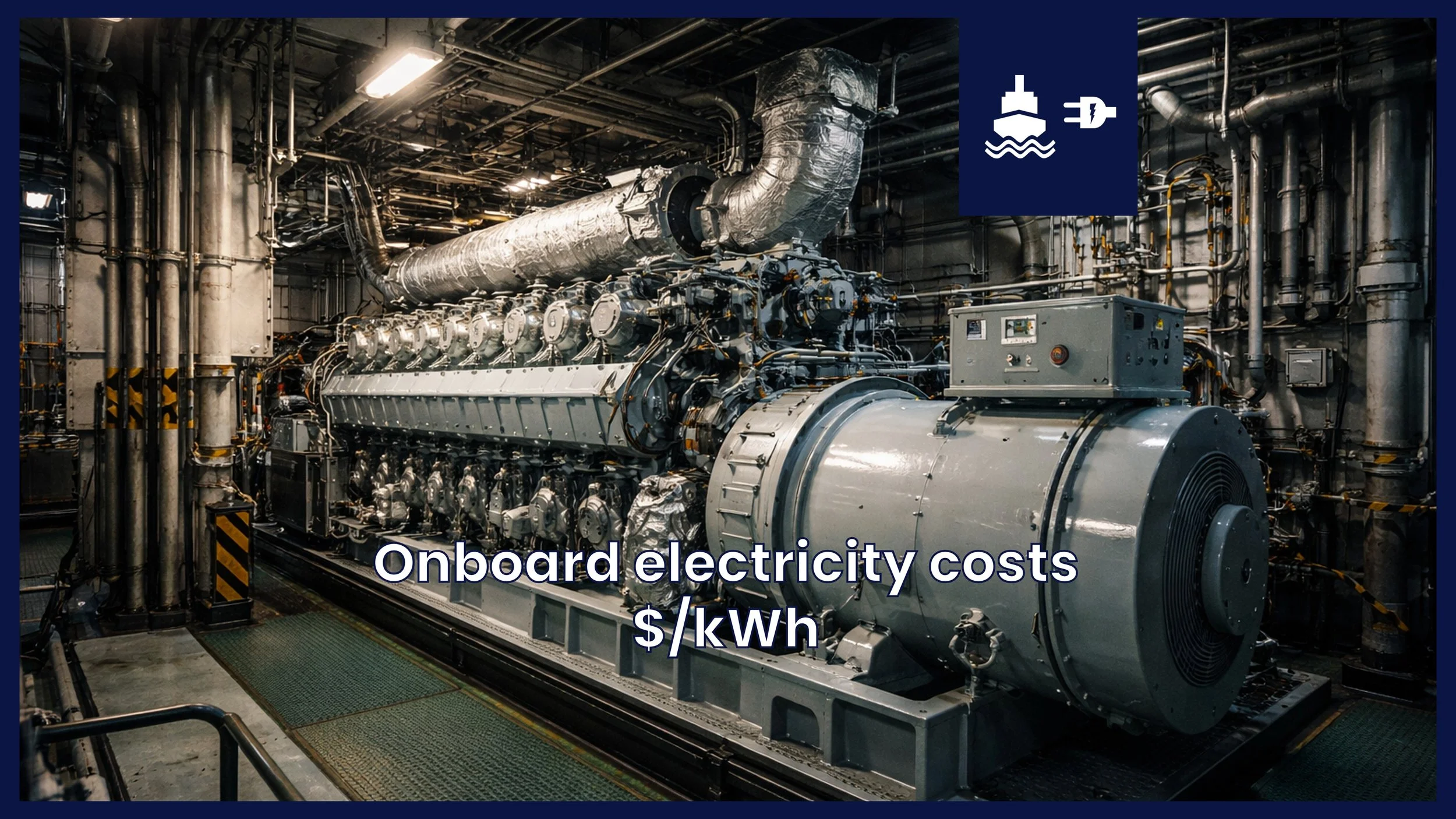
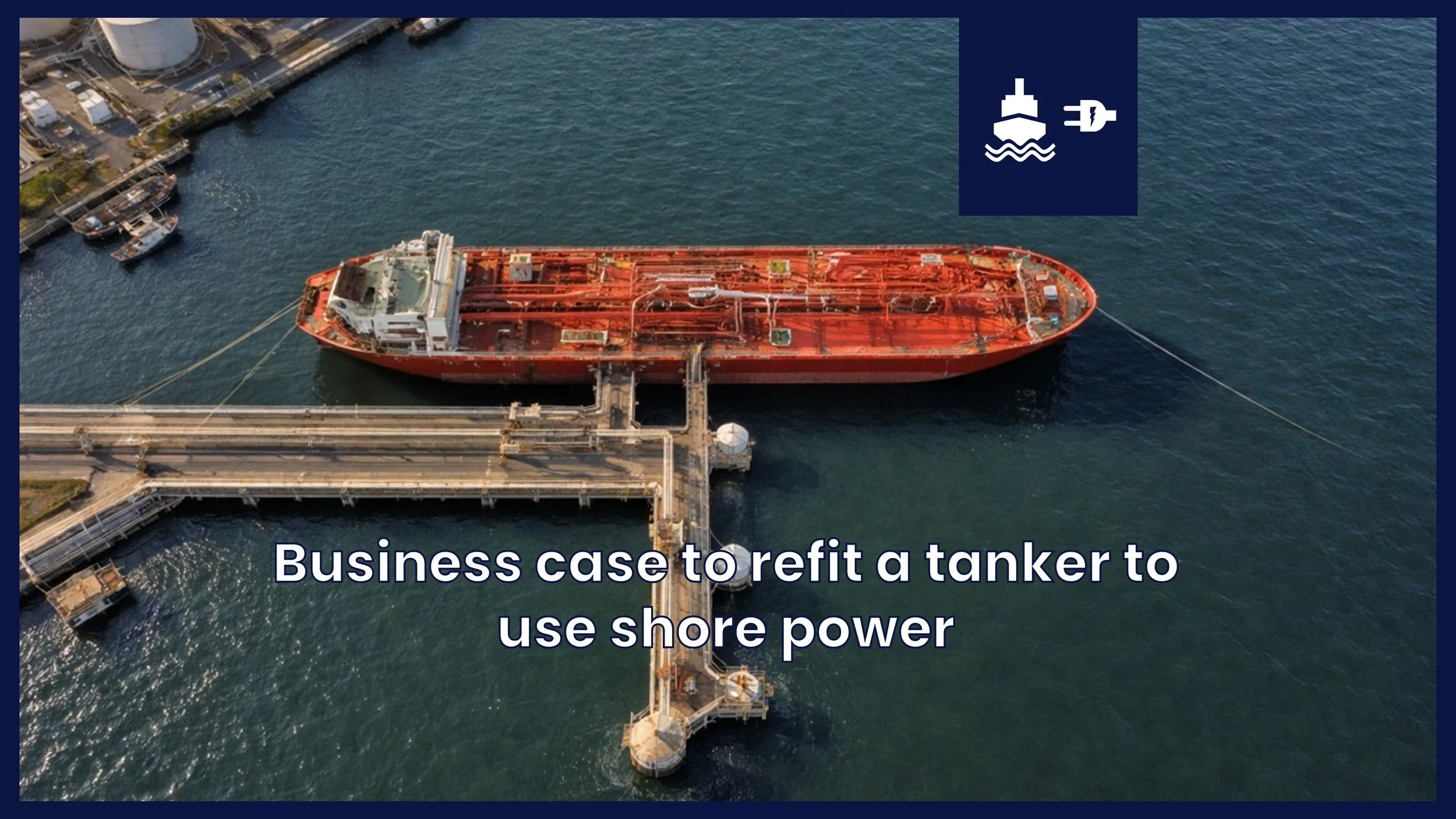












How much power does a ship actually draw at berth? The same vessel can vary by 300%, sister ships doing exactly the same can differ by 30%, and Tankers of the same size can differ tenfold in installed capacity. This masterclass explains the methodology we use to estimate average shore power demand per ship category, using GT-based scaling functions and calibrated load factors built on 7,102 ships and 153 measured datasets.