
Marine Fuel Properties and Costs Masterclass
A shipowner's guide to marine fuel properties, emissions, regulatory exposure and the costs that decide the answer
Ask what a marine fuel costs and the honest answer is that nobody can give you a single number. The fuel price is the easy part. What decides the answer is regulatory exposure: EU ETS, FuelEU Maritime and, if it arrives, the IMO Net-Zero Framework. Each of the three defines fuels differently, calculates emissions differently and prices them differently, and getting the wrong emission factor into a business case can cost millions.
This masterclass sets out the framework we built to deal with that. It covers 22 marine fuels grouped into three regulatory groups and six technical families, how the frameworks differ, what a fuel actually costs once compliance is stacked on top of the bunker price, and how to read the result. It took roughly a year to put together, because the original question, what will my fuel cost, turned out to be impossible to answer without first harmonising the properties, the emission factors and the regulatory treatment of every fuel.
The single most useful output is a date. Compliance costs for conventional fossil fuels rise gently until the mid 2030s and then climb steeply, to the point where by 2045 compliance can be several times the fuel price itself. That makes 2035 the tipping point, after which compliance costs outweigh fuel price significantly.
Sign up to become a member and download the latest version of the guide, databases and tools used in this masterclass.
(1) Why heavy fuel oil is used, and why it is so hard to replace
Crude oil is distilled into streams. The lightest fractions rise to the top, the heaviest sink to the bottom, and what remains at the very bottom is bitumen and heavy gas oil: the literal bottom of the barrel. It is difficult to sell, expensive to dispose of, and energy dense by volume. Ships can burn it. That combination, cheap and energy dense, is why heavy fuel oil became the default marine fuel and why it has been so durable.
It also explains the problem. Residual fuels carry sulphur, nitrogen and other contaminants, and the energy density that makes them attractive is exactly what alternative fuels struggle to match. Everything downstream in this discussion follows from those two facts.
The practical fuel landscape today is narrower than the marketing suggests. Four families cover the overwhelming majority of what ships actually burn: heavy fuel oil (including LFO and residual grades), marine gas oil and marine diesel oil (the distillates, typically for auxiliary and four-stroke engines), LNG, and biofuels, mostly biodiesel and HVO. Together these account for something in the order of 90% of marine fuel use.
(3) The (disagreeing) frameworks that define marine fuels
Four regulatory instruments determine what a fuel costs and how it may be used:
ISO 8217 sets the technical specification: grades, viscosity, flow properties and operational limits.
EU ETS is a carbon price. It works on absolute CO2 equivalent, tank to wake, within EU scope, through allowances: one allowance per tonne of CO2 equivalent emitted. It is the simplest of the three to calculate, being mass multiplied by an emission factor.
FuelEU Maritime works on greenhouse gas intensity in grams of CO2 equivalent per megajoule, well to wake, across the whole supply chain. It includes methane slip, engine type, electricity consumed and reward factors. If you are above the target you pay; if you are below it you generate a surplus. Targets tighten every five years.
IMO Net-Zero Framework is conceptually similar to FuelEU, well to wake with tiers, but is not yet enacted and its timing remains uncertain.
Behind all of them sits the Renewable Energy Directive, which certifies whether a fuel counts as a biofuel or an e-fuel at all.
The difficulty is that they do not agree with each other. They use different scopes, different calculation methods, different verification routes, and in places different lower calorific values and emission factors for the same fuel. EU ETS applies a zero CO2 factor to biofuels; FuelEU instead adjusts the certified E-value. The result is that the same physical bunker delivery can produce materially different numbers depending on which framework you are calculating under, which is precisely why a harmonised properties database was the necessary first step.
One further quirk worth knowing: with the exception of IMO, the frameworks lump the conventional fossil fuels together. The cleanest MGO and the dirtiest MGO are treated identically from a compliance perspective. Sulphur content still matters commercially and operationally, with ultra low below 0.10%, very low between 0.10% and 0.50% and high above 0.50%, the last requiring a scrubber in regulated waters, but it does not change the compliance calculation.
(3) Sustainable Ships Fuel Framework - 3 groups - 6 families - 22 fuels
The classification that came out of harmonising those frameworks is the backbone of everything else.
Three groups, which is how regulations, emissions and costs treat fuels:
Fossil
Biofuels
E-fuels, produced from renewable electricity and a feedstock. The EU calls these RFNBOs, renewable fuels of non-biological origin; the IMO calls them ZNZ, zero or near-zero fuels.
Six families, which is how engines and operations treat fuels: residuals, distillates, LNG, hydrogen, ammonia and methanol.
The distinction matters more than it first appears. Talk in groups when you are discussing regulation, emissions and cost. Talk in families when you are discussing engines, bunkering, tanks and safety. A fossil LNG, a bio-LNG and an e-LNG are the same fuel to the engine, provided the specification is met. What differs is the feedstock, the certification and therefore the compliance cost.
That has a genuinely useful commercial consequence. If you commit to methanol, ammonia, hydrogen or LNG today, you can move to the bio or e variant of that same family later without changing anything on the vessel. The engine does not care. You are buying optionality on the compliance side while keeping the hardware fixed.
To qualify as a biofuel or e-fuel under the Renewable Energy Directive, a fuel must achieve at least a 70% greenhouse gas reduction against a fixed reference of 94 gCO2e/MJ, which puts the qualifying ceiling at 28.2 gCO2e/MJ. That number governs a great deal of what follows.
(4) About methane slip
Methane slip is bad, but can be managed. LNG burns cleaner than residual fuel, but combustion is never complete. A small quantity of unburned methane passes through the chamber and escapes, through crevices, through valve overlap where intake and exhaust are briefly open together, and through wall quench where the chamber wall is cooler than the flame. Methane has a global warming potential many times that of CO2, so even small quantities are penalised heavily under well-to-wake frameworks. Default slip values are prescribed per engine type; demonstrating a lower figure requires evidence. It is manageable, and it is the main technical caveat on an otherwise strong LNG case.
(5) What a fuel actually costs
The formula is straightforward once the properties are harmonised:
Total cost = fuel price + EU ETS + FuelEU penalty − FuelEU surplus + IMO penalty
Two things make it comparable across fuels. First, everything is normalised to VLSFO equivalent, meaning cost per tonne of fuel adjusted so that every fuel delivers the same energy. Comparing a tonne of ammonia with a tonne of heavy fuel oil is meaningless; comparing equal energy is not. Second, the compliance components are calculable, even when the fuel price is not.
Because fuel price genuinely is not predictable. Prices were relatively stable for a long period, then spiked sharply following disruption around the Strait of Hormuz. Supply agreements vary. Nobody can tell you what your bunker will cost in 2034. What can be modelled, with reasonable confidence, is the regulatory layer stacked on top of it.
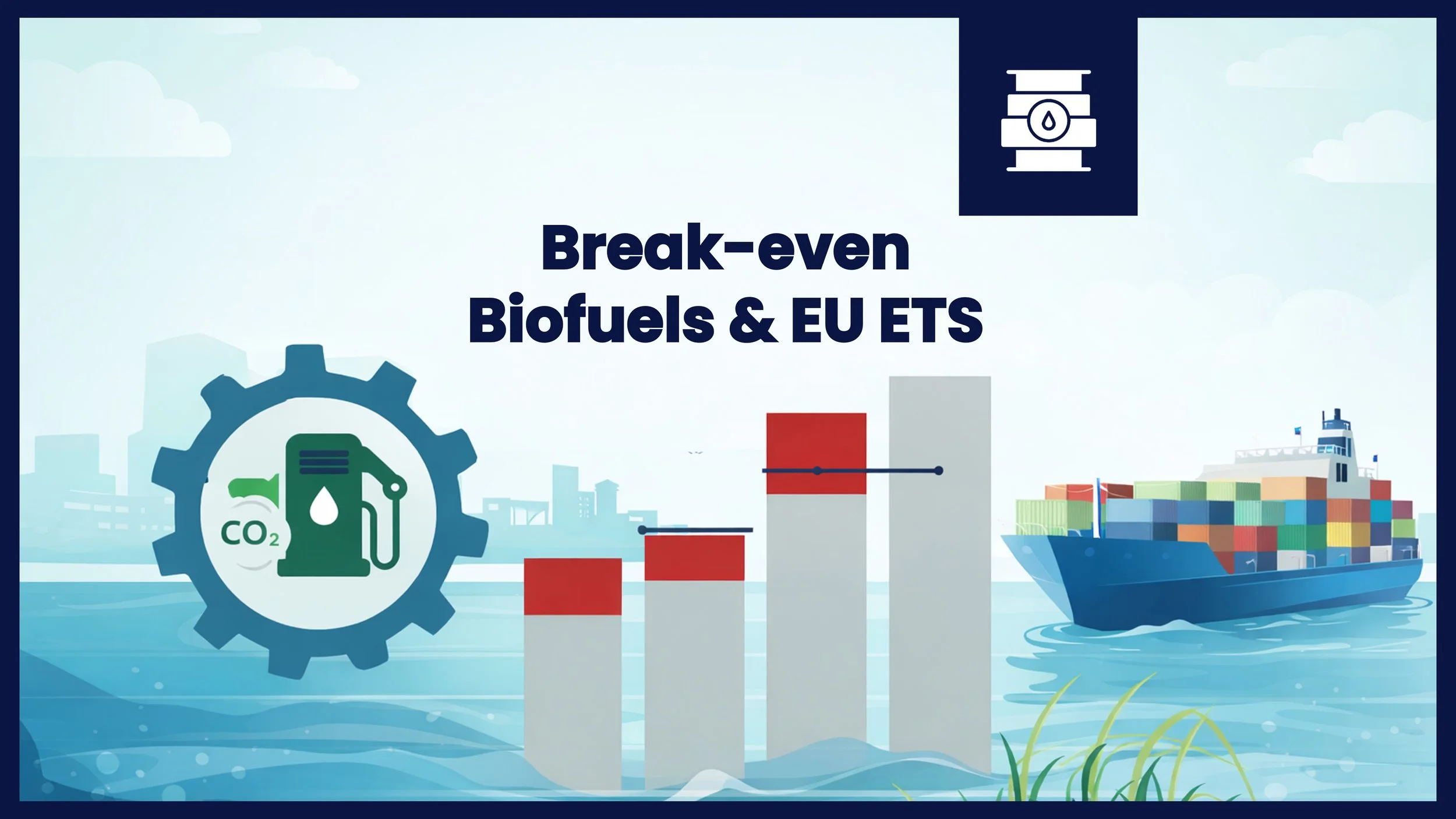
Modelled for LFO on a constant fuel price, with EUAs rising around 7% per year and FuelEU stepping up every five years, the shape of the result is consistent: modest exposure through the late 2020s, a noticeable step in the early 2030s, and a steep climb thereafter. By the mid 2040s, compliance cost can run several times the fuel price itself. At that point the bunker price becomes almost irrelevant to the decision.
Biofuels and e-fuels behave very differently. Modelled at the 28.2 gCO2e/MJ qualifying ceiling they stay essentially flat until around 2050, and a fuel certified meaningfully below that, in the region of 18 gCO2e/MJ or lower, carries close to zero compliance exposure under the current rules. The certificate, not the fuel name, determines the exposure.
(6) The 2035 tipping point
Put those two trajectories side by side and they cross. Before roughly 2035, conventional fossil fuels remain workable and the compliance layer, while real, is not decisive. After 2035 the fossil options become progressively more expensive than their bio and e equivalents, and the gap widens every year. That produces a decision rule that is far more useful than any fuel recommendation:
Ship reaching end of life before 2035. Do very little. Prepare rather than refit. Start blending biofuels, primarily to build operational experience and supplier relationships, not because the economics demand it yet. Major engine investment is hard to justify.
Ship still sailing after 2035. You will need a refit, or at minimum you need to prepare for one now. In practice that means dual fuel capability, shore power capability, and enough biofuel experience to know which fuel and which supplier you would choose. Building that optionality lets you defer the actual fuel commitment to the latest sensible moment, which is valuable when the supply picture is still moving.
Ship still sailing after 2045. This is a new design question rather than a refit question, and it is far enough out that the answer will change several times before it matters.
The first question to ask about any vessel is therefore not which fuel, but how long does this ship need to keep sailing.
(7) The often overlooked constraint - volume
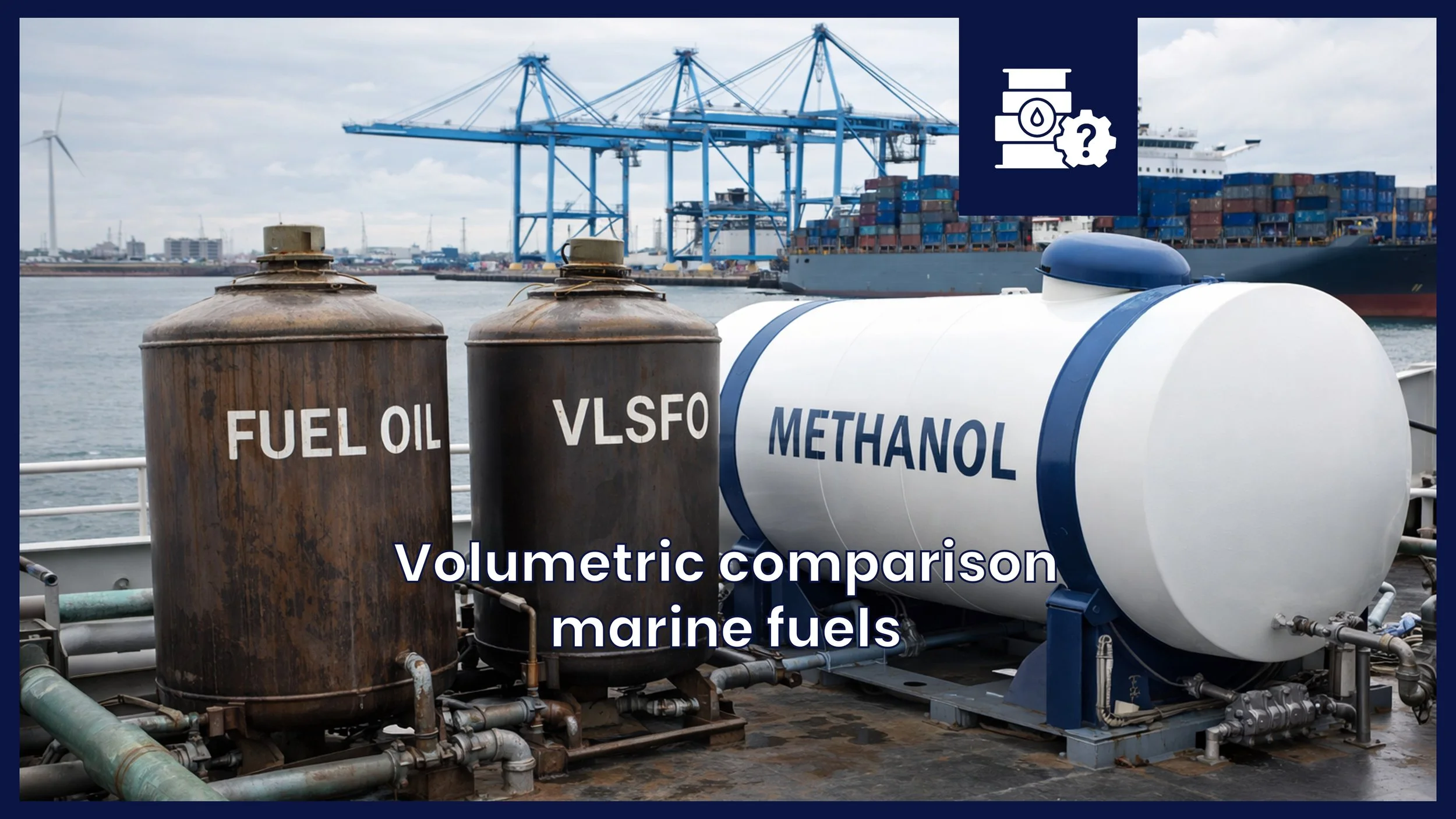
Cost analysis dominates fuel discussions and volume gets forgotten, which is a mistake, because a ship has a fixed amount of space and you cannot carry what does not fit. Taking heavy fuel oil as the 100% baseline for equal energy content:
Biodiesel and HVO need modestly more volume, close enough to be workable as drop-in fuels.
LNG needs roughly twice the volume, before accounting for insulation and tank structure.
Methanol, ammonia and liquid hydrogen need roughly two to three times the volume, again before insulation and containment.
For the same tank space, that means less range, or the same range with less cargo. It is a large part of why heavy fuel oil has been so hard to displace, and it is why methanol is often a shipowner's first choice among the alternatives: it is liquid at ambient pressure, it is the least volumetrically punishing of the genuinely alternative fuels, and it needs safety measures such as double-walled piping rather than cryogenic containment. The trade-off is that methanol still emits carbon, so the case depends on securing a bio or e variant.
Ammonia avoids the carbon problem but introduces operational and safety complexity of its own. There is no option without a cost somewhere.
(8) FuelEU surplus: the part most business cases miss
FuelEU works against a target. Perform better than the target and you generate a compliance surplus, which can be pooled across ships and redistributed. That surplus has real monetary value, and it changes fuel rankings substantially.
Run the comparison without surplus and HVO looks reasonably attractive. Run it with surplus included and HVO and biodiesel become clear winners, with bio-LNG generating particularly large surpluses. This is a significant part of why LNG remains a popular newbuild choice: it performs adequately now, and it provides a route to bio-LNG and eventually e-LNG without changing the vessel, capturing surplus value along the way.
If your fuel business case does not model the surplus, it is understating the case for the low-intensity options.
(9) Main conclusions
Fuel choice is a regulatory exposure question, not a bunker price question. The price per tonne is the part you cannot predict; the compliance layer is the part you can model.
Three groups for regulations, six families for engines. Fossil, bio and e-variants of the same family are identical to the engine, which means feedstock can change later without changing the vessel.
The frameworks genuinely disagree. EU ETS, FuelEU and IMO Net-Zero use different scopes, methods and in places different factors for the same fuel. Harmonising them is the prerequisite for any credible comparison.
Compare on VLSFO equivalent, never on price per tonne, or the energy content difference makes the comparison meaningless.
2035 is the tipping point. Fossil compliance costs climb steeply after it, reaching several times the fuel price by the mid 2040s.
Ask how long the ship must sail before asking which fuel. End of life before 2035 means prepare rather than refit; sailing beyond it means building dual fuel and shore power optionality now.
Qualifying as a biofuel or e-fuel requires 70% reduction against 94 gCO2e/MJ, a ceiling of 28.2. Fuels certified well below that carry close to zero exposure under current rules.
Volume is the forgotten constraint. LNG needs roughly double the space for equal energy, methanol, ammonia and liquid hydrogen roughly two to three times.
Model the FuelEU surplus. It changes the ranking of fuels materially and is a genuine revenue line for low-intensity options.
Blend biofuels early regardless. Not for the economics today, but for the operational experience and supply relationships you will need later.
Sign up for premium tools and benefits

The Shore Power Quickscan is a comprehensive tool designed to provide a business case for a shore power refit onboard vessels, based on IEC/IEEE 80005. It includes CAPEX estimates, operational expenses including fuel costs and engine maintenance, emissions savings as well as key regulations such as FuelEU and EU ETS. This purchase allows you to store your calculations, work offline anywhere, plus print a comprehensive techno-economic feasibility that you can show off to friends or your management.
Use Apple Pay to purchase the Excel (only on iPhone) - contact helpdesk for payment by invoice
Don’t want to sign up? Check pay-per-use options
References
Sustainable Ships - Fuel Properties and Costs Guide
Sustainable Ships - Fuel Cost Calculator
Sustainable Ships - Decarbonizer
Sustainable Ships - Compliance costs per mT of fuel from 2025 until 2050
Sustainable Ships - FuelEU Maritime
Sustainable Ships - EU ETS Maritime
Sustainable Ships - RED, Renewable Energy Directive
ISO 8217 - petroleum products, fuels (class F), specifications of marine fuels
Regulation (EU) 2023/1805 - FuelEU Maritime
EU ETS Directive as applied to maritime transport
IMO Net-Zero Framework - draft measures
Renewable Energy Directive (EU) 2018/2001 and 2023/2413
You might also like






Choosing a marine fuel is no longer about price per metric ton, it is about total regulatory exposure. This masterclass covers 22 marine fuels across three groups and six families, how EU ETS, FuelEU Maritime and IMO Net-Zero each calculate costs differently, and why 2035 is the tipping point that should drive your decision.