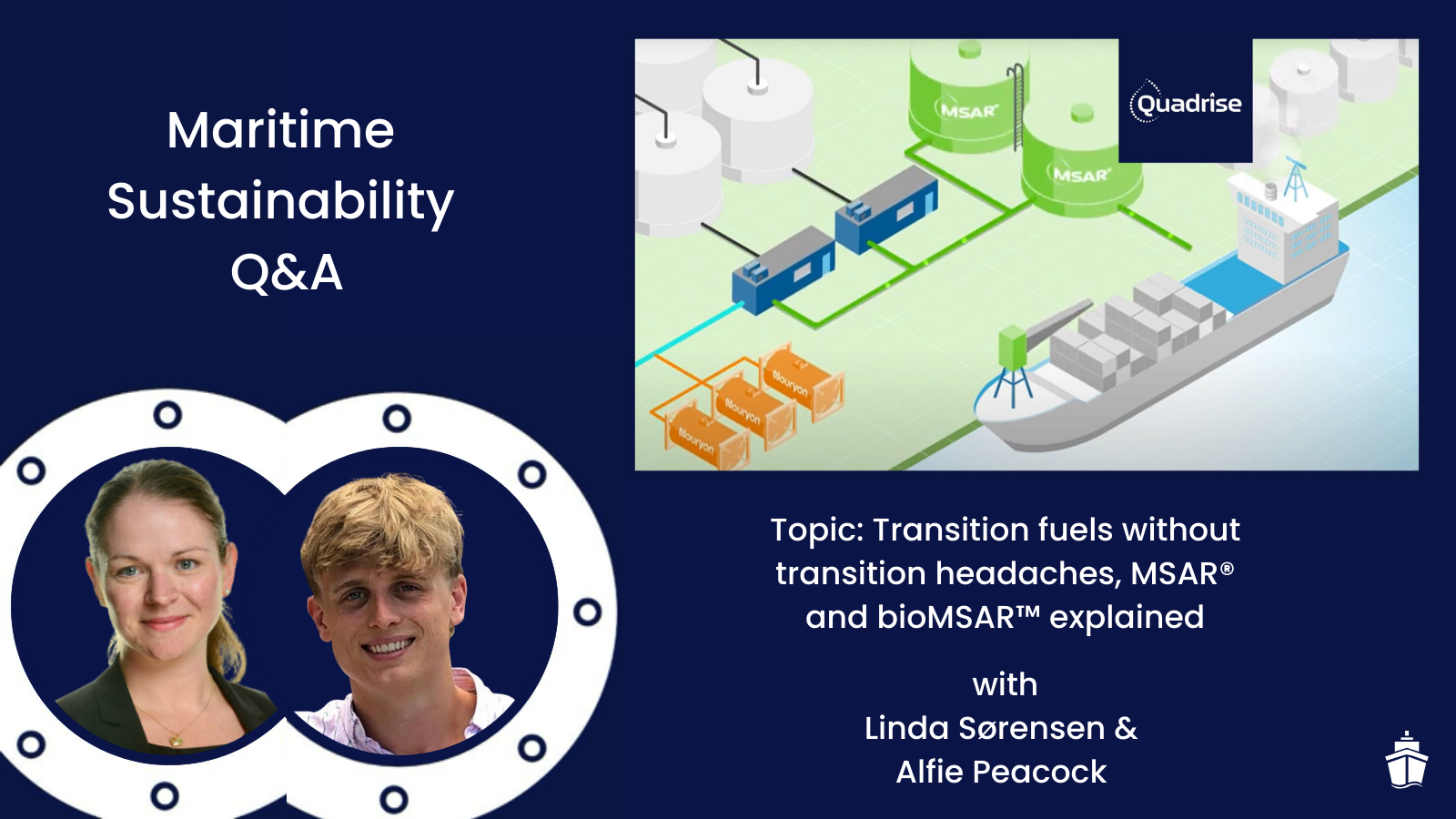
Transition fuels without transition headaches - Q&A with Quadrise
About Q&A
This Maritime Sustainability Q&A focused on transition fuels that can be deployed now, without waiting for new infrastructure or major vessel conversions. Quadrise explained the fundamentals behind MSAR® and bioMSAR™, two oil-in-water emulsion fuels designed to improve combustion and reduce emissions while remaining compatible with existing marine engines.
The session also covered how these fuels fit into current and upcoming regulatory frameworks, including EU ETS, FuelEU Maritime, and the trajectory toward IMO Net-Zero, followed by a walkthrough of the Quadrise × Sustainable Ships fuel comparison tool used to build vessel-specific cost and emissions cases.
Key insights
1) Emulsion structure is the core difference
MSAR® is a fuel-in-water emulsion with very fine droplets (typically 5–10 microns) which supports more complete combustion at lower temperatures. Quadrise positioned this as a practical pathway to reduce emissions without relying on new fuel infrastructure.
2) The value proposition is not only CO₂
Beyond CO₂ reduction, Quadrise highlighted significant local emission benefits: NOx reductions up to 45% were mentioned, alongside strong particulate matter reduction (with visible smoke reduction discussed). bioMSAR™ adds renewable, waste-based components (e.g., glycerine streams), with up to ~25% emission reduction referenced for a B30 blend.
3) Compliance and cost modelling must be energy-normalised
Because MSAR® and bioMSAR™ include water, the mass-based fuel consumption is higher (lower calorific value). The Q&A stressed that comparisons must be made on an energy-equivalent basis, not simply $/ton. The demo showed how the tool handles this, while also adding EU ETS and FuelEU effects into the business case and reporting.
Questions asked
It sounds too good to be true. What’s the catch, and how does 100 years of experience translate into this?
Emulsion fuels are not new. The technology builds on decades of industrial application, including large-scale use in power generation. MSAR® and bioMSAR™ represent a more stable fuel-in-water emulsion adapted specifically for marine engines and operational requirements.How does this fit into EU ETS, FuelEU Maritime and IMO Net-Zero?
Lower fuel consumption and improved combustion efficiency reduce EU ETS exposure. Bio-based blends can support FuelEU compliance. Scenario modelling allows operators to assess regulatory exposure and cost impacts over time.I have a waste stream (C5/C6 sugars in water). Could that be used in bioMSAR?
Similar waste-based streams can be incorporated, provided they meet marine fuel specifications. Key factors are calorific value and the absence of harmful trace elements (e.g., sodium, calcium, contaminants) that could affect engine performance.Why is it cheaper for shipowners? Is it mainly because of the water content and avoiding distillates?
Cost reductions are primarily driven by avoiding expensive cutter stocks/distillates and enabling the use of very heavy residual feedstocks and certain waste-based bio components. Comparisons must be made on an energy-equivalent basis, not purely per metric tonne.What modifications are typically needed to use MSAR®/bioMSAR™ onboard?
Modifications are generally limited and case-specific. For two-stroke engines, electronically controlled injection systems are preferred due to ignition timing adjustments. In some cases, minor fuel system adaptations or booster units may be required.Does installation require dry dock or off-hire time?
Installation can typically be completed without dry dock or taking the vessel off-hire. The setup is modular and designed to be reversible.Is it compatible with scrubbers and different sulphur grades?
Compatibility depends on the configuration, but sulphur-equivalent comparisons are used to ensure fair benchmarking. The fuels can be aligned with scrubber systems and different sulphur specifications.What operational challenges might occur?
Operational considerations include managing fuel switching temperatures to avoid thermal shock and ensuring proper filtration. Fuel mixing should be controlled to avoid contamination. No structural engine redesign is required.Where is it currently available, and how will supply scale?
Supply is currently hub-based, with expansion planned through modular production units and licensing arrangements. The model supports scaling near major bunkering hubs.Why focus on the existing fleet rather than only newbuilds?
The majority of the global fleet will remain operational for decades. Transition fuels provide a lower-CAPEX option for immediate emission reductions while preserving flexibility for future fuel pathways.








This Q&A looks at how equipment finance and leasing shape decarbonization decisions, with Kevin Swannack and Andy Bailey of Wavefront Asset Management, who explain why and how leasing of equipment can actually be the most cost-effective option.