How ships are classified: a reference guide to IMO, EU, and Industry frameworks
The wrong classification can cost you millions in regulatory exposures - this guide provides clarity on the classification of ships around the world
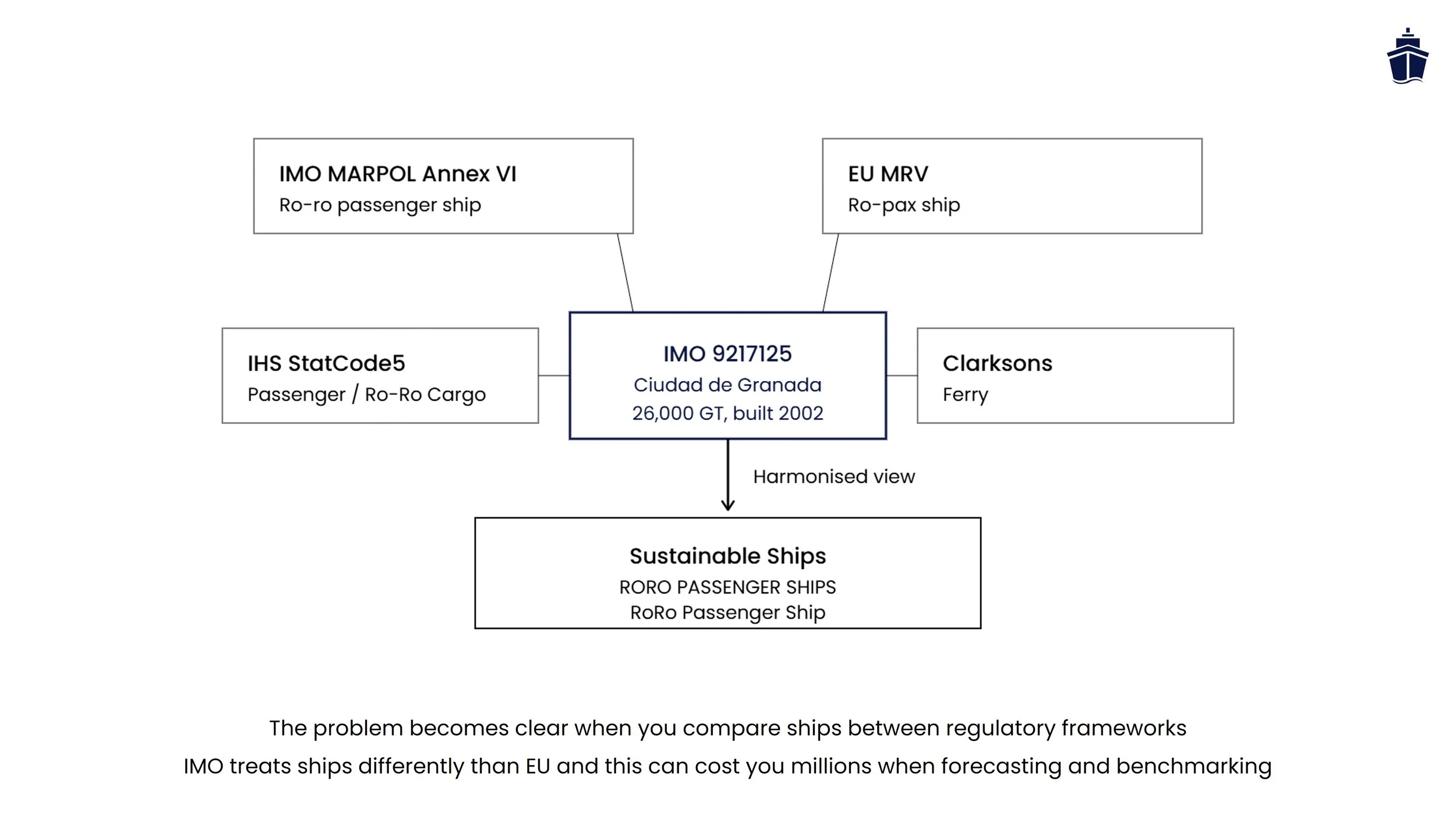
The IMO itself states that "there are no universally applicable definitions of ship types". That means that the same vessel - same IMO number, same hull, same cargo - can show up as a Passenger Vessel in one IHS feed, a Ro-pax ship in EU MRV, a Cruise Passenger Ship under IMO MARPOL Annex VI Chapter 4, and a Passenger in a Clarkson’s fleet report. None of these labels is wrong. They are the ‘working vocabulary’ of different clients, e.g. regulators, classification societies, brokers, shipowners, statisticians, etc.. Each of these has built its own taxonomy for its own purpose.
For anyone working across those communities however, calculating compliance costs, comparing vessel data between sources, or simply trying to make sense of which rules apply to which ship, the seams between the frameworks become a real and recurring problem. This guide provides clarity for anyone navigating those seams, with a particular focus on the regulatory and cost dimensions of ship classification.
It documents the Sustainable Ships classification framework: the working taxonomy used across all Sustainable Ships tools and analyses. It is compared side-by-side with the IMO, EU, IHS StatCode5, DNV, Clarkson’s, World Ships, and Ship Knowledge frameworks. The Sustainable Ships framework is built on the IMO and EU regulatory frameworks as its primary regulatory spine, cross-referenced with IHS StatCode5 for industry recognisability and with IMO MARPOL Annex VI for decarbonisation compliance. The guide is subject to continuous change and improvements, check the latest version here.
Key takeaways
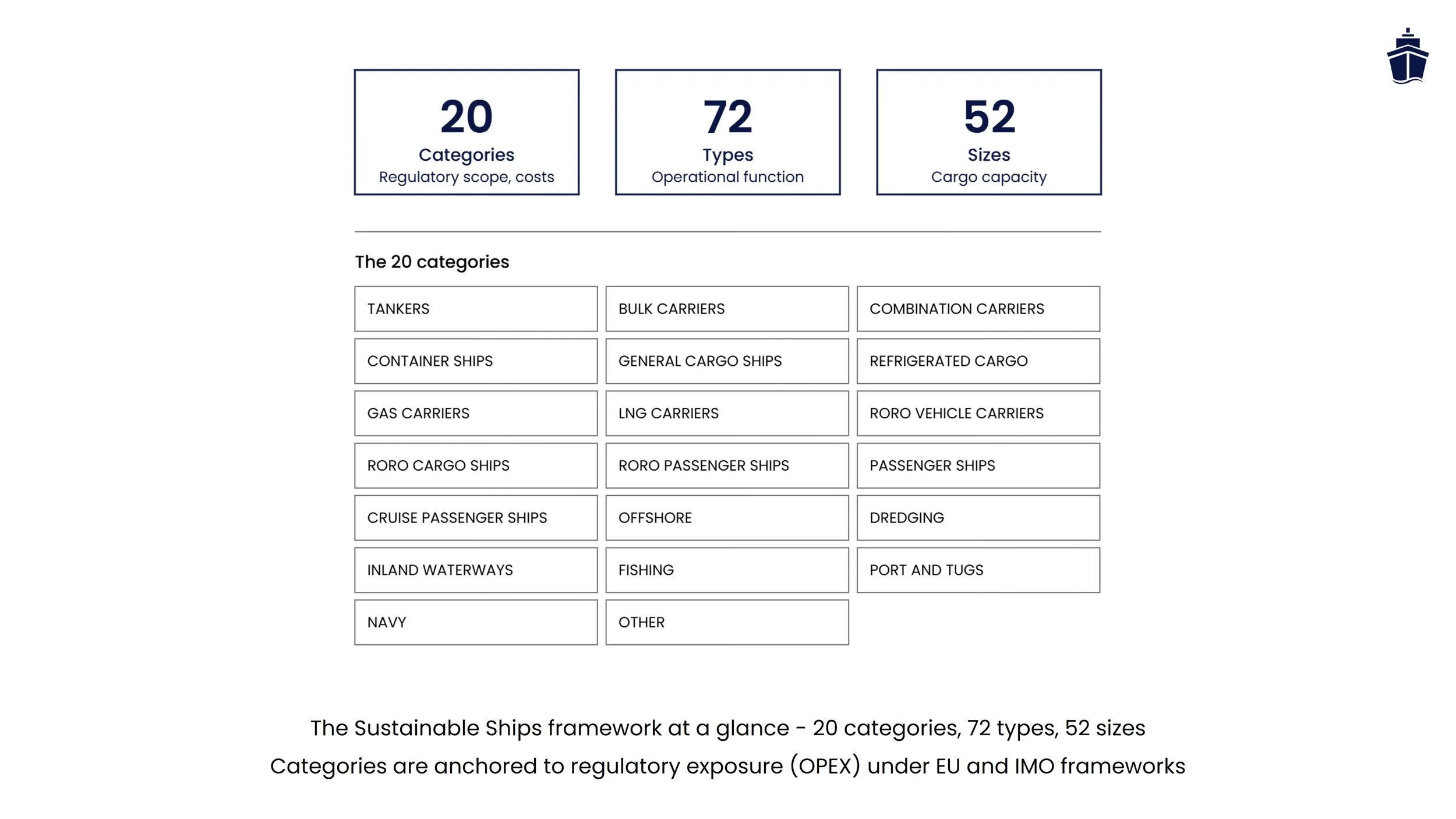
Sustainable Ships’ harmonizes several frameworks (IMO, EU, StatCode5) and organises the global fleet into 20 categories, 72 types, and 52 sizes.
Regulatory scope and costs governs category, operational function governs type, and capacity governs size.
Scroll down below for the full guide plus download. Download spreadsheet with all information here.

The ship type classification problem
A fundamental problem in all maritime (decarbonization) projects
A fundamental problem in maritime decarbonization projects is that everybody names ships differently. The International Maritime Organization itself states that "there are no universally applicable definitions of ship types", which sounds harmless until you try to compare power demand across studies. The same vessel might be a passenger ship in one source, a RoPax ferry in another, and a miscellaneous inland waterways entry in a third. Before any discussion of average power demand begins, stakeholders are often not talking about the same ships.
The inconsistency runs deeper than naming. Some sources agree on major groups like tankers or container ships but split sub-segments differently. The EU separates oil and chemical tankers where others say simply "tanker." IHS places entire segments such as dredging or port and tug vessels into miscellaneous categories. Making shore power projects easier doesn't start with more spreadsheets, it starts with agreeing on what kind of ship is actually being discussed.
What it costs when you get it wrong
Regulatory exposure is sensitive to classification - The same vessel, misclassified in EU MRV or FuelEU reporting, lands in the wrong carbon intensity band or compliance pathway. The financial impact scales to millions of dollars across a fleet and a decade of regulations.
Shore power and port infrastructure planning depends on knowing the fleet accurately - A port planning shore power rollout needs to know which ships it will serve. A list of "passenger ships" is useless without distinguishing cruise ships, with multi-day stays and high power demand, from ferries that turn around in hours. The power and connection specs are radically different.
Benchmarking fails without a consistent taxonomy - You can't compare your fleet's emissions intensity to industry benchmarks if your baseline classification doesn't match the benchmark source.
How Sustainable Ships solves it
Sustainable Ships developed a harmonized classification framework by cross-referencing the most widely-used systems: IMO, EU MRV, IHS, World Ships, and Ship Knowledge by Klaas van Dokkum. IMO and EU take precedence because they drive compliance cost and regulatory OPEX. The framework distinguishes clearly between category, type, and size, because each serves a different purpose in modelling. In total it uses 20 categories and 72 types. It is a lot, but still better than pretending all sources mean the same thing when they clearly do not.
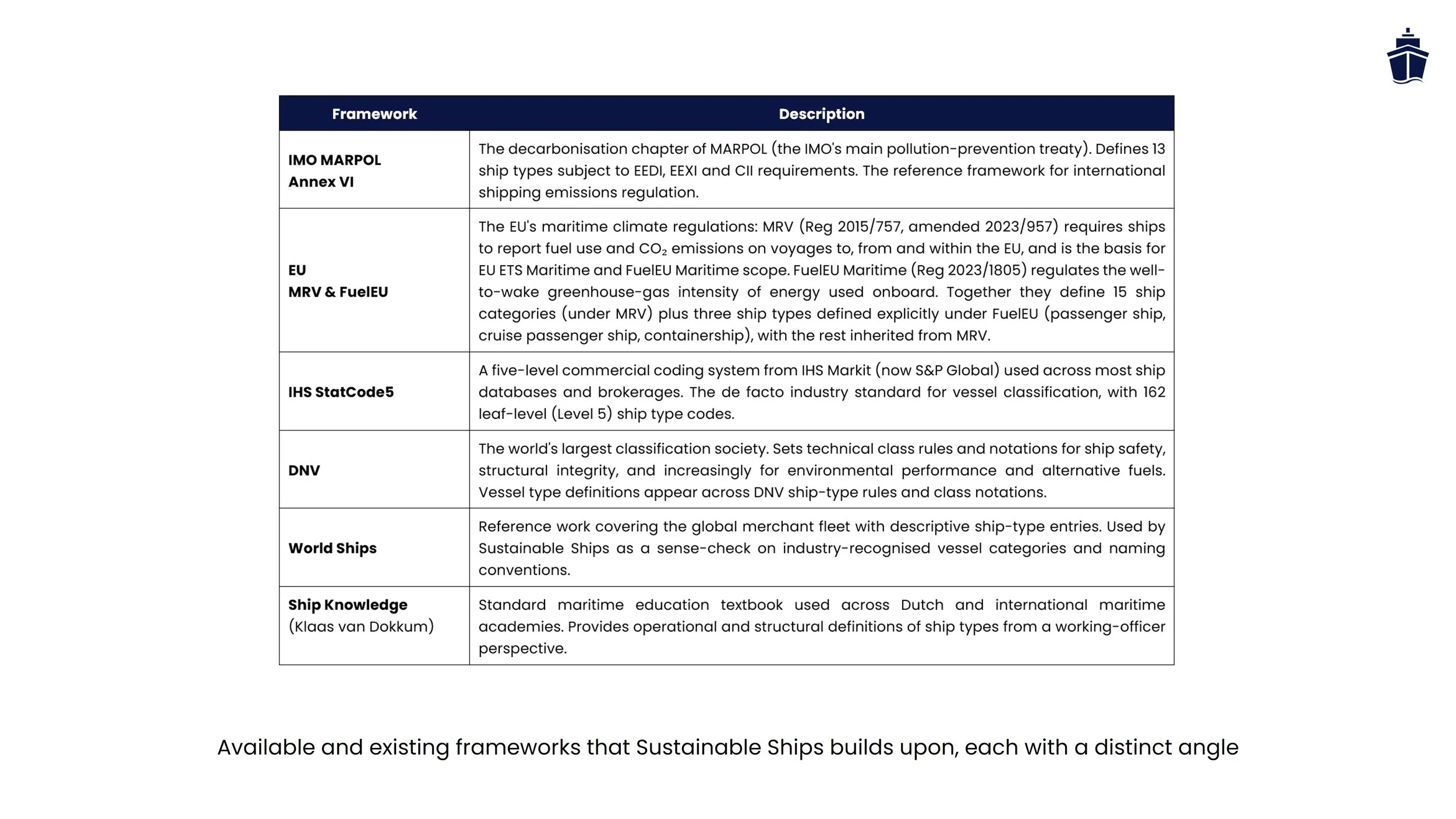
Despite the lack of cross-framework consistency, specific names and definitions are used rigorously inside each framework. IMO conventions, EU MRV and FuelEU Maritime, classification societies, and commercial data providers each have their own taxonomy. Each was designed for a different purpose (regulatory compliance, commercial data, technical class rules, operational training) and each contributes something the others miss. The three key frameworks that Sustainable Ships builds upon are listed below. More are documented in the Guide.
IMO ship types framework
IMO maintains 13 lists, scattered across conventions, codes, and resolutions, each defining the ships relevant to its own scope
The IMO's ship-type definitions live across dozens of instruments. SOLAS defines passenger ships and bulk carriers for safety purposes. MARPOL Annex I defines oil tankers for pollution prevention. The MODU Code defines mobile offshore drilling units for the construction and equipment of those specific assets. Where the same ship type appears in multiple instruments, definitions can vary in scope or emphasis.
For decarbonization regulation (which is where most current Sustainable Ships work focuses) the authoritative source is MARPOL Annex VI Chapter 4, brought in by Resolution MEPC.328(76) (2021). Chapter 4 Regulation 2.2 defines the 13 ship types subject to EEDI, EEXI, and CII compliance. For ship types outside this scope (passenger ships, fishing vessels, MODUs, special purpose ships, high-speed craft), the relevant SOLAS, MARPOL Annex I, and specialised code definitions apply.
The list below is a non-exhaustive set of the IMO's most commonly used ship-type definitions. The full Sustainable Ships Guide (premium) cites the exact instrument and regulation number behind every definition. Useful when you need to point to a specific clause in a contract, audit, or compliance filing.
Bulk carrier
A ship constructed generally with single deck, top-side tanks and hopper side tanks in cargo spaces, intended primarily for dry bulk cargo, including ore carriers and combination carriers.
Combination carrier
A ship designed to load 100% deadweight with both liquid and dry cargo in bulk.
Containership
A ship designed exclusively for the carriage of containers in holds and on deck.
Cruise passenger ship
A passenger ship without a cargo deck, designed exclusively for the commercial transport of passengers in overnight accommodation on a sea voyage.
Fishing vessel
A vessel used for catching fish, whales, seals, walrus, or other living resources of the sea.
Gas carrier
A cargo ship, other than an LNG carrier, constructed or adapted and used for the bulk carriage of any liquefied gas.
General cargo ship
A ship with a multi-deck or single-deck hull designed primarily for general cargo. Excludes specialised dry cargo ships (livestock carrier, barge carrier, heavy load carrier, yacht carrier, nuclear fuel carrier) for EEDI reference line purposes.
High-speed craft (HSC)
A craft capable of travelling at high speed, calculated by formula based on volume of displacement at design waterline.
LNG carrier
A cargo ship constructed or adapted and used for the bulk carriage of liquefied natural gas.
Mobile offshore drilling unit (MODU)
A vessel capable of engaging in drilling operations for the exploration or exploitation of seabed resources such as liquid or gaseous hydrocarbons, sulphur, or salt.
Nuclear ship
A ship provided with a nuclear power plant.
Oil tanker
A ship constructed or adapted primarily to carry oil in bulk in its cargo spaces. Includes combination carriers, NLS tankers (as defined in MARPOL Annex II), and gas carriers (as defined in SOLAS Ch.II-1 reg.3.20) when carrying oil cargo in bulk.
Passenger ship
A ship which carries more than 12 passengers.
Refrigerated cargo carrier
A ship designed exclusively for the carriage of refrigerated cargoes in holds.
Ro-ro cargo ship
A ship designed for the carriage of roll-on / roll-off cargo transportation units.
Ro-ro cargo ship (vehicle carrier)
A multi-deck roll-on / roll-off cargo ship designed for the carriage of empty cars and trucks.
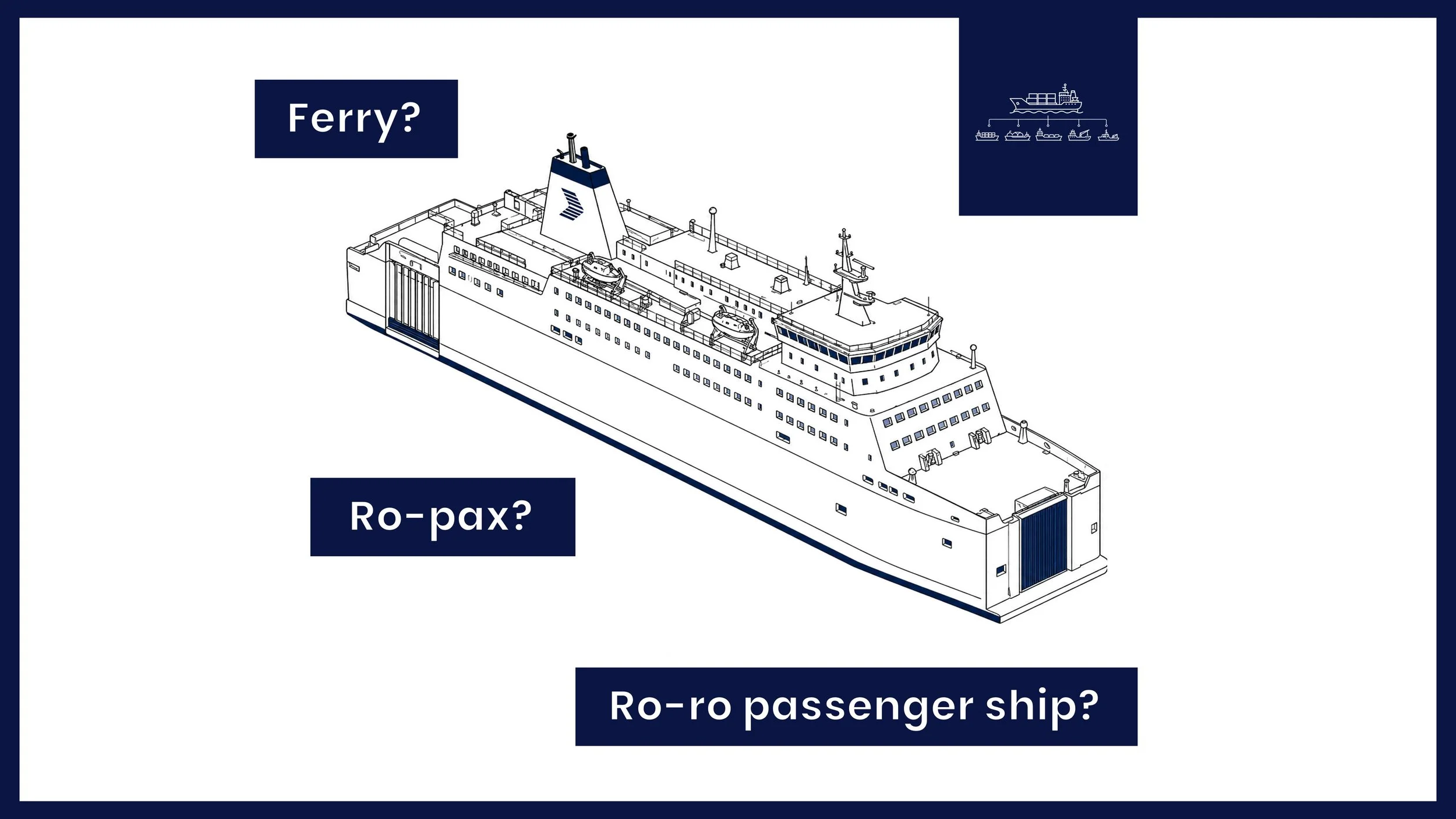
Ro-ro passenger ship
A passenger ship with roll-on / roll-off cargo spaces.
Special purpose ship (SPS)
A mechanically self-propelled ship which by reason of its function carries on board more than 12 special personnel. Includes research vessels, training ships, and ships involved in offshore activities such as wind turbine maintenance.
Tanker
An oil tanker as defined in MARPOL Annex I, or a chemical tanker / NLS tanker as defined in MARPOL Annex II.
EU ship types framework
The EU's ship-type taxonomy is built on a single regulation that everything else inherits from → EU MRV
The EU MRV Regulation (Regulation (EU) 2015/757) is the spine of EU maritime ship-type classification. The 15 ship categories listed in MRV's reporting dropdown form the backbone, and both EU ETS Maritime (Directive 2023/959) and FuelEU Maritime (Regulation 2023/1805) reuse this scope rather than defining their own. FuelEU adds three of its own definitions (passenger ship, cruise passenger ship, and containership) but only because those three face differentiated treatment under the regulation itself (with regards to onshore power supply).
The practical result is that EU regulators speak with one voice on ship types. A vessel reported as a "Bulk carrier" in MRV is also a "Bulk carrier" under ETS Maritime and FuelEU Maritime. Where the EU does diverge from IMO — most notably by splitting "Tanker" into Oil tanker and Chemical tanker, and by treating Ro-pax as a category distinct from generic Ro-ro — it does so consistently across all three regulations.
The list below is the 15 ship categories used in EU MRV, plus the additional FuelEU-specific definitions. The full Sustainable Ships Guide (premium) cites the exact regulation, article, and annex behind every definition, including the cargo-determination rules from Implementing Regulation (EU) 2016/1928.
Bulk carrier
A ship intended primarily to carry dry cargo in bulk (Annex I Table B.1 reporting category).
Chemical tanker
A tanker designed for the bulk carriage of chemicals (Annex I Table B.1 reporting category, distinct from oil tanker).
Combination carrier
A ship designed to carry both liquid and dry cargo in bulk (Annex I Table B.1 reporting category).
Container ship
A ship designed exclusively for the carriage of containers in holds and on deck.
Cruise passenger ship
A passenger ship that has no cargo deck and is designed exclusively for the commercial transportation of passengers in overnight accommodation on a sea voyage.
Gas carrier
A cargo ship constructed or adapted for the bulk carriage of liquefied gases other than LNG (Annex I Table B.1 reporting category).
General cargo ship
A ship designed primarily for the carriage of general cargo (Annex I Table B.1 reporting category).
LNG carrier
A cargo ship constructed or adapted for the bulk carriage of liquefied natural gas (Annex I Table B.1 reporting category).
Oil tanker
A tanker designed for the bulk carriage of oil (Annex I Table B.1 reporting category, distinct from chemical tanker).
Other ship types
Catch-all category for vessels not fitting the named 14 categories. Used by ships ≥5,000 GT engaged in commercial transport that do not match a more specific MRV category.
Passenger ship
A passenger ship as defined in Article 2, point (i) of Directive (EU) 2016/802 (the sulphur-in-marine-fuels directive); a ship which carries more than 12 passengers.
Refrigerated cargo carrier
A ship designed for the carriage of refrigerated cargoes in holds (Annex I Table B.1 reporting category).
Ro-pax ship
A roll-on / roll-off vessel carrying both wheeled cargo and more than 12 passengers (Annex I Table B.1 reporting category, distinct from generic Ro-ro ship).
Ro-ro ship
A ship designed for the carriage of roll-on / roll-off cargo transportation units, or with roll-on / roll-off cargo spaces (Annex I Table B.1 reporting category).
Container/ro-ro cargo ship
A hybrid vessel combining cellular container capacity with roll-on / roll-off cargo spaces (Annex I Table B.1 reporting category, distinct from both Container ship and Ro-ro ship).
Vehicle carrier
A specialised roll-on / roll-off vessel designed for the carriage of empty cars and trucks (Annex I Table B.1 reporting category, distinct from Ro-ro ship).
Statcode5 framework
IHS StatCode5 is the commercial industry standard used by databases, brokers, port authorities - but it is not a regulatory taxonomy!
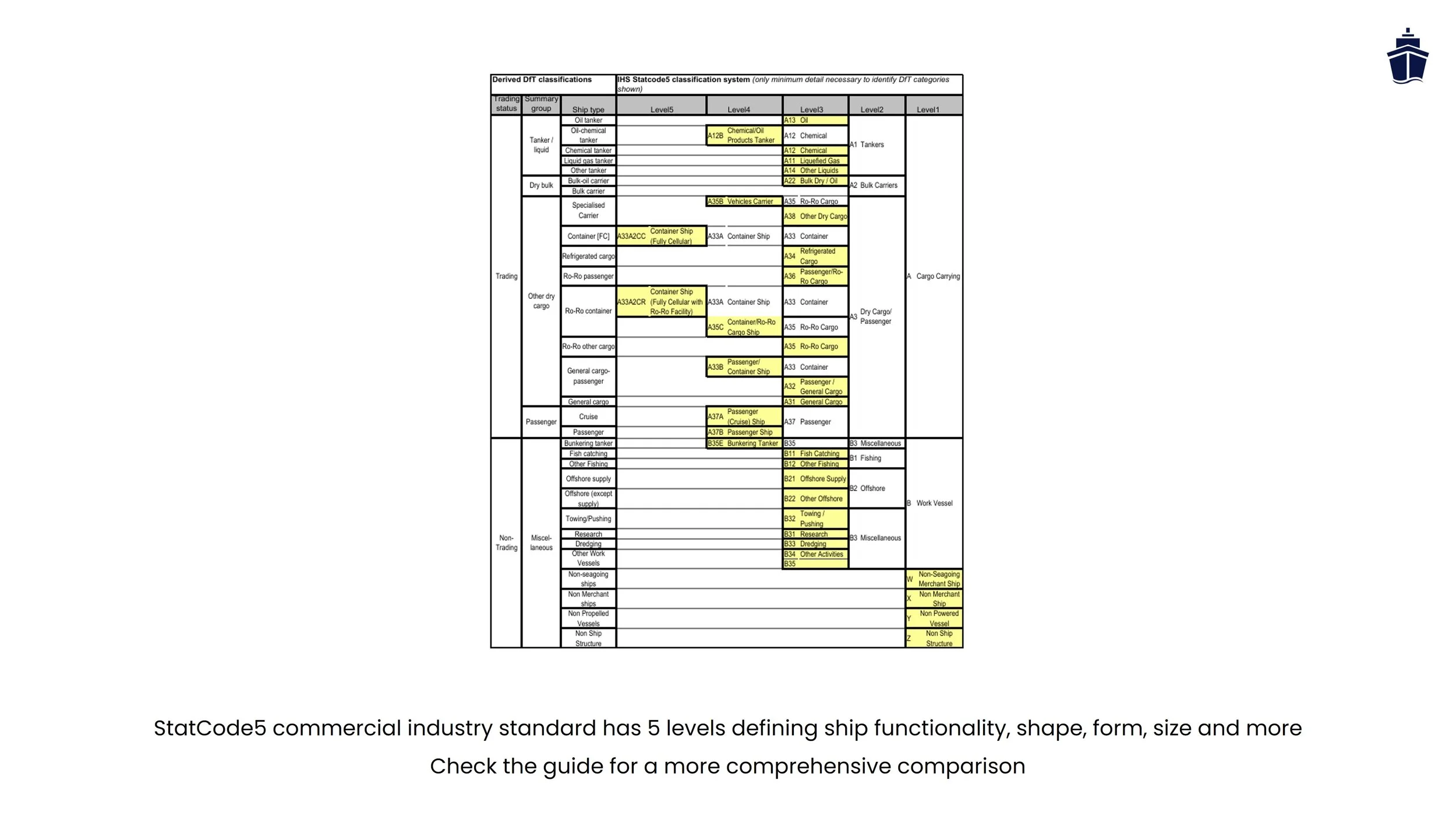
IHS StatCode5 was adopted in 2009 to replace the older International Classification of Ship Types (ICST) and is now the de facto industry standard. It is used across virtually all commercial ship databases, brokerages, port authority systems, and government statistical agencies — including the UK Department for Transport, which is the most accessible public mirror of the system.
Unlike IMO MARPOL Annex VI or EU MRV, StatCode5 is not a regulatory taxonomy. It does not define ship types in legal terms, and its definitions are descriptive rather than prescriptive. What it offers is granularity: a five-level hierarchy that reaches roughly 169 leaf-level codes covering specialised vessel sub-types — far more detail than any regulator captures.
The structure breaks down as follows: Level 1 distinguishes broad fleet groupings (Cargo Carrying Merchant Ship, Non-Seagoing Merchant Ship, Non Merchant Ship, Non Powered Vessel, Non Ship Structures). Level 2 splits each into ship-type families (Tankers, Bulk Carriers, Container Ships, Offshore). Level 3 adds intermediate detail. Level 4 names specific commercial ship types (Crude Oil Tanker, Chemical Tanker, VLGC). Level 5 reaches the granular variants. The natural alignment point with regulatory frameworks is at Levels 2 and 3, where StatCode5 ship-type families correspond closely to regulatory ship categories.
Ship structure type (Cargo Carrying Ship Structures / Work Vessel / Non-Propelled / Non-Merchant / Non-Ship Structures)
Major functional grouping (Tankers, Bulk Carriers, Dry Cargo/Passenger, Fishing, Offshore, Other Activities, etc.)
Sub-grouping (Liquefied Gas, Chemical, Oil, Other Liquids; Bulk Dry, Bulk Dry/Oil, Other Bulk Dry; etc.)
Ship-type family (Chemical Tanker, Oil Products Tanker, General Cargo Ship, Ro-Ro Cargo Ship, etc.)
Granular variant (LPG/Chemical Tanker, Chemical/Oil Products Tanker, Bulk Carrier (with Vehicle Decks), etc.)
Sustainable Ships framework
How Sustainable Ships classifies ships in their tools and databases
Sustainable Ships built its classification framework by harmonising the most widely-used systems: IMO MARPOL Annex VI, EU MRV and FuelEU Maritime, IHS StatCode5, DNV, World Ships, and Ship Knowledge by Klaas van Dokkum. Where these sources agree, the choice is easy. Where they diverge (and they often do!) Sustainable Ships follows the regulatory source where possible, and documents the industry-standard equivalent for discoverability.
The harmonisation process reveals just how inconsistent the industry still is. Some sources broadly agree on major groups like tankers or container ships, but split sub-segments differently. The EU separates oil and chemical tankers where others say simply "tanker." IHS places entire segments such as dredging or port and tug vessels into miscellaneous categories. World Ships and Ship Knowledge add operational detail that no regulator captures. None of these are wrong, they just answer different questions.
The Sustainable Ships approach is to keep the regulatory spine (IMO and EU take precedence, because they drive compliance cost and OPEX) and cross-reference everything else for context. The framework distinguishes clearly between category, type, size, because each serves a different purpose in modelling. In total: 20 categories, 72 types, and 52 size bands. This is granular enough to capture commercially meaningful differences, lean enough to be usable.
Categories
The category is the top level. It answers the broadest question a regulator, broker, or analyst can ask about a ship: what kind of vessel is this, in commercial and regulatory terms? Every ship in the Sustainable Ships database is assigned to exactly one category, and the category determines which downstream choices are available: which types are valid, which size bands apply, and which regulatory regimes are in scope.
The 20 categories are listed below in the order they appear in the database. Cargo-carrying merchant vessels come first (Tankers through LNG Carriers), followed by RoRo and passenger segments, then Offshore, then non-merchant and out-of-scope segments.
TANKERS - Bulk liquid cargo: crude oil, refined products, chemicals
BULK CARRIERS - Bulk dry cargo: ore, coal, grain, cement
COMBINATION CARRIERS - Switches between dry bulk and liquid bulk
CONTAINER SHIPS - Standardised intermodal containers (TEU/FEU)
GENERAL CARGO SHIPS - Mixed dry cargo, breakbulk, project cargo
REFRIGERATED CARGO CARRIERS - Temperature-controlled perishables (declining segment)
GAS CARRIERS - Liquefied gases other than LNG (LPG, ammonia, ethylene, CO₂)
LNG CARRIERS - Carriers of liquefied natural gas at -162°C
RORO CARGO VEHICLE CARRIERS - Roll-on/roll-off carrier of automobiles, trucks, wheeled cargo
RORO CARGO SHIPS - Roll-on/roll-off freight (≤12 passengers)
RORO PASSENGER SHIPS - Ro-Pax — wheeled cargo plus >12 passengers
PASSENGER SHIPS - Vessels carrying >12 passengers, excluding cruise and Ro-Pax
CRUISE PASSENGER SHIPS - Multi-day leisure voyages with full hotel accommodation
OFFSHORE - Oil & gas and offshore wind support: PSV, AHTS, OCV, FPSO
DREDGING - Seabed excavation for navigation, ports, land reclamation
INLAND WATERWAYS - Vessels operating on rivers, canals, lakes (non-seagoing)
FISHING - Commercial catching, processing, transport of marine resources
PORT AND TUGS - Harbour and ocean tugs, pilot vessels, port service craft
NAVY - Government military and law-enforcement vessels
OTHER - Catch-all: barges, yachts, research vessels, non-ship structures
Types
The type is the second level. Where category answers what kind of vessel, type answers what it specifically does. Each category contains between one and thirteen types, depending on how diverse the segment is, CONTAINER SHIPS has one type (containerships are containerships), OFFSHORE has thirteen because offshore vessels do everything from supply runs to drilling to floating production.
Sustainable Ships uses 72 types across the 20 categories. The naming follows the dominant industry convention where one exists, with regulatory and StatCode5 equivalents documented as synonyms. Most categories include an "Other" type to capture vessels that do not fit the named types — important for database integrity, since real-world vessel data rarely fits a clean taxonomy.
The full Ship Types Guide (premium) lists every type per category with a short description, regulatory synonyms, and IHS StatCode5 cross-reference.
Sizes
Size is the third level. Where category answers what kind of vessel and type answers what it does, size answers how big. Size determines whether two ships of the same type are operationally and commercially comparable: a Handysize tanker and a VLCC are both Crude Oil Tankers, but they trade different routes, call at different ports, burn different volumes of fuel, and face different compliance costs.
Sustainable Ships uses 52 size bands across 8 categories. The other 12 categories (General Cargo Ships, all RoRo segments, Passenger Ships, Cruise Passenger Ships, Dredging, Inland Waterways, Fishing, Port and Tugs, Navy, and Other) have no industry-standard size bands and are left unbanded. The bands follow the dominant industry convention per category:
TANKERS uses the AFRA scale (Handysize, MR, Panamax, Aframax, Suezmax, VLCC, ULCC), as published by the London Tanker Brokers' Panel.
BULK CARRIERS and COMBINATION CARRIERS use the Clarksons dry-bulk convention (Handysize, Handymax, Supramax, Ultramax, Panamax, Post-Panamax, Capesize, VLOC, Chinamax).
CONTAINER SHIPS uses the canal-fit convention (Small Feeder, Feeder, Feedermax, Panamax, Post-Panamax, Neo-Panamax, ULCV).
GAS CARRIERS uses the LPG industry convention (MGC, LGC, VLGC, ULGC).
LNG CARRIERS uses the Qatar fleet generations (Small-scale, Small Conventional, Conventional, Large Conventional, Q-Flex, Q-Max).
REFRIGERATED CARGO CARRIERS uses the reefer industry convention measured in cubic feet, a legacy unit retained because it is what the trade still uses.
Capacity units vary by what makes commercial sense for the cargo: DWT for liquid and dry bulk, TEU for containers, CBM (m³) for liquefied gases, and cubic feet for refrigerated cargo. This mirrors how the industry actually quotes vessel size: a broker describes a Capesize bulker by its DWT, a containership by its TEU, and an LNG carrier by its m³, never by gross tonnage. Each size band lists the dominant industry name, with synonyms and acronyms documented separately (LR1 for tanker Panamax, Kamsarmax for bulker Panamax, VLBC for Chinamax, and so on).
The full Sustainable Ships Guide (premium) provides every size band with its DWT, TEU, m³, or cuft thresholds, plus all documented synonyms — useful for any project that needs to convert between size conventions or specify vessels precisely.
References
Available to premium users
IMO - 2021 IMO Resolution MEPC.328(76)
IMO - 2025 IMO Circular Letter No. 5005 (April 2025)
IMO - Safety regulations for different ship types
EU ETS - 2015 Regulation EU 2015-757 EU ETS
EU - 2016 Commission Implementing Regulation EU 2016-1928
FuelEU Maritime - 2023 Regulation EU 2023-1805 FuelEU
UK - 2020 UK Shipping Fleet Statistics Notes and Definitions
IHS Markit - StatCode 5 Shiptype Coding System
World Ships - Ship Database
Ship Knowledge - Klaas van Dokkum
Sign up for premium tools and benefits
Premium tools and expert support at your fingertips
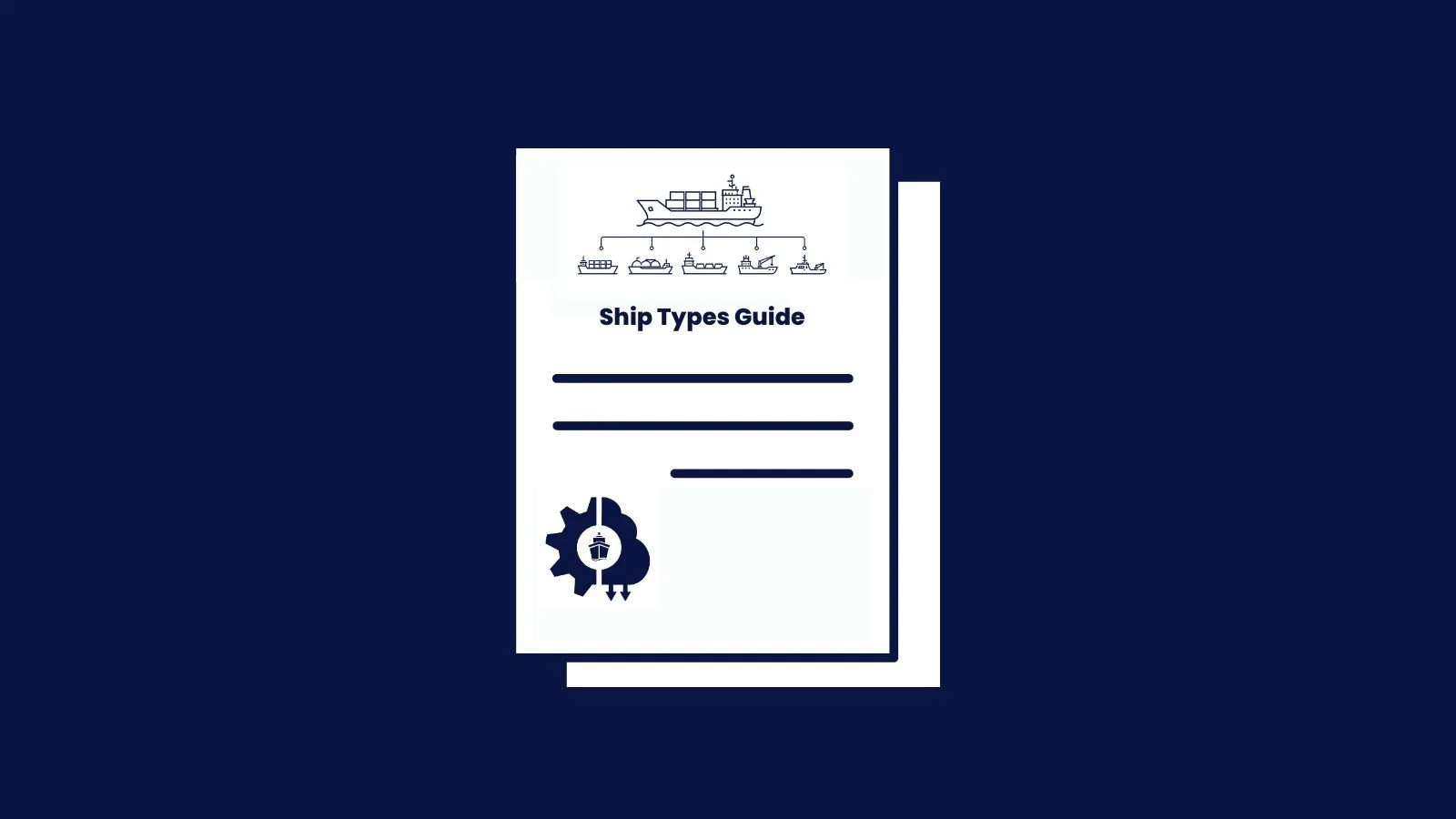
The Ship Types Guide provides a structured reference for navigating ship classification across regulatory and commercial frameworks. Drawing on IMO MARPOL Annex VI, EU MRV, IHS StatCode5, DNV, World Ships, and Ship Knowledge, the guide maps the Sustainable Ships classification: 20 categories, 72 types, and 52 sizes, against each source framework and documents where they agree, where they diverge, and why.
A downloadable spreadsheet with more detailed information on ship types is included
Use Apple Pay to purchase the Excel (only on iPhone) - contact helpdesk for payment by invoice
Don’t want to sign up? Check pay-per-use options
You might also like





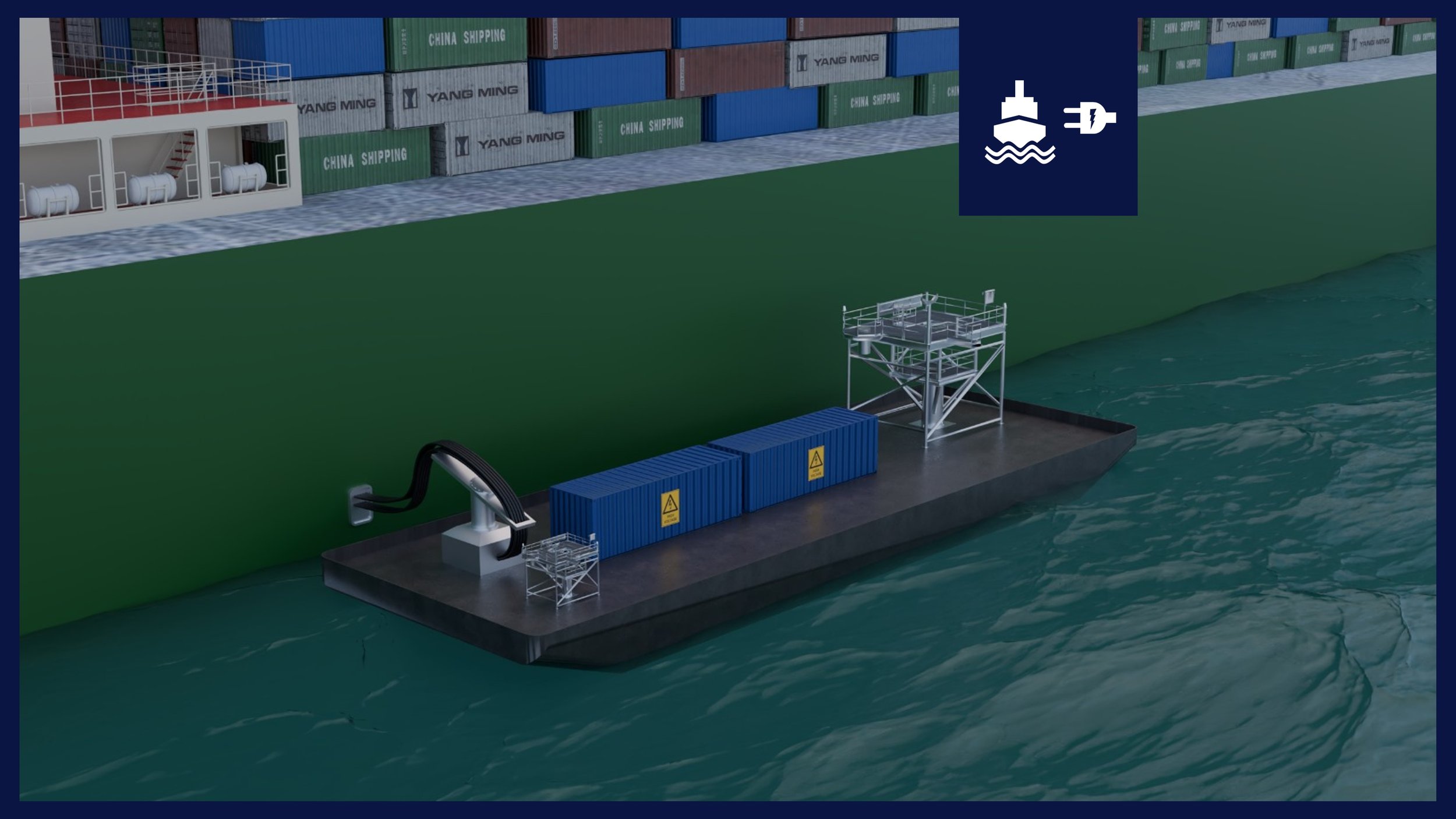



This case study determines what it takes to remove the fuel from a cruise ship, comparing a 50,000 GT ocean cruise ship with an inland river cruise vessel. The ocean cruise ship obtains a payback of around five years, but only with very cheap electricity, battery prices of $150 per kWh, long-term financing and the sale of FuelEU surplus (many caveats!). The river cruise ship is technically easier, but is extremely challenging to make a business case for because EU ETS and FuelEU do not apply to it.