
Grid Services FAQs: 24 Questions on FCR, aFRR, Trading, and Congestion Management
Here are the 24 questions we hear most from developers and port operators
This article draws directly from the Grid Services Guide, a comprehensive reference for understanding FCR, aFRR, mFRR, day-ahead, intraday, and GOPACS markets. The full guide includes detailed technical requirements, asset qualification checklists, and revenue estimates with source material that can be relevant for your own business case modelling. +
-
The Grid Services Guide provides a structured reference for navigating the markets that determine battery storage revenue across Northwest Europe. Drawing on TenneT, ENTSO-E, EPEX SPOT, GOPACS, and the EU Network Codes (EB-GL, SO-GL, RfG), the guide documents the three main grid service categories balancing, trading, and congestion management and sets each market side-by-side with its technical requirements, revenue mechanics, and access models, showing where opportunities lie, where the constraints bind, and what the differences mean for asset economics.
Rather than treating grid services as a single revenue stream, the guide anchors each market in its commercial consequence: the wrong product choice can mean the wrong technical requirements, the wrong revenue assumption, and the wrong investment case.
Market scoping – Determine which products fit your asset: FCR, aFRR, mFRR, day-ahead, intraday, or congestion management.
Technical requirements – Detailed specifications for prequalification, telemetry, response times, and minimum bid sizes across all balancing products.
Market access models – Compare direct BSP, aggregator, and supplier pass-through routes, with practical guidance on which fits which asset profile.
FAQ and definitions – Resolve common ambiguities with authoritative source citations from TenneT, ENTSO-E, and the EU Network Codes.
What are grid services?
Grid services are the mechanisms through which the electricity grid is kept in balance and operational. They cover three distinct areas: balancing markets (keeping the grid frequency at 50 Hz in real time), trading markets (matching supply and demand ahead of delivery), and in some regions also congestion management (resolving local grid capacity constraints). Each area has its own operators, products, revenue structures, and technical requirements.
What is the difference between balancing markets and trading markets?
Balancing markets deal with capacity (kW, MW) and pay asset owners to stand ready to respond to frequency deviations in real time. They are operated by TSOs. Trading markets deal with energy (kWh, MWh) and allow market parties to buy and sell electricity ahead of delivery, from years out down to minutes before real time. They are operated by power exchanges such as EPEX SPOT. Balancing markets require prequalification and real-time control; trading markets only require a flexible energy contract on the EAN code.
Why do balancing markets exist?
The electricity grid operates at a fixed frequency of 50 Hz across continental Europe. Any mismatch between supply and demand causes the frequency to drift, which can damage equipment and ultimately cause blackouts. TSOs are legally responsible for maintaining this balance, but are not allowed to own generation or storage themselves. They procure balancing capacity from market parties instead, which is what creates the revenue opportunity for flexible assets.
What is the role of the TSO?
Each EU member state has a Transmission System Operator legally responsible for maintaining grid frequency and procuring balancing reserves. In the Netherlands, this is TenneT. TSOs operate the balancing markets, set technical requirements, run prequalification, and pay BSPs for the services delivered. TSOs are neutral parties, not market participants; they are not allowed to own generation or consumption assets.
What is congestion management?
Congestion management is the process of resolving local grid capacity constraints, separate from frequency balancing. When too much power is produced or consumed in a local area, the physical grid can be overloaded. In the Netherlands, this is addressed through GOPACS, a platform operated jointly by TenneT and the regional DSOs. Flexible assets located in congested areas can earn revenue by reducing or shifting their load on request.
What's the difference between an aggregator and a BSP?
A BSP (Balance Service Provider) is a formal market role recognised by the TSO; it is the party contracted to deliver balancing services, accountable for prequalification, communication, and delivery performance. An aggregator is a business model, not a formal market role. An aggregator pools the flexibility of multiple smaller assets (batteries, CHP units, curtailable loads) into a portfolio that can be offered to the markets. Most aggregators active in balancing markets are also BSPs, because someone in the chain has to hold the BSP role to contract with the TSO. But an aggregator can also operate without BSP status, for example by selling pooled flexibility to a third-party BSP, or by focusing purely on trading markets and passive balancing, which do not require a BSP role. The distinction matters to asset owners: you can be part of an aggregator's pool without becoming a BSP yourself, and the aggregator handles whichever market role is needed in exchange for a share of the revenue.
Do I need to be a BSP to earn revenue from balancing markets?
No. You can participate through an aggregator that holds BSP status (simpler setup, shared revenue, aggregator handles technical compliance). Most smaller asset owners go this route as it does not require becoming a BSP yourself (and you do not have to go trough the qualifying process).
What's the difference between BSP and BRP?
A BRP (Balance Responsible Party) is ultimately (and financially) responsible for the balance of its portfolio and submits an E-programme to the TSO. A BSP (Balance Service Provider) is the party that physically delivers balancing energy through prequalified assets. A BRP does not need to be a BSP, and vice versa. They can be the same company or separate parties.
Can I participate in trading markets without being a BSP?
Yes. Trading markets (futures, day-ahead, intraday) are open to any party under the condition that they have a flexible energy contract on the EAN code. There is no prequalification, no minimum size, and no real-time control obligation.
Which market is most profitable for a battery?
It depends on size, cycling profile, and risk appetite. FCR offers the highest capacity revenue per MW but with the strictest operational constraints and supply in the form of battery assets is increasing, thereby reducing revenue. Day-ahead and intraday trading reward energy throughput but expose the asset to price volatility. Most large battery operators run revenue stacking strategies that allocate capacity dynamically across multiple products (aFRR one day, trading the next). One can expect considerable change in markets in the coming years.
What's the difference between capacity fee and activation fee?
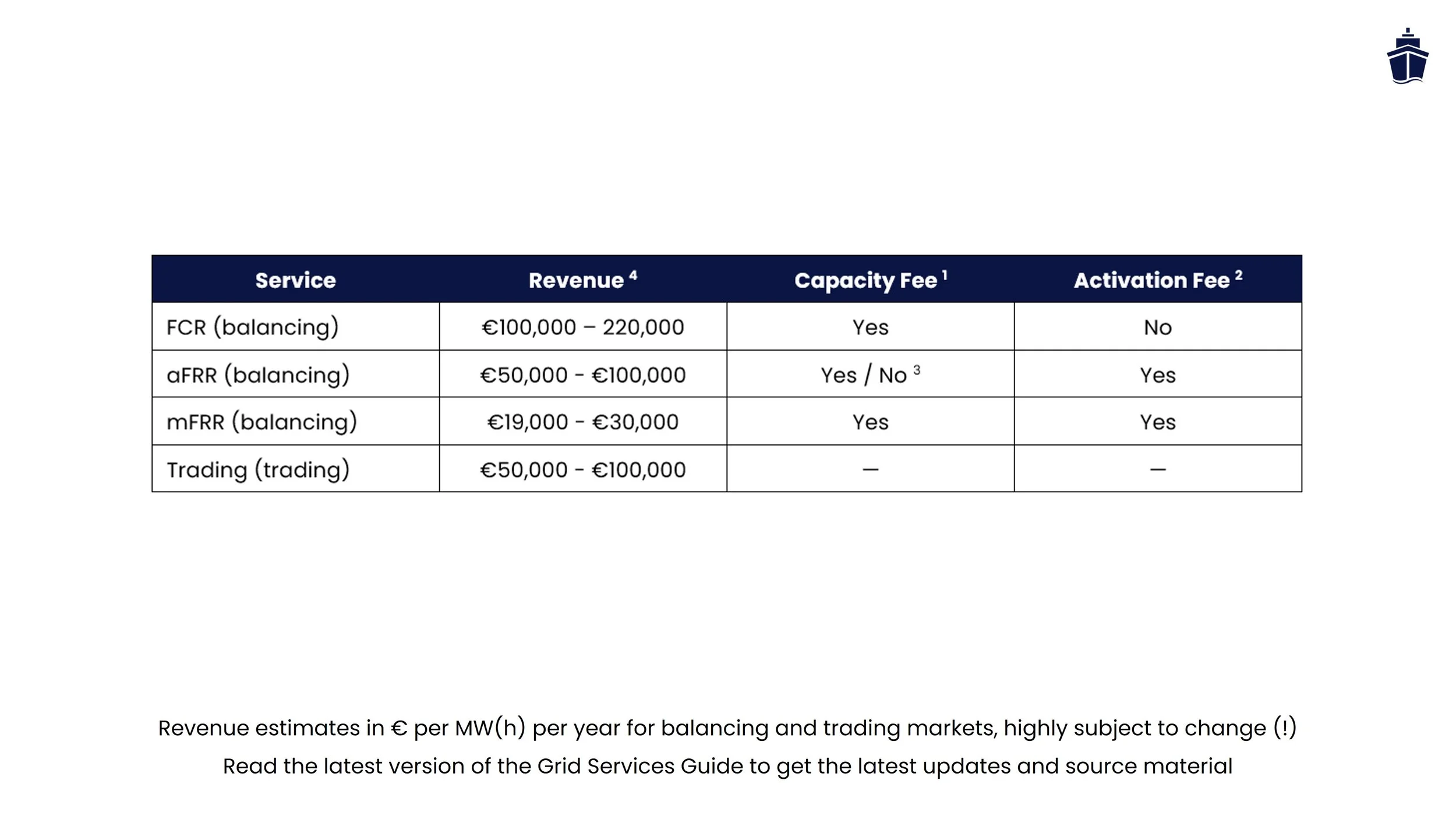
The capacity fee is paid for making the asset available, whether or not it is actually activated (!). The activation fee is paid on top when the asset actually delivers energy. FCR pays capacity only, aFRR and mFRR pay both. Trading markets pay neither, since revenue there comes purely from price spreads between trades.
Is my revenue guaranteed once I am contracted?
Not per se. Capacity payments are conditional on the asset being available and compliant during the contracted period. Failure to deliver can result in penalty payments or loss of the full period's capacity revenue. Prequalification compliance must be maintained continuously.
What's the technical difference between FCR, aFRR, and mFRR?
FCR (primary) responds automatically within 30 seconds to frequency deviations and is the first line of defence for TSOs. aFRR (secondary) responds automatically within 5 minutes to a signal from the TSO. mFRR (tertiary) is activated manually within about 12.5 minutes for larger or longer-lasting imbalances. They operate in cascade, each freeing up the faster reserve as it takes over.
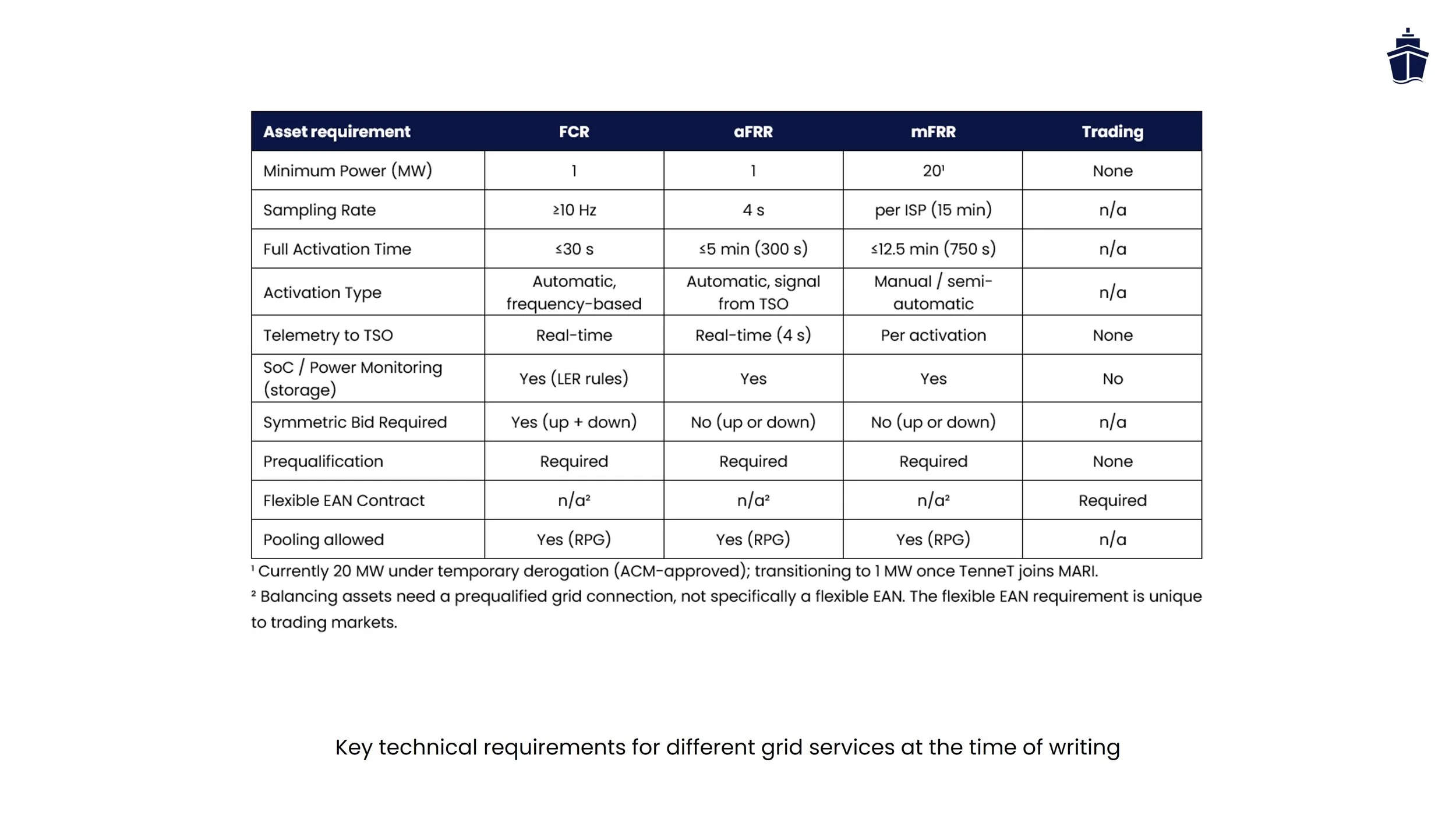
Do I need a separate grid connection for grid services?
Not per se. You can use an existing EAN connection, but it must have enough headroom to deliver the contracted service without interfering with other loads behind the meter. This is both a technical and contractual requirement. For a 1 MW FCR contract, the connection must be able to handle 1 MW on top of any existing consumption or production at that point (and you must be allowed to do so as per your contract).
What is a Reserve Providing Group (RPG)?
An RPG is a pool of Technical Installations (TIs) behind one or more grid connections that together meet the technical requirements of a balancing product. It is the mechanism by which smaller or technically diverse assets can participate collectively. A Special RPG (Virtual Power Plant) allows TIs of different types, such as batteries, CHP units, and curtailable loads, to be combined.
Why is active state-of-charge (SoC) management required for FCR?
Because batteries are classified as Limited Energy Reservoirs (LERs). To sustain 15 minutes of full FCR delivery at any moment, the SoC must stay within an operating window that enables both upward and downward response. The FCR Manual for BSPs sets specific rules on how this charge management can operate without distorting the FCR signal.
How do I know if my asset is prequalified?
Prequalification is conducted with the TSO (TenneT in the Netherlands) through a structured testing process covering control behaviour, communication, and measurement accuracy. Once passed, the asset is added to the BSP's portfolio of prequalified units. Prequalification is per product: FCR qualification does not automatically confer aFRR or mFRR qualification, although the technical requirements are strictly decreasing from FCR down to mFRR. Learn more about the qualification process here.
Who operates the balancing markets in Europe?
Each EU member state has its own TSO (TenneT in the Netherlands, 50Hertz, Amprion, TenneT DE and TransnetBW in Germany, Elia in Belgium, RTE in France, and so on). For FCR, the TSOs procure jointly through the FCR Cooperation on the regelleistung.net platform. aFRR and mFRR are moving toward harmonisation through the PICASSO and MARI platforms respectively, but are still primarily procured nationally.
Which EU regulations govern the balancing markets?
The main ones are the Electricity Balancing Guideline (EB-GL, Regulation (EU) 2017/2195), the System Operation Guideline (SO-GL, Regulation (EU) 2017/1485), and the Requirements for Generators (RfG, Regulation (EU) 2016/631). These are supplemented by national grid codes, applied by each TSO.
What is passive balancing?
Passive balancing is when a BRP deliberately deviates from its E-programme to help resolve system imbalance, without being contracted to do so. The deviation is settled through the imbalance price. It requires no prequalification, no contract, and no merit-order participation, but exposes the party to imbalance price risk, and is settled only in arrears.
What is GOPACS?
GOPACS is the Dutch congestion management platform, operated jointly by TenneT and the regional DSOs. It allows market parties to submit bids to help resolve local grid congestion, with payment per activation. It is distinct from the balancing markets, which address frequency stability rather than local grid capacity.
What is the first step if I want to start participating?
If you're an asset owner, the quickest route is usually to contact an aggregator. They handle prequalification, market access, and operational control, and share revenue with you. If you want to go and become a BSP yourself, contact the TSO (BSP@tennet.eu in the Netherlands) to start the BSP onboarding process.
How long does prequalification take?
For a single asset, typical timelines are 3 to 6 months from initial contact to first contracted period, depending on the complexity of the asset, the chosen communication option, and testing availability. Pooled assets or Special RPGs can take longer, particularly when different asset types are combined.
Where can I find live market data and prices?
TenneT publishes live balance delta, imbalance prices, and settlement prices on its transparency portal. ENTSO-E aggregates pan-European data on the Transparency Platform. regelleistung.net publishes FCR auction results for the cooperation. EPEX SPOT publishes day-ahead and intraday prices. Links to all of these are in the References section of the guide.
TenneT balance delta page (link)
Transparency Platform (link)
regelleistung.net Datacenter (link)
EPEX SPOT Market Results (link)
What is the estimated revenue from each market?
Revenue potential for all grid services varies wildly and depends heavily on asset location, market conditions, and timing. Most detailed data from TSOs and operators is anonymized and available online in many cases. The ranges below are drawn from those public sources, field interviews, project experience and other and TSO transparency databases. In general a combination of aFRR and day-ahead trading yields the largest / easiest revenue. FCR was typically the highest grossing market, but this has changed due to a large amount of batteries coming online. Check the guide for the latest updates and estimates. No rights can be claimed from these numbers, subject to continuous change.
1. Balancing Markets
FCR (Frequency Containment Reserve): €100,000–€220,000/MW/year Capacity-based, with relatively stable monthly tenders. Has the tightest requirements of all balancing markets. Prices have trended downward since 2023 as battery prequalified capacity has scaled; expect 2024–2026 figures to be in the lower half of this range.
aFRR (automatic Frequency Restoration Reserve): €50,000–€150,000/MW/year Mixed capacity and activation fees. More volatile than FCR due to European cross-border coupling via PICASSO (since October 2024). Dutch aFRR bids now compete directly with German, Belgian, and Nordic capacity, pushing prices toward the lower end in high-wind or high-solar periods.
mFRR (manual Frequency Restoration Reserve): €19,000–€30,000/MW/year Lowest revenue, but minimal operational overhead. Activation is infrequent (roughly 30 times per year historically). Less relevant for most small-to-medium batteries, typically not worth investigating for OPS-related projects.
2. Trading Markets
Day-ahead: €50,000–€100,000/MWh/year Revenue depends entirely on your ability to forecast hourly prices and manage charge/discharge efficiently. Typical margin is €30–€80/MWh on favorable days. Dutch market averaged around €60/MWh in 2023–2024, but intra-year volatility is extreme (€10/MWh in summer, €150+/MWh in winter peaks).
Intraday: €50,000–€100,000/MWh/year as an uplift over day-ahead The 10–30% revenue boost from intraday typically comes from shorter-term price moves and the ability to react to forecast errors. Requires active monitoring and automated execution. Less predictable than balancing, but higher ceiling in volatile markets.
3. Congestion Management
GOPACS / Congestion relief: Activation fee per delivered MWh, typically €20–€150/MWh depending on severity and region Revenue is sporadic and location-dependent. Congested zones (red on the capacity map) may see 10–50 activations per year; uncongested areas may see none. Minimum participation size is 500 kW via ETPA.
Important caveat: These figures are based on 2023–2024 market data. By the time you read this, regulation, battery deployment volumes, and wholesale electricity prices will have shifted. Always run a site-specific economic model using current TSO settlement data and your actual asset location before committing capital.
Sign up for premium tools and benefits
Premium tools and expert support at your fingertips
The Grid Services Guide provides a structured reference for navigating the markets that determine battery storage revenue across Northwest Europe. Drawing on TenneT, ENTSO-E, EPEX SPOT, GOPACS, and the EU Network Codes (EB-GL, SO-GL, RfG), the guide documents the three main grid service categories balancing, trading, and congestion management and sets each market side-by-side with its technical requirements, revenue mechanics, and access models, showing where opportunities lie, where the constraints bind, and what the differences mean for asset economics.
Use Apple Pay to purchase the Excel (only on iPhone) - contact helpdesk for payment by invoice
Don’t want to sign up? Check pay-per-use options













This FAQ provides essential answers on grid balancing markets (FCR, aFRR, mFRR), trading markets (day-ahead, intraday), and congestion management. Covers prequalification timelines, revenue ranges, operator roles, technical requirements, and more. It is intended for developers and asset owners in Northwest Europe.