Overzicht van de duurzaamheids- en walstroomambities van havens
Streefdata voor CO₂-neutraliteit en walstroomprojecten van havens
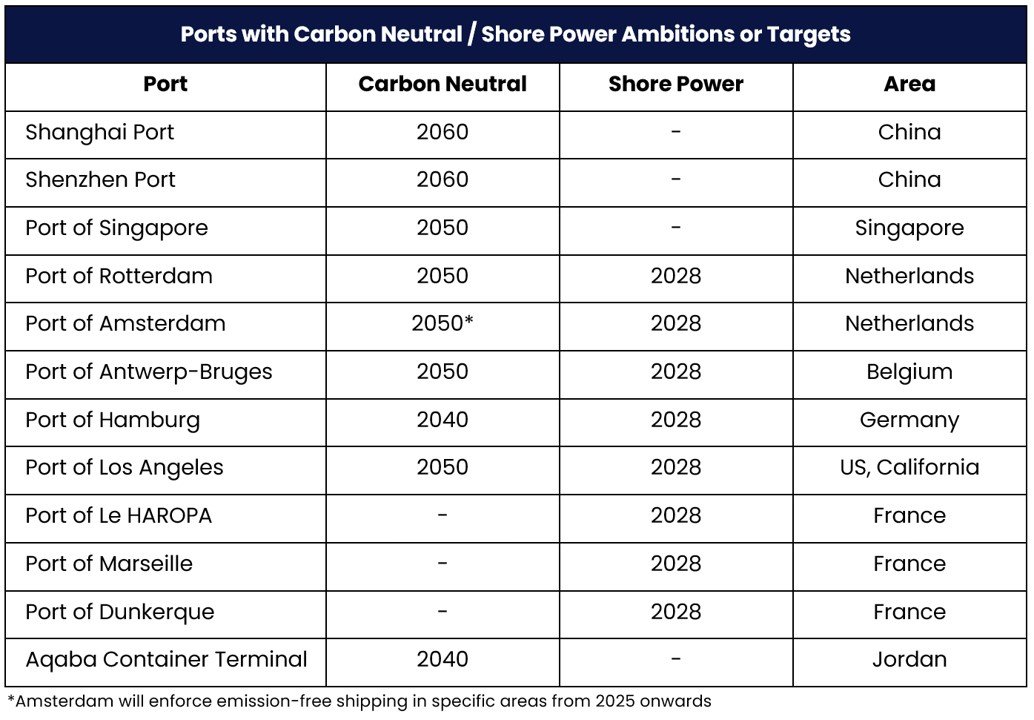
Samenvatting – De meeste havens hebben de ambitie om in 2050 CO₂-neutraal te zijn. Dit sluit doorgaans emissies van schepen uit en richt zich alleen op Scope 1/2 van de havenactiviteiten. Een aanzienlijk deel van de havens wereldwijd hebben walstroomverklaringen (shore power declarations) ondertekend om ‘waar mogelijk tegen 2028 elektriciteit vanaf de wal in te zetten’, waaronder alle grote Noordzeehavens, Los Angeles, Montreal en alle grote Japanse havens. Cruiseschepen en containerschepen zijn voor de meeste havenregelgeving de belangrijkste doelgroepen en de EU begint schepen vanaf volgend jaar via EU ETS te belasten.
Wanneer een schip afgemeerd ligt, kost 100 [kW] aan hulpvermogen ongeveer €150 per dag aan EU ETS-kosten (bij een prijs van €100 / mT CO₂), oftewel €50.000+ per jaar. Bereken hier je EU ETS kosten hier.
Not all ports are available. Works better on computer, not phone. This blog uses publicly available information updated until late 2022.
De spil van de energietransitie in de maritieme sector —> Havens
Op een bepaald moment moet elk schip terug naar huis. Havens zijn de thuisbasis van alle schepen. En op een bepaald moment zullen ook havens CO₂-neutraal moeten worden. Gelukkig hebben, zoals te zien is in onderstaande tabel, 9 van de 12 havens aangegeven de ambitie te hebben om CO₂-neutraal te worden. Hoewel deze tabel verre van volledig is, benadrukt deze wel de onvermijdelijkheid van CO₂-neutraliteit van havens over de hele wereld – en daarmee van de schepen die naar deze havens terugkeren.
Verreweg het belangrijkste aspect voor havens om CO₂-neutraal te worden – wanneer de focus ligt op emissies van schepen of ‘drijvende’ emissies – is walstroom. Het is een belangrijk element in de strijd voor CO₂-neutraliteit. Een kosteneffectieve uitrol van walstroom staat daarom hoog op de agenda van beleidsmakers in havens. Dit kan echter erg lastig zijn.
Dat komt doordat havens weliswaar een spilfunctie kunnen hebben bij de implementatie van walstroom, maar havenautoriteiten zelf beperkte ‘macht’ kunnen hebben als het gaat om haveninfrastructuur. Dit komt doordat zij noch de consument, noch de leverancier van energie of technologie voor walstroom zijn. Havenautoriteiten treden op als facilitator of, in een beperkt aantal gevallen, als investeerder. Hun ‘zegen’ is cruciaal voor de ontwikkeling van walstroomprojecten, maar zij hebben scheepseigenaren en leveranciers van walstroomtechnologie nodig om de infrastructuur daadwerkelijk te bouwen.
Dit inzicht komt duidelijk naar voren in het ondertekenen van een ‘walstroomverklaring’ door een aanzienlijk aantal grote havens over de hele wereld, zoals in de volgende sectie wordt uitgelicht.
One of the most stringent ports in the world regarding shore power, which is mandatory by 2027 for all vessels by authority of CARB.
Learn all about the sustainable ambitions of the Port of Singapore, in particular with regards to shore power.
Port of Amsterdam has the ambition to become carbon neutral by 2050 but plans on a zero-emission zone of the inner city by 2025. Learn more about Port of Amsterdam’s sustainable ambitions and shore power here.
Port of Shanghai has the ambition to become carbon neutral by 2060. Learn more about the targets and ambitions of Shanghai with regards to maritime sustainability here.
Port of Hamburg has the ambition to become carbon neutral by 2040. It is one of the most ambitious ports in terms of sustainability in the world and has an installed capacity of 72 MVA of shore power by 2024. Learn more about the targets and ambitions of Port of Hamburg here.
Port of Antwerp has the ambition to become carbon neutral by 2050. Learn all more about the targets and ambitions of Antwerp with regards to maritime sustainability here.
Learn all about Port of Rotterdam’s sustainable ambitions, in particular with regards to shore power.
One Ocean Summit 2022
Overheidsministers en havenautoriteiten van over de hele wereld ondertekenden op 10 februari 2022 tijdens de One Ocean Summit een walstroomverklaring. Samen met de Europese Investeringsbank spraken de betrokken partijen af zich maximaal in te spannen om tegen 2028 elektriciteitsvoorziening vanaf de wal te realiseren, met name voor cruise- en containerschepen. Hieronder staan de havens die de walstroomverklaring hebben ondertekend.
● Le Havre, Rouen, Paris (HAROPA) (Frankrijk)
● Marseille (Frankrijk)
● Dunkerque (Frankrijk)
● Port of Breme (Duitsland)
● Port of Hamburg (Duitsland)
● Port of Antwerp-Bruges (België)
● Port of Ostende (België)
● North Sea Ports (België, Nederland)
● Port of Amsterdam (Nederland)
● Port of Rotterdam (Nederland)
● Port of Copenhagen (Denemarken)
● Port of Göteborg/Gothenburg (Zweden)
● Port of Malmö (Zweden)
● Port of Montreal (Canada)
● Port of Los Angeles (VS)
● Port of Busan (Zuid-Korea)
● Port of Osaka (Japan)
● Port of Kobe (Japan)
● Port of Yokohama (Japan)
● Port of Tokyo (Japan)
● Port of Tanger (Marokko)
De exacte betekenis van ‘best efforts’ moet nog blijken en voor sommige havens is het slechts een symbolisch gebaar. De haven van Los Angeles moet bijvoorbeeld al vrijwel volledig voldoen aan de uitrol van walstroom vanwege de Ocean Going Vessels at Berth Regulation. Desondanks is het grote aantal ondertekenaars een positief en welkom signaal voor de maritieme sector.
More stories
This is a case study on the ‘Skoon Skipper’, a general cargo large Rhine vessel, with an average of 40 [kW] power demand while moored to which a shore battery is applied. Batteries can help you comply with shore power regulations where no infrastructure exists with limited to no CAPEX investments. CAPEX is €0 for this case study as the battery pack is rented at an estimated €400 dayrate. Purchase cost for battery pack are approx. €350.000. This case study is powered by our preferred partner Skoon.
This is a story about how the shore power connection for Heerema in the Port of Rotterdam was realized from idea to reality. It is told from the perspective of Heerema, but could not be realized without help from Eneco, Siemens, Port of Rotterdam, the City Council of Rotterdam and InnovationQuarter. This story portrays the power of open collaboration for a sustainable future, and shows what can be achieved when working together on a common cause.
How a single project from Heerema - made possible by Sustainable Ships - kicked shore power developments in Rotterdam into high gear and led towards the Rotterdam Shore Power Strategy.
Stena Line realized a shore power connection for sea-going ferries of two times 3 [MW] in Hoek van Holland in 2012.
The Port of Marseille, headquartering CMA CGM, committed themselves, by signing a Blue Charter, to respecting rules that are much more stringent than national and international regulations. These include the use of shore power from 2025 for ships fitted with the equipment.
The Global Pricing Dashboard made by the World Bank is one of the most complete overviews carbon pricing initiatives worldwide. 23.17% of all global greenhouse gas emissions were covered in 2022. Only EU ETS aims to incorporate shipping emissions at the moment, others are expected to follow suit.
One of the most stringent ports in the world regarding shore power, which is mandatory by 2027 for all vessels by authority of CARB.
China officially aims for carbon neutrality “before 2060”. With legislation on carbon tax and fuel specifications upcoming but not yet active in the foreseeable years, main focus has been on the development of shore power infrastructure but the technology remains under-utilized in ports in the country.
Learn more about the targets, ambitions and upcoming rules and regulations of the Netherlands with regards to maritime sustainability here.
IMO aims for 11% carbon intensity reduction per 2026, 40% in 2030 and 70% reduction in 2050. MARPOL and MEPC are key regulatory bodies within IMO. Virtually all rules and regulations apply to vessels of 5.000 GT and above. The most important rules and regulations for shipowners to comply with are SEEMP (includes DCS and CII), EEXI/EEDI and Emission Controlled Areas (ECAs).
IMO Net-Zero Framework - similar to a carbon tax - under MEPC 83, from 2028 onwards for ships above 5,000 GT
Cruise ships capable of accommodating more than 100 passengers in Sydney Harbour are required to limit emissions of sulphur oxides when berthing (maximum 0.10% m/m). It is like a mini-ECA in Sidney waters. Learn more here.
China’s coastal shipping sector is to implement low-carbon marine fuel regulations no later than 2030. Learn more about the low-carbon fuel regulations in China here.
China’s national ETS – the world’s largest in terms of covered emissions – started operating in 2021. Shipping is not included, for the moment. Learn more about ETS here.
Emissions from cruise ships and ferries in World Heritage Fjords are to be zero by 2026 latest. Read more here.
The ETD is the principal taxing scheme used for fossil and low-carbon fuels in EU. Fossil fuels will be taxed more, and renewable low-carbon fuels will receive incentives, including shore power.
RED targets supply side - production - of fuels in the EU, aiming for a 40% energy share from renewable sources by 2030.
AFIR targets the supply side of marine infrastructure and fuels in the EU, mandating the use of low-carbon fuels and shore power by 2030.
EU MRV is the CO2 reporting system in Europe, used for carbon tax determination. It is applicable to vessels of 5000 GT and above. It is expected to apply to 400 GT and above. Learn more about EU MRV here.
ECAs (Emission Control Areas) are sea areas that limit SOx or NOx emissions. Currently there are several ECAs active in North America and Europe. Learn more about ECAs here.
For ships operating outside Emission Control Areas (ECAs), the limit for sulphur content of fuel oil is 0.50% m/m (mass by mass). Learn more about the global sulphur limit for shipping here.
Learn all about the sustainable ambitions of the Port of Singapore, in particular with regards to shore power.
In the Netherlands, ‘Renewable Fuel Units’ (HBEs) are an economic incentive to gradually expand the use of green energy in transport and the reduction of greenhouse gasses. Fossil fuel producers are required to purchase HBEs from green fuel producers. The market is controlled by the Dutch Emission Authority. You can make up to €0.20 per green kWh sold. Learn more about HBEs here.
The Programma Aanpak Stikstof (PAS) is a Dutch law that strictly prohibits the deposition of NOx on environmental protection areas in the Netherlands. Impact on maritime operations can be severe - in particular for wind farm construction - required 80% NOx reduction on top of Tier III restrictions. Learn more about PAS here.
Port of Amsterdam has the ambition to become carbon neutral by 2050 but plans on a zero-emission zone of the inner city by 2025. Learn more about Port of Amsterdam’s sustainable ambitions and shore power here.
Port of Shanghai has the ambition to become carbon neutral by 2060. Learn more about the targets and ambitions of Shanghai with regards to maritime sustainability here.
Port of Hamburg has the ambition to become carbon neutral by 2040. It is one of the most ambitious ports in terms of sustainability in the world and has an installed capacity of 72 MVA of shore power by 2024. Learn more about the targets and ambitions of Port of Hamburg here.
The Ship Energy Efficiency Management Plan II (SEEMP II) is the updated version of the first SEEMP. It includes to obligation of vessels of 5000 GT and above to input CO2 data into the IMO Data Collection System (DCS). Learn more about SEEMP II and how it impacts your vessel’s operations here.
Learn all about the targets, ambitions and upcoming rules and regulations of the Unites Kingdom with regards to maritime sustainability.
Rosneft has the ambition to become carbon neutral by 2050. Learn all more about the targets and ambitions of Rosneft with regards to maritime sustainability here.
Sinopec has the ambition to become carbon neutral by 2050. Learn all more the targets and ambitions of Sinopec with regards to maritime sustainability here.
PetroChina has the ambition to become carbon neutral by 2050. Learn all more the targets and ambitions of PetroChina with regards to maritime sustainability here.
Petronas has the ambition to become carbon neutral by 2050. Learn all more the targets and ambitions of Petronas with regards to maritime sustainability here.
Petrobras has the ambition to become carbon neutral by 2050. Learn all more the targets and ambitions of Petrobras with regards to maritime sustainability here.
The Port of Marseille, headquartering CMA CGM, committed themselves, by signing a Blue Charter, to respecting rules that are much more stringent than national and international regulations. These include the use of shore power from 2025 for ships fitted with the equipment.