
Business case to convert a Cruise Ship to full electric propulsion
Techno-economic guidance for full electrification of an ocean and a river cruise ship - when ‘a battery’ works and when not
This case study determines what it actually takes to retrofit a cruise ship from a ‘conventional’ diesel combustion drive train to a fully electric drive train. Two vessels rather than one are benchmarked: the SSC Thunder Volt, a 50,000 GT short sea cruise ship with 12 MW of installed power, and Viking Aegir, an inland cruise vessel operating on the Rhine with a little over 1 MW installed power.
From a technical perspective, the river cruise ship is easier to convert as the battery capacity and related power equipment are less complex, i.e. ~150 MWh for 2 full days of operations are required whereas 600 MWh would be needed for the ocean cruise ship at least. From a commercial perspective however, the ocean going cruise ship is an easier business case, as it is subject to both EU ETS and FuelEU, for which a full electric drive train generates a lot of benefits, i.e. an estimated $250 million in cost savings over the 15 year analysis period.
To make a proper business case for a full electric ship, not only does the ship have to be subject to both EU ETS and FuelEU, an extremely low electricity price of $50 per MWh is required, battery prices of $150 per kWh or less, plus any surplus generated by FuelEU needs to be sold for more than €200 per mT CO2 equivalent. Payback under these conditions can be less than five years, but any charging infrastructure is left out of this equation.
The ocean cruise ship's conventional lifetime OPEX to 2041 is ~$548 million, of which roughly $200 million is EU ETS and FuelEU compliance cost alone.
Full electrification of the large ship costs on the order of $100 million in CAPEX, and around $200 million if the pack is doubled for two days of endurance.
The single biggest lever is the electricity price, which needs to be well below $100 per MWh. The second biggest lever is the battery price. Marine-grade packs run around $300 per kWh. Land-grade packs are nearer $100 to $150, and negotiating that difference and involving class early on is advised.
The biggest operational issue is volume. The proposed fully electric ships would sail for 48 hours only, whereas the same tank volume filled with HFO buys at least 22 days of autonomy.
Charging infrastructure of 60+ MW would be required, and is outside the scope of this study. It is a separate engineering challenge and a serious one.
Use the Decarbonizer to make your own business case and have fun!
-
The Decarbonizer is a comprehensive tool designed to provide a business case for any decarbonisation measure onboard vessels, from shore power and hull coating through to methanol, hydrogen and full electric propulsion. It includes CAPEX estimates, operational expenses including fuel, electricity, maintenance and consumables, emissions savings, and full regulatory exposure across FuelEU Maritime, EU ETS, UK ETS, IMO Net-Zero, CII and EEXI. The tool guides users through selecting a vessel, setting the operational profile, choosing and combining measures, and adjusting technical and economic parameters to create a customised business case over the full lifetime of the investment. It includes:
A database of up to 30,000 vessels across every ship type and size band, so you can start from a ship close to your own and adjust from there.
Ten decarbonisation measures that can be compared side by side and stacked together, with the incremental effect of each addition shown before you commit to it.
Complete regulatory treatment, including the option to buy compliance credits rather than pay penalties, and to sell FuelEU surplus into a pool.
A full lifetime view with cumulative cash flow, payback year, day rate impact, and the option to finance the retrofit rather than pay it in year one.
Volumetric comparison of bunker tank and battery sizes, so the space and endurance consequences of a fuel switch are visible alongside the cost.
Automatic modelling of hull fouling over time, so energy demand rises year on year as it does in reality, and drops back at each cleaning.
Historical and forward fuel, electricity, carbon and battery prices, so you can test how sensitive your case is to the assumptions that matter most.
Tooltips and guidance throughout to assist users in understanding the calculations and making informed decisions.
About the ships
SSC Thunder Volt - short sea cruise ship
A 50,000 GT diesel-electric cruise ship with four main engines of 3,000 kW, giving 12 MW installed. Power is distributed at 6,600 V and 60 Hz to electric propulsion motors and hotel load. For a vessel of this tonnage 12 MW is on the modest side, which makes her a short sea cruise ship rather than a full ocean liner.
The operating profile is roughly 56 per cent of the year sailing and the remainder at berth, moving between destinations. While sailing, all four engines run at 80 per cent load. At berth, two engines run at 60 per cent, giving around 3.5 MW of hotel demand. Specific fuel consumption is around 170 to 180 grams per kWh, which is an efficient plant and therefore a conservative baseline to beat.
Viking Aegir - inland cruise ship
A river cruise vessel operating on the Rhine, carrying around 200 passengers and 50 crew, with a little over 1 MW of main engine power and 140 kW of auxiliary. Vessels of this type moor overnight in city centres, which is exactly where charging infrastructure and local air quality pressure both sit.
This is a real ship rather than a constructed example, and one we have connected to shore power ourselves. It already carries battery packs.

The building block: battery packs
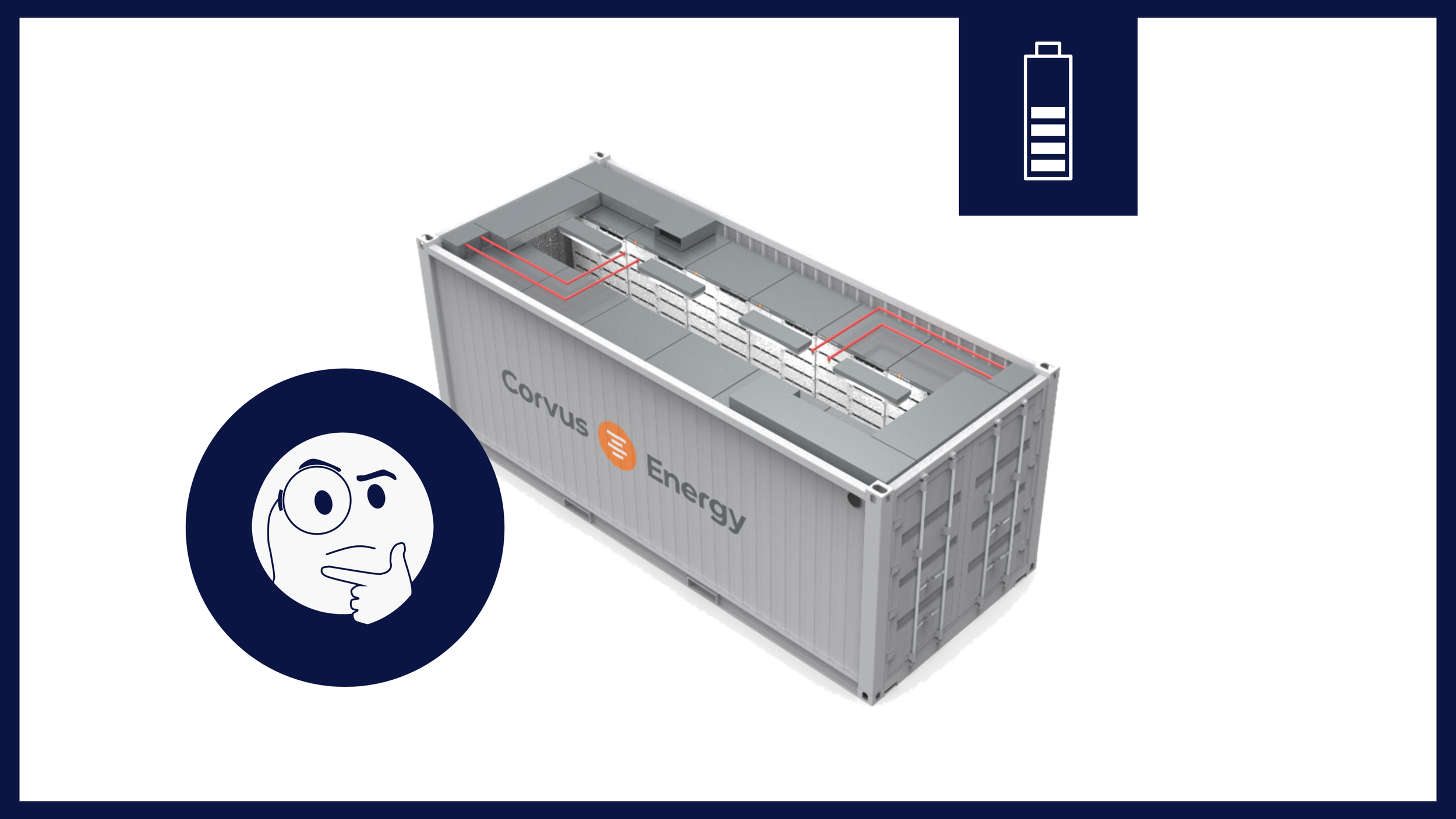
Everything in this study is sized in containerised battery packs, because a defined unit is far easier to dimension with than an abstract energy figure. The base case uses 3 MWh packs at around 1,000 V.
On a genuine newbuild you would build the cells directly into the hull and drop the container itself, but the racking, the spacing, the cooling and the fire suppression all remain, so the volume does not go away. Containerised packs are also the honest assumption for a retrofit, which is what this study models.
One caveat worth stating plainly: there are plenty of packs available at this scale, but not many that are marine grade. Alongside charging infrastructure, that is one of the two things most likely to stop a project of this kind, and it is easy to overlook when the analysis is purely technical and economic.

Electrical layout
Battery packs store DC. Inverters convert to AC, and transformers step up to switchboard voltage to feed the consumers behind it. On a larger ship with multiple engine rooms you would expect a split main switchboard with a bus tie between the sections.
The alternative most engineers would prefer, including us, is a DC busbar, with the inverters and transformers sitting behind it only where a consumer needs AC. That saves conversion losses. It is not what this model assumes, because this study is framed as a retrofit and replacing the ship's distribution is a far larger job than adding to it. The Decarbonizer will support full DC architectures in a future version.
From an economic standpoint the choice matters less than it might appear. Round-trip efficiency is assumed at 92%, which is high but achievable, and the difference between architectures is perhaps an order of magnitude less important than the price paid per kWh.

The technical wall: volume
(And onshore charging infrastructure but we’re not talking about that)
This is the part that decides whether the ship can exist at all, and it is not the money. Normalising against HFO, a bunker tank of roughly 1,000 m3 gives this vessel about 22 operating days of sailing. The same ship on batteries gets 24 hours. Put another way, one day of sailing needs about 50 m3 of MGO or about 1,900 m3 of battery. That is the single most important number in this study. You can push against it in three ways, and the video works through all three:
Longer endurance. Doubling to 48 hours doubles the pack to around 600 MWh and roughly doubles the CAPEX. Three days would need six times the tank volume, which is not feasible.
Denser packs. At 6 MWh per container rather than 3, the same 600 MWh fits in around 100 containers. That is not commercially available today at marine grade, but it is close to what the technology will allow, and it is the assumption that makes 48 hours look plausible.
Parasitic load. A fossil engine needs pumps, cooling, fuel handling and engine room HVAC to run at all. An electric drive train does not. The default assumption here is 5 per cent, but on larger working vessels and offshore ships we have seen parasitic loads as high as 40 per cent. At 40 per cent the battery gets close to the same tank volume as the fuel it replaces, and still only buys two days.
Combining a 6 MWh pack with 48 hours of endurance lands at around 100 battery containers. Six hundred megawatt hours sounds unmanageable. One hundred containers, on a ship this size with the fuel tanks and engine room removed, is at least conceivable.
About onshore charging infrastructure
If the ocean cruise ship sails for 24 to 48 hours and then charges overnight in an 8 to 12 hour window, the shore connection needs to deliver in the order of 20 to 60 MW. That is a substantial installation of transformers, inverters and power equipment, and it needs to exist at every port on the itinerary. This study looks only at the ship side. That is a deliberate limitation and worth being explicit about, because for the large vessel the shore side is arguably the harder problem. For the small vessel it is much more tractable.
What it costs
CAPEX: $106 million, and nine tenths of it is the battery
The Decarbonizer builds the retrofit cost from individual line items across five categories. For SSC Thunder Volt at the base case of 318 MWh installed, the total comes to $106.2 million:
Focus on battery costs only
It means almost every instinct about controlling retrofit cost is pointed at the wrong target. Design engineering across supplier and owner together is $100,800, or one tenth of one per cent. Adding two million dollars of additional engineering hours and class approval drawings, which is a generous allowance for a first-of-kind vessel that a class society will scrutinise heavily, moves the total by under two per cent. It disappears into the rounding.
Installation is $717,600 for the entire scope: means of access, scaffolding, battery room structural preparation, switchboard installation, module racking, cable routing and penetrations, HVAC and fire suppression, painting and non-destructive testing. All of it, for less than one per cent of the project. So the practical conclusion is blunt. Do not optimise engineering scope. Negotiate the battery price.
What makes the business case work
1. Electricity price
The default in the model is $332 per MWh, which is deliberately conservative. The current EU average is nearer $250 per MWh. The lowest credible figure is around $50 per MWh, and reaching it means a long-term power purchase agreement or your own wind or solar generation. This is the single most important variable in the study. It is also, usefully, a risk that can be fixed contractually: high CAPEX combined with a known OPEX over fifteen years is something you can actually finance.
2. Battery price
Marine-grade packs are around $300 per kWh. Land-grade packs, on the terms the automotive and stationary storage markets get, are in the order of $100 per kWh. Closing that gap by paying two million dollars for class approval and additional fire protection to allow for normal land based equipment is far more effective than any other single action available, but it imposes a certain risk which also needs to be covered by increasing the design and engineering budget.
3. FuelEU surplus
A ship at 0 GHG intensity generates a large compliance surplus. Selling it into a pool at around $200 per tonne of CO2, which is close to the current market rate, is absolutely crucial. Without the ability to sell the surplus, there is no viable business case for a vessel of this kind.
4. Financing
Paying $100 to $200 million out of pocket in year one is not realistic for most owners. Financing reduces total savings but dramatically reduces maximum exposure, which is what a CFO actually cares about. At 8 per cent over five years the exposure profile becomes manageable. At 4 per cent over eight years, which is not unreasonable for a project of this profile from a development bank or a public body, it becomes genuinely attractive.
Download Model
Save and optimize your premium business case, get access to the complete techno-economic feasibility report and customize all calculations.

This is a copy of the Decarbonizer tool by Sustainable Ships, intended for internal use by those who want to build their own models. This Excel contains all the information, values and formulas used by the online Decarbonizer, but only contains the Excel. The interactive tool as shown on the website is not included in this purchase. The Excel sheet is accompanied by a manual that supports further modding and understanding of the Excel sheet. This purchase will ensure you can build your own Decarbonizer without being dependent on Sustainable Ships.
Use Apple Pay to purchase the Excel (only on iPhone).
References
Sustainable Ships - Decarbonizer
Viking - Viking Announces Float Out of the World’s First Hydrogen-Powered Cruise Ship
You might also like










This case study determines what it takes to remove the fuel from a cruise ship, comparing a 50,000 GT ocean cruise ship with an inland river cruise vessel. The ocean cruise ship obtains a payback of around five years, but only with very cheap electricity, battery prices of $150 per kWh, long-term financing and the sale of FuelEU surplus (many caveats!). The river cruise ship is technically easier, but is extremely challenging to make a business case for because EU ETS and FuelEU do not apply to it.